Is Beretta Buying Ruger? | What the 25% Stake Means for Ruger Firearms

Is Beretta buying Ruger?

Not outright—at least not yet. Beretta Holding is reportedly preparing to increase its ownership of Sturm, Ruger & Company from approximately 10% to as much as 25%.

That would not give Beretta majority control of Ruger. It would, however, make the Italian firearms group an extremely influential minority shareholder. The agreement also gives Beretta the right to propose two independent directors for Ruger’s board.

For Garand Thumb Blog readers interested in Ruger firearms, Beretta guns, American firearm manufacturing and the future of Marlin lever-action rifles, this is considerably more important than an ordinary stock transaction.

It is not currently a Beretta takeover of Ruger. It could still influence what Ruger builds, where components are manufactured and how two major gun companies compete in the American firearms market.

Is Beretta Buying Ruger in 2026?

A September 17, 2026 Reuters report⁠ says Beretta Holding is preparing an offer that could increase its Ruger stake from 9.93% to 25%.

The companies established the path for that investment through a strategic cooperation agreement signed in May.

According to the official Beretta-Ruger agreement filed with the Securities and Exchange Commission⁠, Beretta may make an all-cash tender offer for up to 2,400,184 additional Ruger shares. The purchase price must be at least $44.80 per share, although Beretta may offer more.

A tender offer allows existing Ruger shareholders to sell their shares directly to Beretta under the stated terms.

Beretta cannot simply purchase unlimited Sturm Ruger stock and declare itself ruler of the Ruger kingdom. The agreement caps Beretta’s ownership at 25%.

That is a major investment, but it is not the same as buying the entire company.

Does Beretta Own Ruger?

No. Beretta does not currently own Sturm, Ruger & Company.

Ruger remains an independent American publicly traded company. Its stock trades on the New York Stock Exchange under the symbol RGR, meaning the company is owned collectively by its shareholders.

Beretta Holding currently owns about 9.93% of Ruger. If the announced process is completed successfully, that position could increase to 25%.

Ownership of one-quarter of a company provides considerable influence, especially when the agreement includes board representation. It does not provide the majority voting power normally required to control the company alone.

Under the disclosed Beretta Ruger deal:

  • Beretta may increase its Ruger ownership to 25%.
  • Beretta may propose two independent Ruger directors.
  • Ruger’s board must approve the proposed directors.
  • The directors cannot be Beretta employees or officers.
  • Beretta accepted a multiyear standstill restricting certain takeover and proxy activities.
  • Ruger remains an independent American public company.

The accurate answer to “Does Beretta own Ruger?” is therefore no.

Beretta is becoming a major Ruger shareholder with board-level influence and an opportunity to pursue commercial cooperation.

That is less dramatic than “Beretta buys Ruger,” but reality is frequently less cooperative than a social-media headline.

Why Is Beretta Buying Sturm Ruger Stock?

Beretta Holding has said the investment supports its effort to strengthen its presence in the United States.

That explanation makes sense. Beretta is already a substantial international firearms group with more than 20 brands and extensive experience manufacturing pistols, shotguns, rifles and ammunition.

Ruger provides something different: an enormous American consumer-firearms business with broad domestic manufacturing, established distribution and recognizable product lines.

Ruger’s portfolio includes:

  • Ruger 10/22 rimfire rifles
  • Ruger American centerfire rifles
  • Ruger revolvers
  • Ruger AR-556 rifles
  • Ruger Mark IV pistols
  • Ruger Security pistols
  • Ruger RXM handguns
  • Ruger-made Marlin lever-action rifles
  • Glenfield-branded firearms

The Ruger catalog contains nearly 800 variations across more than 40 product lines. That gives Beretta exposure to large portions of the American rimfire, hunting, defensive-handgun, modern sporting rifle and lever-action markets.

Beretta Holding brings international scale, additional engineering resources and its own manufacturing and distribution network.

That does not prove either company has decided to combine factories or produce joint firearms. It does explain why a Ruger-Beretta partnership could be valuable.

What Could the Beretta Ruger Deal Change?

The companies have not announced changes to Ruger firearms, warranties, customer service or manufacturing.

Anything beyond that is informed speculation, and Garand Thumb Blog is not going to invent a secret product roadmap merely because speculation attracts clicks.

The agreement says Ruger and Beretta may explore cooperation involving sales, sourcing, supply chains and manufacturing. Any actual project would require a separate written agreement.

That leaves several realistic possibilities.

Shared Firearm Manufacturing and Supply Chains

Firearm manufacturers depend on forgings, castings, barrels, springs, magazines, small parts, coatings, machinery and specialized vendors.

Beretta and Ruger may be able to reduce costs or improve production by sharing suppliers and manufacturing resources. Ruger’s long experience with investment casting could be particularly valuable across Beretta Holding’s collection of firearm brands.

The benefit would depend on what happens to quality.

Reducing waste while maintaining reliable guns is good business. Replacing proven parts with cheaper ones so an accountant can produce a happier spreadsheet is not firearm innovation.

New Beretta and Ruger Firearms

The companies could eventually cooperate on new firearms or adapt existing designs for different markets.

Beretta has deep experience with semiautomatic pistols, competition guns and sporting shotguns. Ruger is extremely strong in rimfire rifles, revolvers, affordable bolt-action rifles and American-made consumer firearms.

Beretta is already teasing a new Beretta competition pistol for 2026⁠. Ruger continues expanding its pistol, rifle and Marlin catalogs.

There is considerable room for cooperation without destroying either brand.

A Beretta-designed pistol manufactured at an American Ruger facility is conceivable. Ruger manufacturing technology could also support future Beretta Holding products.

Those are possibilities, not announced projects. Anyone claiming to possess the secret Ruger-Beretta product schedule is either violating several agreements or manufacturing industrial quantities of internet baloney.

Expanded American Firearm Production

Beretta’s stated interest in strengthening its United States presence could lead to additional domestic firearm production.

That would be the most encouraging result for American gun owners.

Private gun ownership depends on a healthy firearms industry capable of producing guns, magazines, parts and ammunition without begging hostile politicians for permission to import them.

More American production means more skilled manufacturing jobs, greater parts availability and less exposure to import restrictions or overseas shipping disruptions.

A large Beretta investment in Ruger could provide money for equipment, product development and factory expansion.

It could also become corporate consolidation that produces more meetings than firearms. The final products will matter more than the executive presentation.

Will Ruger Guns Still Be Made in America?

Nothing in the disclosed Beretta Ruger agreement says Ruger production will move overseas.

The companies explicitly described Ruger as remaining an independent American public company while preserving its brand, heritage and strategic direction.

A 25% shareholder does not automatically control factory locations, firearm designs or daily operations.

Garand Thumb readers should therefore ignore claims that Ruger firearms will suddenly become Italian imports. There is no factual support for that conclusion.

The question worth watching is whether future cooperation increases American manufacturing, changes particular Ruger product lines or assigns some components to other Beretta Holding facilities.

Until either company announces a change, Ruger’s existing American manufacturing structure remains the relevant fact.

What Happens to Marlin Firearms?

Ruger acquired the Marlin firearms business and related assets from the Remington bankruptcy in 2020. It subsequently returned American-made Marlin lever-action rifles to production.

Marlin is now one of Ruger’s most valuable brands.

The possibility of Beretta influence naturally raises questions about future Marlin firearms, particularly the Model 1895, Model 1894 and Model 336.

No announced term of the Beretta Ruger deal transfers Marlin away from Ruger or changes Marlin production.

If Beretta’s investment helps Ruger increase manufacturing capacity, Marlin buyers could benefit from greater availability and continued product development. If corporate priorities change, gun owners will watch for discontinued configurations, increased prices or declining quality.

For now, there is no evidence that the Beretta investment will harm Marlin. There is also no reason to grant any corporation unlimited trust merely because it owns firearm brands we like.

Judge the rifles.

Is This a Beretta Takeover of Ruger?

The disclosed agreement is not a complete Beretta takeover of Ruger.

Three facts matter:

  1. Beretta’s authorized ownership is capped at 25%.
  2. Ruger remains an independent publicly traded company.
  3. Beretta accepted a standstill restricting proxy contests and certain takeover activities.

Beretta’s two proposed directors must also qualify as independent. They cannot simply be Beretta executives sent over to order Ruger employees around.

That arrangement gives Beretta meaningful influence without handing it direct control.

Could something larger happen eventually? Yes. Corporate agreements expire, ownership positions change and companies negotiate new transactions.

There is no confirmed full Ruger acquisition today.

The Garand Thumb Take on Beretta Buying Ruger

The firearm industry does not need fewer independent companies producing the same collection of committee-approved guns.

It needs competition.

Competition forces manufacturers to improve reliability, introduce better designs, control prices and correct problems. Gun owners benefit when Ruger, Beretta, Smith & Wesson, SIG Sauer, Glock and other manufacturers fight for the same customer.

Corporate cooperation can still produce good results. Beretta may provide Ruger with capital, international reach and additional engineering resources. Ruger may offer Beretta stronger American manufacturing and access to market segments where Beretta Holding is less dominant.

The danger appears when cooperation becomes consolidation and consolidation becomes complacency.

Garand Thumb Blog will judge this agreement by the firearms that eventually reach gun shops—not corporate slogans, stock-market enthusiasm or carefully polished promises about “synergy.”

If Beretta’s investment produces better Ruger guns, more Marlin rifles and expanded American manufacturing, good.

If it produces higher prices, fewer choices and cheaper components, gun owners should say so plainly.

What Ruger Owners and RGR Investors Should Watch

Anyone interested in the future of Ruger firearms, Beretta guns or Sturm Ruger stock should watch official filings rather than social-media speculation.

The important developments include:

  • The official launch and price of Beretta’s tender offer
  • How many Ruger shareholders sell their stock
  • Beretta’s final Ruger ownership percentage
  • The identities of Beretta’s proposed Ruger directors
  • Any manufacturing or supply-chain agreement
  • New joint firearms or shared product technology
  • Changes to Ruger or Marlin production
  • American factory investment or expansion
  • Warranty and customer-service changes
  • Any attempt to extend Beretta’s influence after the standstill period

The percentage Beretta actually acquires matters. Authorization to reach 25% does not guarantee that Ruger shareholders will tender enough stock for Beretta to get there.

Final Verdict

Beretta is not buying all of Ruger, but calling this an ordinary stock investment understates it.

A possible 25% Beretta stake, two board nominees and formal discussions about manufacturing, sourcing and sales could influence the future of Ruger firearms.

The best outcome is straightforward: Beretta’s capital and international experience help Ruger expand American manufacturing, improve its products and produce more reliable guns for private citizens.

The worst outcome is equally familiar: corporate consolidation, reduced competition, higher prices and a conference room full of people explaining why fewer firearm choices represent greater consumer choice.

Nothing announced so far proves either result.

For now, Ruger remains Ruger. Beretta may soon own one-quarter of the company, not all of it.

That distinction matters—but so does the size of the investment.

Garand Thumb Blog will continue following the Beretta Ruger deal, its effect on Ruger firearms and any changes involving Marlin, American firearm manufacturing or future Beretta products.

GarandThumb.com was established on May 4, 2012, to document my experiences trying to become a better marksman.
Posted in XTC

New Beretta Competition Pistol 2026 | What We Know Before the USPSA Reveal

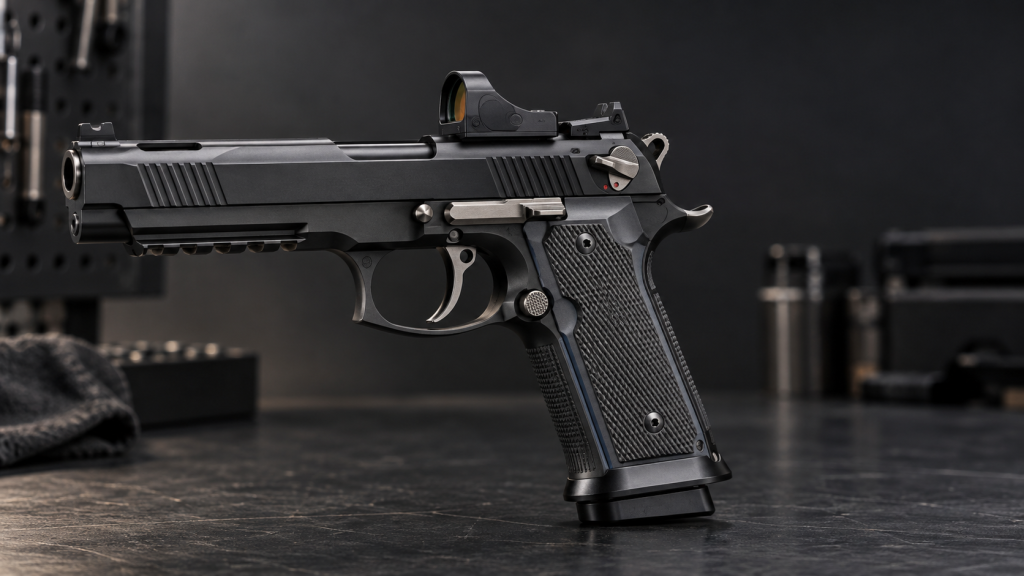
Beretta is about to reveal a new competition pistol at the 2026 USPSA Factory Gun Nationals in Hurricane, Utah.

The company has confirmed that competitors and spectators will be allowed to handle the unreleased handgun before it officially enters the United States market. Beretta has not disclosed the model name, price, specifications, release date or even whether it belongs to the 92X, PX4 or APX family.

That makes this an unusual opportunity.

People are already searching for the new Beretta pistol, but most gun websites have nothing useful to tell them. Some will solve that problem by inventing details and adding a photograph of an existing Beretta 92X Performance.

I will try the more difficult approach: separating what Beretta confirmed from what the company has not said.

What Did Beretta Announce?

Beretta announced on September 14, 2026 that it will display an unreleased competition-focused pistol during the USPSA Factory Gun Nationals.

The official announcement distributed by Beretta⁠ says attendees will receive an early look at a new pistol that has not been released in the United States.

Beretta describes the handgun as:

  • A new pistol
  • Intended for competition
  • Unreleased in the United States
  • Available for competitors and spectators to handle
  • The “next evolution” of Beretta’s competition lineup

That last description suggests more than a new finish or commemorative engraving.

It does not prove that Beretta developed a completely new operating system. “Next evolution” can describe anything from a heavily revised 92X to an existing European model finally entering the American market.

When Will Beretta Reveal the New Pistol?

The SIG Sauer USPSA Factory Gun Nationals are being held at Southern Utah Practical Shooting Range in Hurricane, Utah.

The early match takes place September 16–17, followed by the main match from September 18–20. Beretta representatives will be present with the new pistol during the event.

That means photographs, video and firsthand reports could begin appearing immediately.

The first images may come from competitors rather than Beretta’s product page. Buyers should expect partial specifications, improvised photographs and several confident YouTube explanations recorded by people who handled the gun for approximately four minutes.

The new Beretta competition pistol has not received an announced retail-release date. “Before it officially arrives in the U.S. market” confirms a future American release but does not tell us whether dealers will receive it next month or next year.

Is This a New Beretta 92X Performance?

A new Beretta 92X Performance model is the most obvious possibility, but Beretta has not confirmed it.

The 92X Performance family is already Beretta’s established steel-frame competition-pistol line. Existing versions combine the familiar Beretta 92 operating system with competition-oriented frames, triggers, controls and optics-ready configurations.

Beretta also released the 92X Performance Dark Series in 2026. That model uses a heavy Brigadier-style slide, steel Vertec frame, optics-ready slide and competition-focused components.

Launching another mildly altered 92X immediately afterward would be less interesting. Calling the mystery gun the “next evolution” suggests Beretta may have changed something more substantial than the finish.

Possibilities include:

  • A redesigned 92X Performance
  • A new Beretta Carry Optics pistol
  • A competition model based on the APX
  • A revised PX4 using its rotating-barrel system
  • An American version of an existing European competition handgun
  • A completely new platform

Those are possibilities, not leaked specifications.

Beretta has not identified the frame material, action type, trigger system, barrel length, magazine capacity or optic footprint.

Could It Be a Beretta APX Competition Pistol?

An APX-based competition gun would make commercial sense.

The Beretta APX A1 is a polymer-frame, striker-fired 9mm pistol with an optics-ready slide. Current versions compete in the crowded market occupied by the Glock 17, SIG P320, Walther PDP, Smith & Wesson M&P and similar duty-size handguns.

A serious APX competition model could add:

  • A longer slide and barrel
  • A larger magazine well
  • An improved trigger
  • Competition sights
  • Direct-mounted red-dot compatibility
  • Heavier frame components
  • Porting or compensation
  • Extended controls
  • Higher-capacity magazines

The problem is identity.

Beretta already has one of the most recognizable pistol designs in the world. A premium competition handgun wearing the open-slide silhouette of the Beretta 92 attracts attention that another polymer striker-fired pistol may not.

The market has no shortage of perfectly competent black plastic 9mm pistols. Several appear to reproduce when left unattended inside dealer display cases.

Could the New Beretta Be a Competition PX4?

A performance-oriented PX4 would be considerably more interesting.

The full-size Beretta PX4 uses a rotating-barrel system rather than the more common tilting-barrel action. Its design has earned a loyal following, particularly after Langdon Tactical demonstrated how much performance could be extracted from the platform.

A factory competition PX4 could combine:

  • The rotating-barrel action
  • A heavier or redesigned frame
  • A longer sight radius
  • An optics-ready slide
  • Improved trigger components
  • Competition controls
  • A larger magazine well
  • USPSA-compatible dimensions

That would give Beretta something mechanically different from the CZ Shadow 2, SIG P320 XFive, Walther PDP Match and Staccato competition pistols.

It would also create immediate searches for Beretta PX4 competition pistol, PX4 Carry Optics, Beretta rotating-barrel race gun and new Beretta PX4 2026.

There is no verified evidence yet that the mystery handgun is a PX4. It is simply the option I would find most interesting.

What Does “Factory Gun” Mean in USPSA?

The name of the event may provide a clue about Beretta’s intended market.

The 2026 USPSA Factory Gun Nationals includes Carry Optics, Production, Single Stack and Revolver. These divisions emphasize factory-produced firearms and impose more equipment restrictions than Open or Limited Optics.

According to USPSA’s published 2026 schedule⁠, Carry Optics represented 37 percent of reported division activity in 2025. Production accounted for another five percent.

Carry Optics is therefore the obvious commercial target.

A successful new Beretta Carry Optics pistol would need to compete directly with established, thoroughly developed handguns. It cannot merely be attractive inside a foam-lined case. It needs dependable magazines, a good trigger, durable small parts, useful grip geometry and an optic mounting system that does not resemble an apartment balcony.

The Optic Mount Could Decide Whether the Pistol Matters

The new Beretta’s red-dot mounting system may be more important than its cosmetic design.

Competition shooters want an optic mounted securely and low enough to provide a natural presentation. Adapter plates create flexibility, but they also add screws, height and additional surfaces that can shift or fail.

Direct mounting reduces parts and height but commits the buyer to a particular footprint.

Beretta could choose:

  • An RMR-pattern direct mount
  • A DeltaPoint Pro footprint
  • A modular plate system
  • A proprietary low-mount interface
  • Separate slides for several popular footprints

My discussion of absolute and lower-third co-witness⁠ concerns rifle optics, but the underlying geometry still matters on a pistol. Sight height changes presentation, visual indexing and how much of the optic window is occupied by the iron sights.

A competition pistol does not need enormous backup sights blocking half the glass. It needs a secure optic mount that survives repeated slide movement without forcing the red dot into the approximate altitude of a rooftop air-conditioning unit.

What Should the Trigger Be Like?

Beretta has not said whether the new pistol is striker-fired, double-action/single-action or single-action only.

Each option creates a different competition product.

A 92X- or PX4-based pistol would probably preserve a hammer-fired system. An APX competition model would use a striker. A single-action-only design could target a different buyer and potentially different USPSA equipment rules.

Whatever Beretta chooses, the trigger needs:

  • A predictable break
  • Minimal unnecessary movement
  • A positive reset
  • Safe engagement
  • Durable internal components
  • Consistency from the first shot through the last

A light trigger that becomes unreliable after several thousand rounds is not a competition advantage. It is a malfunction with an entry fee.

Beretta’s sponsored shooters include JJ Racaza, Sal Luna, Cameron Templin and Ben Hardt. Putting the pistol in front of accomplished competitors should generate useful feedback quickly—provided Beretta listens after the promotional photographs are finished.

New Beretta Competition Pistol Price

Beretta has not announced the price.

The likely range depends entirely upon the platform.

An APX-based competition pistol could target the broad market below premium steel-frame guns. A revised 92X Performance or specialized PX4 could land much higher. A hand-fitted flagship model could compete with expensive race-ready pistols from Staccato and other premium manufacturers.

Until Beretta publishes an MSRP, any precise price is fiction.

Buyers should remember that the pistol is only part of the real cost. A competition setup may also require:

  • A red-dot sight
  • Additional magazines
  • Magazine extensions
  • A competition holster
  • Magazine pouches
  • Replacement springs
  • A belt system
  • Spare small parts
  • Match ammunition

A $1,500 pistol can become a $2,500 equipment decision with impressive speed.

Should You Wait for the New Beretta?

Anyone already considering a Beretta 92X Performance, CZ Shadow 2, SIG P320 XFive, Walther PDP Match or another premium competition 9mm should wait several days.

The mystery pistol is close enough to its public debut that buying immediately makes little sense. Waiting until September 20 should reveal substantially more about the design without costing anything.

Do not sell a proven competition pistol based upon a press release.

Do not preorder an unidentified gun because somebody photographed one at an angle that made the slide cuts look expensive.

The new Beretta must prove:

  • What model family it belongs to
  • Which USPSA divisions it fits
  • Whether it accepts existing Beretta magazines
  • What red-dot optics it supports
  • Whether holsters are available
  • Its unloaded weight and dimensions
  • Its trigger configuration
  • Its American price and release date
  • Whether replacement parts will be readily available

Those details will determine whether this is a serious competition gun or an attractive specialty model destined to spend most of its life being discussed on forums.

New Beretta Pistol Questions

What is Beretta’s new pistol for 2026?

Beretta has confirmed an unreleased competition pistol but has not announced its model name.

When will the new Beretta competition pistol be revealed?

The pistol is being shown during the USPSA Factory Gun Nationals in Hurricane, Utah, from September 16–20, 2026.

Is the new Beretta a 92X Performance?

Possibly, but Beretta has not confirmed that it belongs to the 92X family.

Is it a new Beretta PX4?

Beretta has not identified the platform. A competition PX4 is one possibility, not an established fact.

Will the new Beretta accept a red-dot sight?

A modern USPSA-focused competition pistol is likely to be optics-ready, but the company has not confirmed the mounting system or supported footprints.

What will the new Beretta pistol cost?

No MSRP or retail price has been announced.

When can I buy the new Beretta in the United States?

Beretta says the pistol will officially arrive in the American market later, but it has not published a release date.

Final Verdict

Beretta has created a legitimate hardware story without revealing enough hardware to judge.

We know a new competition pistol exists. We know American competitors can examine it at the USPSA Factory Gun Nationals. We know Beretta considers it the next evolution of its competition lineup.

We do not know the model, action, frame, capacity, optic footprint, price or release date.

That uncertainty is precisely why the story is worth watching. If Beretta has built a genuine successor to the 92X Performance—or finally produced a full factory competition PX4—it could become one of the most important new 9mm competition pistols of 2026.

If it is an existing gun with different slide cuts and an optimistic price tag, the internet will figure that out before the match staff finishes painting the steel.

I will update the details when Beretta reveals the actual pistol.

GarandThumb.com was established on May 4, 2012. Finch writes about firearms, shooting equipment, competition and the continuing effort to become a better marksman.

Posted in XTC

How to Buy a CMP M14 in 2027 | Price, Eligibility and Order Checklist

The Civilian Marksmanship Program expects to begin selling genuine surplus M14 rifles in January 2027 for less than $2,000 each.

CMP Chairman and CEO Jerry O’Keefe also says the initial purchase limit will be two M14 rifles per eligible buyer per year. More than 100,000 rifles could eventually become available.

Those are the important numbers. The important warning is that the CMP M14 order page, final price, grades and application packet have not been published yet.

Anyone advertising “CMP M14 preorders” is therefore selling something the CMP does not currently offer.

Here is what prospective buyers can do now, what remains unknown and why the CMP M14 sale could become the most important military-surplus rifle release in decades.

When Will CMP M14 Sales Begin?

The official CMP M14 announcement⁠ gives a fulfillment window of late 2026 through early 2027.

During an August 2026 interview at Camp Perry, O’Keefe narrowed the expected opening to January 2027. The CMP wants to accumulate enough completed rifles before opening orders rather than accept a mountain of applications while converting rifles one at a time.

That is sensible. The moment sales open, every collector with an internet connection will suddenly remember that his grandfather loved the M14.

The current timeline is:

  • January 2027 target for initial CMP M14 sales
  • Final ordering date not yet published
  • No active M14 order form
  • No official grade descriptions
  • Mail-order and physical-store sales expected
  • Details subject to change before orders open

Sign up for the sales-email list linked from the official announcement. Do not rely upon Facebook rumors, forum speculation or a Garand Thumb video thumbnail announcing that orders secretly opened eleven minutes ago.

What Will a CMP M14 Cost?

O’Keefe says the CMP M14 price will be below $2,000, although the organization has not announced the final figure.

That price is lower than many collectors expected. Speculation initially placed genuine military M14 rifles between $3,000 and $5,000, depending upon condition and manufacturer.

A price below $2,000 also places the CMP rifle near the suggested retail price of a new commercial Springfield Armory M1A. Springfield currently lists traditional M1A models around the $2,000 mark, with variations depending upon configuration.

The comparison is not perfect.

The M1A is a commercially manufactured semiautomatic M14-pattern rifle. The CMP M14 began life as a genuine U.S. military rifle and will be permanently converted to semiautomatic operation under special CMP authority.

That military receiver, original manufacturer and government history are precisely why collectors will care.

How Many CMP M14 Rifles Can You Buy?

The initial limit is expected to be two CMP M14 rifles per person per year.

O’Keefe said CMP may reconsider the restriction after seeing actual demand. Starting with a two-rifle annual limit should prevent a small number of buyers from consuming the first inventory and immediately relisting the rifles at twice the price.

It will not stop flipping entirely. Nothing short of releasing hungry badgers inside the auction houses will accomplish that.

The annual limit does give ordinary CMP customers a reasonable opportunity to buy before the usual secondary-market circus begins.

CMP M14 Eligibility Requirements

The CMP has not published M14-specific eligibility rules. Until it does, buyers should use the organization’s existing military-surplus rifle requirements as their preparation checklist.

The current CMP rifle-purchase eligibility requirements⁠ generally require:

  • Proof of United States citizenship
  • Proof of age
  • Membership in a CMP-affiliated organization
  • Proof of marksmanship or another qualifying firearms activity
  • Legal eligibility to acquire and possess a firearm
  • A completed and notarized purchaser-certification form
  • Any state-required permit, license or identification
  • A successful NICS background check

CMP-affiliated membership can come from a traditional shooting club or a recognized special affiliate. The Garand Collectors Association is a popular option that permits online enrollment. Military service, National Guard membership and membership in certain congressionally chartered veterans’ organizations can also satisfy the affiliation requirement.

Qualifying marksmanship evidence can include a CMP or NRA classification card, match results, military or law-enforcement service, a concealed-carry license, qualifying hunting documentation, an FFL or Curio and Relics license, or a completed marksmanship clinic.

The CMP currently waives the marksmanship-activity evidence for military-surplus rifle buyers over 60, but citizenship and affiliated-organization membership remain required.

Do not assume every existing rule will transfer unchanged to the M14 program. The CMP may create a dedicated order packet, lottery, priority system or additional certification before January.

What Should You Prepare Now?

Anyone serious about ordering should assemble the ordinary CMP documentation now.

Confirm Your Affiliated-Club Membership

Make sure the membership will remain current when orders open. An expired card discovered after the first ordering rush is an avoidable problem.

Locate Proof of Citizenship and Age

A qualifying birth certificate, passport or naturalization document should be copied clearly. A dark photograph taken on a kitchen counter beneath one dying light bulb is not an efficient application strategy.

Find Your Marksmanship Documentation

A Distinguished Rifleman badge, classification card or match record makes this easy. Other buyers can use one of the qualifying alternatives listed by CMP.

Review Your State’s Semiautomatic-Rifle Laws

CMP currently requires rifles sent to residents of several states to pass through an FFL. New York requires a permit to purchase a semiautomatic rifle. Rhode Island currently prohibits CMP from shipping semiautomatic rifles into the state. Other jurisdictions impose age, registration or identification requirements.

The CMP M14 has a detachable magazine and semiautomatic action. State restrictions that do not create problems for an M1 Garand may create problems for an M14.

Check the law again when the order page opens. Gun-control politicians possess an impressive ability to make yesterday’s accurate purchasing guide obsolete.

Set Aside the Actual Purchase Cost

“Under $2,000” does not mean the entire transaction will cost $1,999 or less.

Potential additional expenses include shipping, sales tax, FFL transfer fees where required, magazines, a sling, ammunition and replacement parts. A collector may also want professional inspection before firing a heavily used rifle.

Budgeting around $2,300 would provide more breathing room until the final price and shipping terms appear.

How Will the CMP Convert an M14 to Semiautomatic?

The CMP says every rifle will be modified into a “permanently and irreversibly” semiautomatic rifle.

This is necessary because the military M14 was originally manufactured as a selective-fire weapon. Simply removing the selector does not transform its legal history into that of a commercial M1A.

O’Keefe says the conversion was developed with federal partners and that CMP’s federal charter provides authority unavailable to an ordinary commercial firearm company.

Each receiver must be individually processed and documented. The CMP is using optical character-recognition equipment to track serial numbers and record when each rifle completes its conversion.

I examined that legal and technical problem more closely in Once a Machine Gun, Always a Machine Gun? The CMP M14 Sale Explained⁠.

Buyers should still expect the final sales page to explain the conversion, accompanying documentation and effect upon future repairs. “The government says it is fine” is not the same thing as useful collector documentation.

CMP M14 vs. Springfield Armory M1A

The practical choice will depend upon what the buyer wants.

A new M1A offers known commercial specifications, a manufacturer warranty and several available configurations. Replacement parts, stocks, scope mounts and support are already established.

A CMP M14 offers something the M1A cannot: an original United States military receiver and authentic service history.

That does not guarantee superior accuracy or condition. A rack-worn military rifle may shoot worse than a new M1A. Its stock may be beaten, its finish may be thin and its parts may come from several rebuild periods.

Collectors will pay for history. Shooters should still judge the actual rifle.

The decisive CMP M14 value factors will include:

  • Receiver manufacturer and serial number
  • Barrel manufacturer, date and condition
  • Stock type and markings
  • Arsenal-rebuild evidence
  • Metal finish
  • Parts originality
  • Conversion markings
  • Mechanical condition
  • Documentation supplied by CMP
  • Any eventual grade designation

Until CMP publishes grading standards, nobody can honestly tell you whether the average rifle will resemble an arsenal-fresh collector piece or something recovered from the bottom of a National Guard armory rack.

Will Buyers Be Able to Choose a Manufacturer?

CMP has not announced whether customers can request Springfield Armory, Winchester, Harrington & Richardson or TRW receivers.

The most likely possibilities are random manufacturer assignment, separate manufacturer listings, premium grades or auction treatment for unusually desirable rifles. That is informed speculation, not a published CMP policy.

Do not write “TRW only” across an imaginary order form and expect an armorer in Anniston to appreciate the initiative.

Manufacturer selection, hand-picking fees and store availability remain unanswered.

Is There a CMP M14 Order Form Yet?

No.

As of September 2026, there is no legitimate CMP M14 order form, preorder system or reservation list.

The official CMP announcement says details covering order submission, pricing, limits and sales channels will be published later. The organization expects both mail-order and physical-store sales, but it has not explained how the first inventory will be allocated.

A third-party website cannot reserve your place.

A gun shop cannot guarantee it will receive CMP rifles.

A stranger in a social-media group does not have an uncle secretly writing serial numbers onto sticky notes at Camp Perry.

Wait for the official page.

Should You Buy a CMP M14?

At less than $2,000, the answer will probably be yes for anyone who wants a genuine U.S. military M14 and can legally own one.

These rifles connect the M1 Garand to the Cold War service-rifle era. They combine a 7.62×51mm cartridge, detachable 20-round magazine, excellent aperture sights and unmistakable American military history.

They will also be heavy, ammunition-hungry and more complicated to accurize than an AR-15. That is not a defect. It is part of owning an M14.

My earlier CMP surplus-rifle history⁠ explains why these sales matter beyond adding another rifle to a safe. Firearm revenue supports CMP competitions, training, ranges, scholarships and youth marksmanship programs.

The government spent decades keeping these rifles away from the citizens who paid for them. Returning permanently semiautomatic examples to qualified Americans is considerably better than cutting them apart and selling the remains as scrap.

Final CMP M14 Buyer Checklist

Before January 2027:

  • Join or renew membership in a CMP-affiliated organization
  • Gather citizenship and age documentation
  • Locate acceptable marksmanship evidence
  • Review current state semiautomatic-rifle restrictions
  • Arrange an FFL if your state requires one
  • Subscribe to official CMP sales updates
  • Set aside roughly $2,300 until final costs are known
  • Ignore unofficial preorder offers
  • Wait for the actual order packet and grading descriptions

The confirmed picture is already encouraging: more than 100,000 potential rifles, a starting limit of two per person annually and a price below $2,000.

The remaining questions concern the exact opening date, grades, manufacturer selection, conversion documentation and ordering method.

Prepare the paperwork now. When the CMP M14 sale opens, the slowest part of the process should be the CMP—not somebody discovering that his passport expired during the Obama administration.

GarandThumb.com was established on May 4, 2012. Finch writes about firearms, competitive shooting and the continuing effort to become a better marksman

Posted in XTC

EOTECH Vudu 4-12×36 FFP Review | Is This the Best Compact AR-15 SPR Scope?

The EOTECH Vudu 4-12×36 FFP may be one of the most interesting AR-15 optics released in 2026.

It is only 7.1 inches long, weighs 16.9 ounces and provides 4-12X magnification through a first-focal-plane MRAD reticle. EOTECH also replaced conventional scope rings with an integrated base compatible with most mini-ACOG mounts.

That combination makes the Vudu 4-12 particularly attractive for an AR-15 SPR, compact AR-10, hunting rifle or general-purpose rifle equipped with a secondary red dot.

Search interest in the EOTECH Vudu 4-12 review, Vudu 4-12 versus LPVO, best compact AR-15 scope and best optic for an AR-15 SPR all revolves around the same question:

If a rifle already has a piggyback red dot, does its magnified optic really need to compromise everything else to reach 1X?

After reviewing the EOTECH Vudu 4-12×36 design, specifications, mounting system and closest competitors, I think this compact MPVO makes more sense than many overweight 1-10X LPVOs.

Its weaknesses are fixed parallax, short eye relief and a $1,219 price.

This EOTECH Vudu 4-12 review is based on the production hardware and verified specifications. I have not fired thousands of rounds beneath one, so I will not invent a round count, report imaginary tracking results or claim it survived being thrown from a moving helicopter.

Gun reviews already contain enough fiction.

EOTECH Vudu 4-12×36 FFP Specifications

EOTECH identifies the Vudu 4-12×36 FFP⁠ as a new riflescope for 2026.

Its important specifications include:

  • 4-12X magnification
  • 36mm objective lens
  • First-focal-plane MRAD reticle
  • MR5 and MD5 reticle options
  • 7.1-inch overall length
  • 16.9-ounce weight
  • Aircraft-grade aluminum housing
  • Integrated mini-ACOG-compatible mounting base
  • Capped turrets with 0.1-MRAD adjustments
  • Ten reticle-brightness settings
  • Approximately 300 hours of battery life
  • One CR2032 battery
  • 28.5-foot field of view at 4X and 100 yards
  • 9.5-foot field of view at 12X and 100 yards
  • 2.5-3.1 inches of eye relief at 4X
  • 2.4-3.0 inches of eye relief at 12X
  • Fog-, water- and shock-resistant construction
  • Made in Japan
  • Ten-year warranty
  • $1,219 EOTECH direct price

The dimensions are the real story.

This is not a normal precision scope awkwardly balanced over a lightweight AR-15. The Vudu 4-12 is shorter than many LPVOs and weighs less than several popular 1-8X and 1-10X rifle scopes.

What Is a Compact MPVO?

The EOTECH Vudu 4-12 is a compact medium-power variable optic, commonly shortened to MPVO.

A low-power variable optic normally begins at 1X and tries to provide red-dot speed at close range while retaining useful magnification for distant targets.

That sounds perfect until the laws of optics arrive and begin breaking furniture.

Producing a convincing 1X image while also delivering high magnification, usable eye relief, good light transmission and a forgiving eye box requires compromises. The finished LPVO can become long, heavy, expensive or mediocre at both ends of its magnification range.

The Vudu 4-12 does not attempt to be everything.

Four-power magnification is not a substitute for a red dot inside a room. It is intended for deliberate shooting at intermediate and extended distances. A piggyback or offset red dot supplies the close-range capability.

That gives the rifle two specialized optical systems instead of one complicated system pretending to be both.

A second optic adds cost, weight, height and another battery. It also requires the shooter to practice moving between sights without becoming tangled in his equipment like a raccoon inside a lawn chair.

Mechanically, however, the compact MPVO and red-dot combination makes sense.

Why the EOTECH Vudu 4-12 Is Getting Attention

The current AR15.com discussion about the EOTECH Vudu 4-12 shows why compact MPVO scopes have become a serious alternative to LPVOs.

Shooters are comparing the Vudu 4-12 to the Leupold Mark 4HD 2.5-10, compact Primary Arms scopes and traditional 1-8X or 1-10X LPVOs. They are also debating whether the MR5 or MD5 reticle makes more sense with a piggyback red dot.

The discussion is not just about maximum magnification.

AR-15 owners want enough magnification to identify small targets, read conditions and make precise shots without attaching a full-size precision scope to a rifle intended to remain portable.

People reaching Garand Thumb Blog after searching for a Garand Thumb optic setup, Garand Thumb YouTube scope review or Garand Thumb video about AR-15 optics are usually trying to answer the same practical question:

Which optic provides useful capability without turning the rifle into an expensive barbell?

The EOTECH Vudu 4-12 has a legitimate answer. It removes several inches and ounces while retaining enough magnification for most practical AR-15 distances.

The Integrated Mini-ACOG Mount Is the Best Feature

Most rifle scopes use a conventional 30mm or 34mm tube clamped inside rings or a cantilever mount.

The EOTECH Vudu 4-12 uses an integrated base compatible with most aftermarket mini-ACOG mounts. That allows the super-short optic to attach securely without requiring normal rings around its limited tube space.

It is an intelligent solution.

Conventional rings need enough straight tube to clamp the scope and establish proper eye relief. A 7.1-inch optic does not provide much space once the objective, controls and eyepiece have taken their share.

The integrated base eliminates that problem and reduces unnecessary mounting bulk.

The tradeoff is less flexibility. A conventional 30mm scope can move within its rings and fit an enormous selection of mounts. The Vudu depends on the positions provided by its base and chosen mini-ACOG mount.

Before buying, confirm that the selected mount produces the correct height and eye relief on the intended rifle. “Compatible” means the screws fit. It does not guarantee the scope will meet your eye correctly from every shooting position.

Is the EOTECH Vudu 4-12 Eye Relief Too Short?

The Vudu 4-12 provides between 2.4 and 3.1 inches of published eye relief.

That is not generous.

On a 5.56 NATO AR-15, recoil is mild enough that scope contact is unlikely to be the primary concern. The larger issue is obtaining a complete sight picture from standing, kneeling, prone and improvised positions.

A scope can look excellent from a carefully arranged bench position and become irritating when the rifle must be mounted quickly.

The concern increases on an AR-10, .308 hunting rifle or another firearm producing more recoil. Short eye relief places the ocular lens closer to the shooter and provides the rifle another opportunity to explain physics through facial swelling.

My White Oak Service Rifle⁠ was built around consistency in position and sight alignment. Anyone considering the compact Vudu for an AR-15 Service Rifle, SPR or competition rifle should confirm that the mount permits a repeatable head position in every intended shooting position.

Compactness is useful only when the scope still meets the shooter’s eye.

Fixed Parallax Is the Vudu’s Largest Weakness

The EOTECH Vudu 4-12 does not include side-focus parallax adjustment. Published retailer specifications identify the parallax as fixed.

That keeps the optic smaller and mechanically simpler, but it is the feature I would most like EOTECH to add.

Parallax error occurs when the reticle and target image do not appear on the same optical plane. If the shooter’s eye moves behind the scope, the reticle may appear to move across the target even though the rifle has not moved.

At ordinary distances, consistent head placement may make the issue insignificant. At longer ranges, on small targets or from unstable positions, adjustable parallax becomes more valuable.

A scope offering 12X magnification invites shooters to attempt precise shots. Omitting side focus is therefore more consequential than leaving it off a simple 1-6X LPVO.

The fixed-parallax design should be acceptable on an AR-15 SPR used primarily at practical distances. It is less attractive for small targets, precision competition or shooting across dramatically different ranges.

First Focal Plane Is the Correct Choice

The Vudu’s reticle sits in the first focal plane, meaning its apparent size changes with magnification.

The MRAD measurements remain valid throughout the 4-12X range. A one-mil hold remains one mil whether the scope is set at 4X, 8X or 12X.

That is exactly what I want from a compact precision scope.

A second-focal-plane reticle remains visually the same size, but its hold values are generally accurate at only one specified magnification. That creates another opportunity to apply the correct hold at the wrong power setting.

The Vudu offers MR5 and MD5 reticles. The best choice depends on whether the shooter values faster acquisition at lower magnification or a cleaner precision-oriented sight picture at 12X.

Someone using the magnified optic without a secondary sight may prefer a visually assertive reticle at 4X. A shooter using a piggyback red dot for close targets may prefer the cleaner reticle for precision work.

Whichever reticle you choose, the scope and turrets are both MRAD. That is good. Mixing mil reticles with MOA turrets is an excellent way to turn a simple correction into long division.

The EFLX Piggyback Red-Dot Package

EOTECH offers packages combining the Vudu 4-12 with an EFLX red dot and ring mount. The EFLX can be positioned at 12 o’clock or 45 degrees.

A top-mounted red dot allows the shooter to raise his head for close targets while keeping the rifle upright. An offset sight lets the shooter rotate the rifle while maintaining a lower head position.

Both arrangements have disadvantages.

A 12-o’clock optic sits high over the bore and may require more of a chin weld than a cheek weld. An offset optic changes the rifle’s orientation and may interfere with barricades or equipment.

This is related to the geometry discussed in my article about absolute versus lower-third co-witness⁠. Sight height affects presentation, head position and how naturally the aiming system appears in front of the shooter.

The correct setup is the one you can find quickly and repeat under pressure—not the one that looks best while the rifle is lying beside a plate of chicken wings.

EOTECH Vudu 4-12 vs. LPVO

The primary difference between the EOTECH Vudu 4-12 and an LPVO is close-range capability.

A true 1X LPVO can serve as the rifle’s only optic. The shooter turns the magnification to 1X for close targets and increases power for more distant shots.

The Vudu 4-12 begins at 4X. It needs a secondary red dot if the rifle must handle genuinely close targets quickly.

The compact MPVO provides several advantages in return:

  • Greater top-end magnification than most 1-6X or 1-8X LPVOs
  • Lower weight than many premium 1-10X scopes
  • Shorter overall length
  • A first-focal-plane precision reticle
  • Less dependence on one optical system doing two unrelated jobs

The best choice depends on the rifle.

A home-defense AR-15 or close-range carbine probably benefits more from a true 1X LPVO or red dot.

An AR-15 SPR, designated-marksman-style rifle or compact precision rifle can benefit from the Vudu 4-12 and a separate red dot.

EOTECH Vudu 4-12 vs. Vudu 1-10

The Vudu 1-10×28 FFP provides true 1X capability without requiring a secondary optic.

It is also 10.63 inches long, weighs 21.3 ounces and currently costs $1,939 directly from EOTECH.

The new Vudu 4-12 is 3.53 inches shorter, 4.4 ounces lighter and $720 less expensive. It also supplies two additional powers of magnification.

The Vudu 1-10 wins when one scope must handle close-range shooting and magnified work.

The Vudu 4-12 wins when compact size, lower weight and better top-end magnification matter more—and the shooter is comfortable adding a separate red dot.

For an AR-15 SPR or compact precision rifle, I prefer the logic of the 4-12.

For a defensive carbine that may never receive a secondary sight, a good 1-6X or 1-8X LPVO remains more practical.

EOTECH Vudu 4-12 vs. Leupold Mark 4HD 2.5-10

The Leupold Mark 4HD 2.5-10×42 FFP⁠ is the Vudu’s most uncomfortable competitor.

The illuminated Leupold costs $1,299.99, weighs 21.5 ounces and measures 12.5 inches long. It offers a lower 2.5X setting, larger 42mm objective, substantially longer eye relief and conventional mounting.

The Vudu is dramatically shorter and 4.6 ounces lighter before mounts are considered. It also provides 12X instead of 10X.

The decision is straightforward:

Choose the Leupold if eye relief, lower minimum magnification and mounting flexibility matter most.

Choose the EOTECH if you want the shortest and lightest practical 12X scope for an AR-15 SPR.

Is the EOTECH Vudu 4-12 Worth $1,219?

The EOTECH Vudu 4-12 is expensive, but its price is not absurd within the premium Japanese-optics market.

The buyer receives a compact first-focal-plane scope, illuminated MRAD reticle, capped 0.1-MRAD turrets, integrated mounting interface and ten-year warranty.

The real question is whether its unusual size solves a problem on your rifle.

On a short, suppressed AR-15 or lightweight SPR, removing several inches and ounces from the optic has genuine value.

On a heavy bench rifle where another five inches does not matter, the buyer may be paying for compactness he does not need.

The fixed parallax and short eye relief prevent me from calling it an automatic winner.

Is the Vudu 4-12 the Best Optic for an AR-15 SPR?

The EOTECH Vudu 4-12 belongs on the short list of the best compact scopes for an AR-15 SPR.

It provides enough magnification for target identification, observation and precise shot placement without adding the size and weight of a full-length precision scope.

The integrated mount and optional EFLX package create a complete dual-optic system for shooters who want magnification at distance and a red dot for close targets.

It is not the best choice for every AR-15.

A defensive carbine intended primarily for close distances needs a red dot or genuine 1X optic. A dedicated long-range rifle may benefit more from a larger scope with adjustable parallax, longer eye relief and additional magnification.

The Vudu 4-12 occupies the useful space between those two rifles.

Final Verdict

The EOTECH Vudu 4-12×36 FFP is one of the smartest compact AR-15 optics introduced in 2026.

It provides useful 12X magnification without turning an SPR into a telescope-delivery vehicle. The first-focal-plane reticle, capped MRAD turrets and integrated mini-ACOG mounting interface all support a serious precision-rifle role.

The Vudu 4-12 makes the most sense on an AR-15 SPR, compact AR-10 or hunting rifle equipped with a piggyback or offset red dot.

It makes less sense as the only optic on a close-range defensive carbine. Four power is still four power, regardless of how aggressively someone twists the magnification ring.

My reservations are the fixed parallax, limited eye relief and premium price. Those are real compromises, not internet complaints manufactured because a new scope failed to cure male-pattern baldness.

For the right rifle, the Vudu 4-12 solves a legitimate problem: obtaining useful magnification without mounting a full-size precision scope.

The LPVO tried to make one optic do everything.

EOTECH’s compact MPVO admits that two specialized sights may do the job better.

That may be the more honest answer.

GarandThumb.com was established on May 4, 2012, to document my experiences trying to become a better marksman.

Posted in XTC

Supreme Court AR-15 Ban Case | Viramontes v. Cook County Explained

The Supreme Court AR-15 ban case is officially headed for oral argument.

On December 2, 2026, the Supreme Court will hear Viramontes v. Cook County and Grant v. Higgins. The consolidated cases could determine whether state and local governments may ban AR-15 rifles and similar semiautomatic firearms merely by labeling them “assault weapons.”

The official question before the Supreme Court⁠ is direct:

Whether the Second and Fourteenth Amendments guarantee the right to possess AR-15 platform and similar semiautomatic rifles.

The answer should be yes.

The AR-15 is America’s most popular rifle platform. Millions of peaceful gun owners use AR-15 rifles for home defense, hunting, competitive shooting, training and ordinary recreational shooting. A standard civilian AR-15 fires one round with each pull of the trigger. It is not a machine gun, and calling it a “weapon of war” does not magically create a selector switch.

If the Supreme Court allows politicians to ban one of America’s most commonly owned firearms because they dislike its appearance, the Second Amendment will protect only whatever obsolete or ineffective guns the government chooses to tolerate.

What Is the Supreme Court AR-15 Ban Case?

The Supreme Court granted the ⁠Viramontes v. Cook County⁠ petition⁠ on June 30, 2026.

The Illinois gun owners challenging Cook County’s assault-weapons ban argue that AR-15 rifles and similar semiautomatic firearms are protected by the Second Amendment because they are commonly possessed for lawful purposes.

The Court consolidated Viramontes with Grant v. Higgins⁠, a challenge to Connecticut’s assault-weapons ban.

Together, the cases place a straightforward constitutional question before the justices: Can the government ban AR-15 platform rifles that millions of Americans lawfully possess?

This is not a dispute over an obscure accessory or administrative fee. It is a direct challenge to laws prohibiting an entire class of common semiautomatic rifles.

When Will the Supreme Court Hear the AR-15 Case?

The Supreme Court scheduled the AR-15 case for oral argument on Wednesday, December 2, 2026.

The Court allotted one hour for the consolidated cases. On September 9, the United States requested ten minutes of argument time⁠ to support the gun owners challenging the bans.

Anyone following the Supreme Court assault-weapons-ban case should watch four important stages:

  • Additional briefs filed before the December argument
  • Questions asked by the justices during oral argument
  • Any discussion distinguishing AR-15 rifles from machine guns
  • The final Supreme Court AR-15 ruling, ordinarily expected before the Court’s term ends in 2027

Oral-argument questions do not always predict the final result, but they may reveal which legal theories interest or irritate the justices.

Is the AR-15 Protected by the Second Amendment?

The AR-15 is plainly an “arm.”

The Second Amendment protects the right of the people to keep and bear arms. It does not say “muskets,” “hunting guns” or “whatever rifles a hostile legislature has not banned yet.”

The gun owners’ Supreme Court brief⁠ argues that AR-15 rifles are the most popular rifles in the United States and are owned in the tens of millions.

That should make the common-use analysis easy.

The Supreme Court has repeatedly treated arms commonly possessed for lawful purposes as constitutionally protected. The AR-15 is used for self-defense, hunting, competition, training and recreational shooting throughout the country.

Garand Thumb Blog has covered the AR platform as actual shooting equipment rather than as a scary black object held by a politician who cannot identify its parts. My White Oak Service Rifle⁠ is an AR-15 built for High Power competition. The Crosman MAR177 AR-15 upper⁠ allowed me to practice using the same lower, trigger and rifle geometry indoors.

The real American AR-15 is a competition rifle, defensive rifle, training rifle, hunting rifle and ranch rifle.

It is not unusual, and it is not outside the Second Amendment.

An AR-15 Is Not an Automatic Weapon

Searches about the Supreme Court AR-15 case will inevitably attract the same dishonest claim that the AR-15 is effectively a machine gun.

It is not.

A standard civilian AR-15 is semiautomatic. It fires one cartridge when the trigger is pulled. The trigger must reset and be pulled again before another cartridge fires.

An M16 or other select-fire firearm can fire automatically when configured for automatic operation. That is a substantial mechanical and legal distinction.

The letters “AR” also do not mean “assault rifle.” The name comes from ArmaLite Rifle, the original manufacturer’s designation.

Anti-gun politicians depend on confusion between civilian AR-15 rifles and automatic military weapons because an honest description sounds far less frightening.

“A commonly owned semiautomatic rifle that fires once per trigger pull” does not produce the desired panic.

Why “Assault Weapon” Is a Political Term

State assault-weapons bans commonly identify prohibited firearms through combinations of model names and external features such as pistol grips, adjustable stocks, handguards and muzzle devices.

These features do not turn a semiautomatic rifle into a machine gun.

A pistol grip helps the shooter control the rifle. An adjustable stock helps fit the rifle to different shooters. A handguard protects the shooter from a hot barrel. A muzzle device may reduce flash or recoil.

The laws prohibit rifles because they look frightening to people who already dislike guns.

That is anti-gun bigotry converted into statutory definitions: distrust the peaceful owner, blame the object and ignore the criminal who chooses to hurt somebody.

Punishing ergonomics is particularly stupid. A feature that helps a lawful owner control a firearm does not become dangerous merely because a military rifle has something visually similar.

Why AR-15 Rifles Are Commonly Used for Home Defense

Many Americans choose an AR-15 for home defense because the rifle is accurate, produces manageable recoil and can be adjusted for shooters of different sizes.

A defensive AR-15 can also accept a reliable light, optic and sling. Those components help the owner control the rifle and identify what is in front of it.

That matters because a responsible armed citizen must distinguish a genuine threat from a family member, neighbor or harmless noise before firing.

Police cannot stand inside every home waiting for an emergency. When somebody violently enters a house, the intended victim may be the only person immediately available to protect innocent life.

That is why armed citizens matter.

Restricting defensive firearms does not weaken violent criminals. Criminals already ignore laws against assault, robbery, murder, prohibited possession and unlawful firearm use.

AR-15 bans burden the people willing to obey the law. They leave peaceful citizens with fewer effective defensive choices while accomplishing absolutely nothing to improve the character of a violent attacker.

That is not public safety. It is government-enforced vulnerability.

The United States Supports Striking Down the AR-15 Bans

The United States filed a Supreme Court brief supporting the challenge⁠ on September 4, 2026.

The federal government’s brief states that the AR-15 is the country’s most popular rifle, is lawful under federal law and may be legally possessed in 40 states. It argues that categorical AR-15 bans violate the Second Amendment.

The government is correct in this case.

That does not erase decades of federal hostility toward gun owners or make every federal firearms restriction respectable. It simply demonstrates how difficult these state AR-15 bans are to defend under the Supreme Court’s own Second Amendment decisions.

The federal brief also rejects the argument that states should decide which common firearms citizens are permitted to consider useful for defense.

The people make that decision—not legislators, bureaucrats or judges shopping for a constitutional excuse.

Could Viramontes v. Cook County End Assault-Weapons Bans?

A strong Supreme Court decision could place assault-weapons bans across the country in immediate constitutional trouble.

The case directly concerns the Cook County and Connecticut prohibitions. Other state laws have different wording, prohibited-feature tests and model lists, so a decision may not automatically erase every ban overnight.

The Court’s reasoning will therefore be critical.

If the justices clearly hold that AR-15 rifles are protected arms in common use, hostile states should not be able to preserve their bans by moving a few commas or inventing another insulting name for the same rifle.

A weaker decision could produce years of additional litigation as anti-gun governments search for loopholes.

That is what they do. When courts identify a constitutional limit, these governments do not suddenly discover respect for gun owners. They hire more lawyers and attempt to crawl around the limit.

What Would a Supreme Court AR-15 Ruling Mean for Gun Owners?

A ruling for the challengers could establish that states may not categorically prohibit common semiautomatic rifles.

That would matter to more than current AR-15 owners.

If governments can ban a widely owned rifle because of cosmetic features and speculative claims about dangerousness, the same reasoning can be applied to semiautomatic shotguns, defensive pistols, standard-capacity magazines and other firearms.

Gun owners who personally prefer an M1 Garand, bolt-action rifle, lever gun or shotgun still have a reason to care about Viramontes v. Cook County.

The government rarely stops with the gun you do not own.

Final Verdict

The Supreme Court should strike down the Cook County and Connecticut AR-15 bans.

The AR-15 is an ordinary semiautomatic rifle that fires one round per trigger pull. It is owned by millions of Americans and commonly used for lawful home defense, competition, hunting, training and recreation.

No honest application of the Second Amendment allows the government to ban America’s most popular rifle merely because anti-gun politicians dislike its appearance.

The Supreme Court AR-15 case asks whether the constitutional right to keep and bear arms includes the AR-15 platform.

If the Second Amendment does not protect one of the most commonly owned rifles in America, it protects practically nothing the government has not already chosen to tolerate.

The answer must be yes.

GarandThumb.com was established on May 4, 2012.

Posted in XTC