Fort Miles Rifle Range Ruins

Fort Miles Rifle Range: From WWII to Desert Storm

Fort Miles in Delaware is a fascinating blend of hidden history and overgrown ruins. Part of Cape Henlopen State Park today, this former coastal fort was once bristling with heavy guns and busy training ranges – prompting one historian to dub it “the most heavily armed state park in the world”. In this post, we’ll explore the history of Fort Miles’ rifle range – when it was used, what it was used for – from its World War II origins through its Desert Storm-era final days. No nature walk here; this is all about the military legacy lingering behind the dunes.

World War II: Coastal Defense and a Secret Rifle Range

Established in 1941-42 as a key coastal defense installation, Fort Miles guarded the entrance to the Delaware Bay during World War II. The Army built massive concrete bunkers and mounted huge seacoast guns to deter German warships and U-boats. But alongside the big 16-inch and 12-inch cannons, the fort also included more ordinary facilities – barracks, ammo bunkers, and small-arms firing ranges for training troops. Every soldier stationed at Fort Miles needed to practice with their rifles, so a multi-position rifle range was constructed early on (one veteran recalled building it as “one of the first jobs” when the fort was new in 1941). Troops likely fired M1 Garands and Springfield 1903s on these ranges, honing marksmanship in the pine woods behind the sand dunes.

Despite all the armament, Fort Miles never fired a shot in anger during WWII – no German ships ever came into range. The fort’s biggest brush with the enemy came in May 1945, after V-E Day: the German submarine U-858 approached Cape Henlopen flying a white flag. It became the first enemy warship to surrender in U.S. waters since the War of 1812. The U-boat’s crew was taken ashore at Fort Miles as POWs on May 14, 1945.

Figure: May 1945 – German U-858 crewmen being transferred at sea to a U.S. Navy vessel for internment at Fort Miles. Fort Miles’ claim to fame was accepting this U-boat surrender, a dramatic capstone to its WWII service.
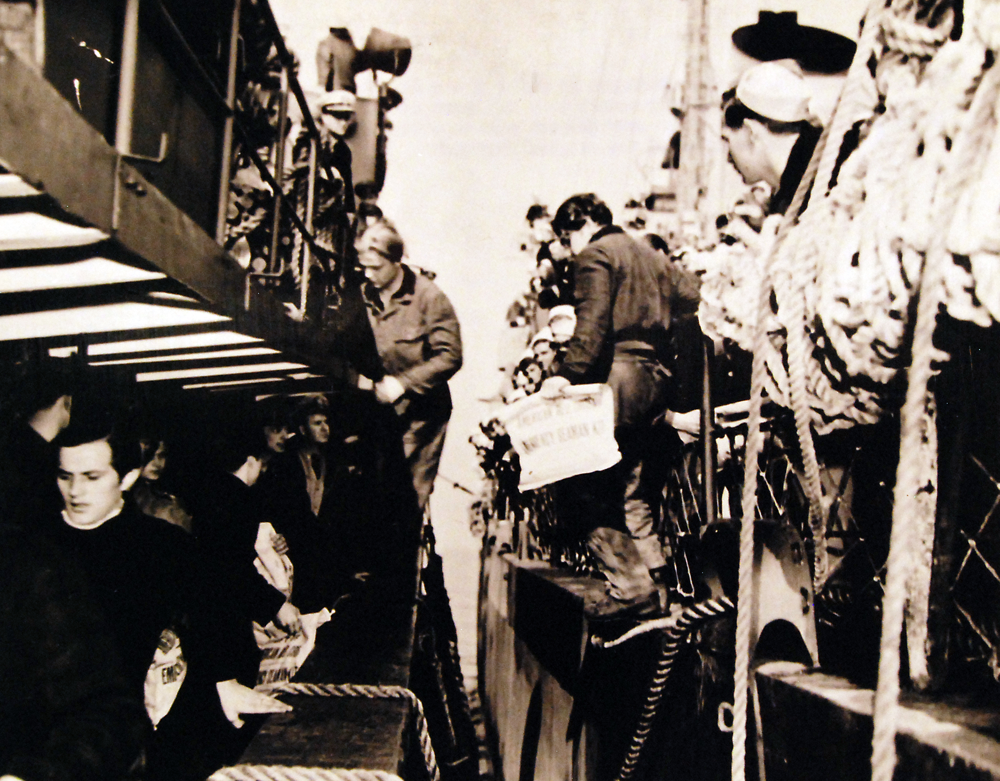
After Germany’s surrender, Fort Miles quickly wound down. The huge coastal guns were declared surplus by 1948 and removed. Yet the post itself did not close completely – a hint that the rifle range’s story wasn’t over yet.

Cold War Training: From Recreation to Reserve Ranges

With the coast artillery mission gone, Fort Miles entered a quieter phase but remained under Army control for decades. In 1961, part of the base became Fort Miles Army Recreation Area, managed by Fort Meade as a seaside rest-and-training center. The federal government started handing over other sections to the new Cape Henlopen State Park (564 acres in 1964 alone), but about 190 acres stayed with the Army for training use. Soldiers and reservists would bring their families to enjoy the beach, even as weekend drills and summer exercises continued on site. Fort Miles’ gentle shoreline proved ideal for amphibious vehicle practice, and local Army Reserve units used the gently sloping beaches for “across-the-beach” landing training. Just inland, the old rifle range waited to be used again.

By the late 1960s and early ’70s, the Army decided to put that range back into action. Plans were made to rehabilitate the 20-position rifle range at Fort Miles so that Delaware-based Army Reserve and National Guard units could conduct their annual rifle qualification there. This would spare local units from traveling to Fort Meade, MD, for target practice. The renovation likely involved rebuilding target butts and clearing the firing lines out to 300 yards. Once refurbished, the Fort Miles range hosted weekend warriors zeroing M14s and later M16s as part of regular training. In fact, a U.S. Army Engineer publication from 1971 noted that reactivating the Fort Miles range would save time and money for Delaware’s Reserve/Guard marksmanship tests.

Throughout the 1970s and 1980s, Fort Miles quietly served as a backwoods training site for Reserve component units. The Delaware Army National Guard’s soldiers would come in to run amphibious drills, practice infantry tactics, and qualify with their service rifles amid the old concrete bunkers. The Army officially categorized Fort Miles as a Morale, Welfare and Recreation (MWR) area, but it was essentially a multi-purpose training annex managed by Fort Meade. During this era, the once-formidable fort slowly faded from public view – parts became a state park campground – yet the crack of rifles could still occasionally echo from the pine forests. Locals may have forgotten the range was there at all.

Desert Storm and the Final Shots

Fort Miles’ long military tenure finally ended in the early 1990s. As part of the post-Cold War base closures, the Army decided to shut down the Fort Miles site completely in 1991. Fittingly, the last official military use of Fort Miles came during Operation Desert Storm. After the Gulf War’s conclusion in 1991, some returning U.S. troops bivouacked at Fort Miles – essentially camping on the old base – for demobilization and homecoming processing. One can imagine those soldiers, fresh from the Arabian Desert, sleeping in tents near the same dunes where GIs had once guarded against Nazi U-boats.

When the Army left for good in 1991, the remaining 96 acres of Fort Miles (including the range area) were transferred to the State of Delaware to be preserved for public recreation. The once-busy rifle range fell silent. No more crack of M16 fire, no more shouted range commands – just the wind in the scrub pines. The earthworks and target pits were left to nature. Over the ensuing years, sand and vegetation slowly began reclaiming the firing lines.

Yet evidence of the range’s final chapter is still out there if you know where to look. On a recent trip into the brush, I discovered several discarded 5.56mm stripper clips on the ground – the kind used to quickly load M16 magazines. Finding these little metal clips was like uncovering artifacts from a modern archeological site. They likely date to the late 1980s or 1990 (the Desert Storm era), confirming that National Guard troops were shooting out here within the last days of Fort Miles’ service. It’s a small but tangible link to the range’s history, bridging the WWII generation and the Gulf War generation on the same soil.

Fort Miles Today: Remnants and Memory

Today, Fort Miles has been reborn as a historical attraction inside Cape Henlopen State Park. The bunkers and gun batteries have been stabilized and opened as the Fort Miles Museum, with exhibits on coastal defense and WWII life. In 2015, volunteers even acquired and installed a massive 16-inch naval gun from the battleship USS Missouri as a centerpiece display – a nod to the fort’s big-gun heritage.

Figure: A rusting 16-inch Mark 7 gun from USS Missouri on display at Fort Miles (2015). Fort Miles’ museum now preserves such artifacts of its coastal defense past, while the old rifle range lies quietly in the surrounding woods.
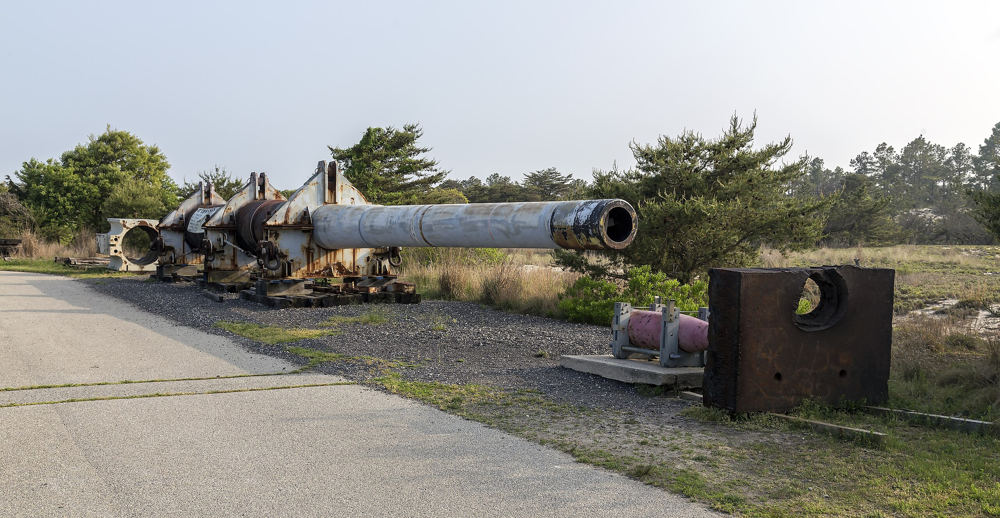
As for the rifle range itself, it remains an unmarked ruin in the woods – a hidden part of the park’s landscape. If you wander off the beaten path near the repurposed barracks area, you might spot the telltale shape of the old earthen berms and concrete target pits. They are largely camouflaged by sand and tangles of vegetation now, but they speak to decades of soldiers firing away at paper targets downrange. There are no signs or tour guides for the range; it’s truly a ghost range, known mainly to local history buffs (and perhaps a few curious hikers who stumble upon an oddly flat clearing backed by a low wall of sand).

In retrospect, the Fort Miles rifle range saw a remarkable span of American military history. Built for WWII riflemen guarding the Delaware coast, repurposed for Cold War reservists during peacetime training, and ultimately used by troops of the Desert Storm era, it quietly mirrored the changes in the U.S. Army over half a century. Now it sits silent, an echo of soldiers past. Next time you visit Cape Henlopen and explore Fort Miles, remember that beyond the big gun displays and towering observation bunkers, a humble rifle range once played its part in keeping America sharp – from the days of M1 Garands to the era of the M16. The targets are gone, the shooters have long since packed up, but the history remains etched in the sand.

Sources: The historical details in this post are drawn from the Fort Miles Museum archives and official records. Key references include the Delaware Public Archives (which note Fort Miles’ extensive WWII facilities and the U-858 surrender), Army Corps of Engineers reports on Fort Miles’ post-war use by Reserve units, and Base Realignment and Closure documents confirming Fort Miles’ 1991 closure after Gulf War service. These sources, along with on-site exploration evidence, paint a comprehensive picture of the rifle range’s life from the 1940s to 1990s. The next time you hear the phrase “if these walls could talk,” think of those mossy bunkers and sand berms at Fort Miles – they’d have some stories indeed, from World War II right up to Desert Storm.

1981 aerial photo Green= pit wall Red = 200 yard firing line Blue = 300 yard firing line

Posted in XTC

What We Have Here Is A Failure to Communicate: Aborted EIC At Camp Perry

Update 7/11/17:

I didn’t post this on Facebook after the June EIC at Perry where the e-targets failed. In service rifle we often talk about owning your bad shot then forgetting about it and moving on. I decided, for the sake of not stirring up drama, it’s best to move on.

However, it has been brought to my attention that the CEO of Civilian Marksmanship Program (CMP) has read my comments on the forum (which I later duplicated into this post) and was downplaying the problems to groups of shooters at the CMP cup. Telling them “oh its just some [a-hole] posting [crap] on the internet”.

I’ll own it, I can be an a-hole sometimes.

But, to paraphrase some of the music from my youth, “I don’t talk shit I state facts,” by sharing my experiences. If I wanted to “talk shit” I’d make jokes about his truck, but that’s not what this blog is for. If Mark thinks me sharing my experiences is the issue, well, we are in for a bumpy ride.

As far as I’m concerned this issue is closed. The targets worked for the CMP cup and the issue has been addressed. Continuing to poke at doesn’t help.

Own it and move on.

Original post:

There’s a couple of things I want to state right off the bat. First, I’m a supporter of e-targets, they help increase participation and when deployed properly work great. Secondly, appreciate all of the support CMP has given to the sport of High Power, I’ve come to know some of the staff over the years and they are all good hard working people who genuinely want to see this sport grow.


Let’s start with the positives, This match was a lot of firsts, it really was historic. It was the first use of e-targets on old Viale range, and first use of CMPs travel targets for an EIC. They had used them before at the Games matches,  most recently at Camp Butner for the Garand and Vintage Sniper Matches.  As an aside back in 2015 at the Western Games I got to see the etargets being piloted.


The match started just a bit late due to some “minor” damage to the targets when they were run up. This took out 5 or so targets on the big end. I don’t mind a little delay especially running on less than a full nights sleep. After that 200 went smoothly, quick relay changes and the targets worked well, I heard no reports of failures.

I was feeling good moving back to 300. Two hundred has historically been make or break for me and felt good about my score. The etargets are nice in rapid especially with an untested zero, the shots pop up right away for quick verification during the mag change.


End of the road at 300

After the line change it became apparent there was a problem. CMP did a nice job keeping us informed. Again the pit crew had ripped the cables out of some of the targets. The targets apparently use some sort of token ring network so they are wired in a series, one goes out the whole block goes out.

We had a vote on if we would stop at 300 or shoot 300 and try to shoot 10 at 600. The vote was keep going in a landslide.

With the remaining 19 targets we soldiered on. Most of the shooters on relay one completed their 300 string. There were a handful of missing shots from where I stood I heard of three shooters getting refires. Relay two wasn’t so lucky, it seemed like most of the shooters had missing shots.

Even after the second time the pit crew ripped the wires out of the targets they were apparently still down there unsupervised as I was told there was no CMP staff in the pits to check the backers for these missing shots.

The rest is history, $10,000 in damage to the targets, no paper targets to finish the match so the match was cancelled. CMP offered refunds or credits to a future match and since we did not complete 300 it did not count against our five EICs. A lot of people left disappointed that day, competitors that had driven hours to shoot there, but also the CMP staff who i’m sure did not want to end the day like that.

See the announcement from CMP Live streamed from the line here.

Steve from CMP made a Mea Culpa here explaining the technical details of what happened.

While CMP’s statement addresses much of this, in 20/20 Hindsight, there were several breakdowns that day.

1. An EIC match shouldn’t be treated as a “dry run” for the new matches. Shooting a match on etargets and being done by noon wasn’t the goal, the goal was to complete match. A goal we failed to meet.

2. CMP openly admits the issue was the training and supervision of the new pit crew. After the crew broke the first set of targets in the morning someone from staff should have been down there supervising the switch over.

3. Always have a back up plan. This was Viale range at Camp Perry, the largest rifle range in the world. A stack of paper targets in the pits ready to go would have let us finish out the match. This is service rifle, No one would have minded pit duty.

Shoulda woulda coulda…. I know.

To be clear I don’t blame the CMP ladies, the folks running the line, the teenagers on the pit crew, or the CMP KTS tech who was working hard to keep us going. This was a leadership failure.  An agenda was being pushed with no regards to the consequences of failure. Frankly, I think it’s time for a change of management.

They are going to try it again for the CMP cup next week. I hope it goes well.


Trying to Pound 7s into 10s and Randomly Spinning Knobs: First XTC matches of the year.

Kicked off the season with three XTC matches over the past 4 weeks.

Bridgeville was first on the schedule. They shoot their first couple matches within 2 weeks of each other at the end of March and beginning of April.  March’s match went well. I shot a solid master score. My streak of consistent off-hand continued, however there was a little “extra wind” in my scope which lead me to discover my garage gunsmithing resulted in a very slight cant in my scope.

So I went back to the garage and fixed it. While its level again it took me the next two matches to square up my no wind zero… and my stubbornness.

Hmm running out of space to the right of the target.

The April match at Bridgeville, I’m not sure I’d call it a trainwreck but it wasn’t pretty. I Let myself get frustrated in off-hand and blew a 6 out the top. Turns out it helps to break the shot in the middle. Shot a 91 in that string including that 6 which is still within what I consider “good.” Of course after I played the “of only I shot a 9 or 10” Lesson learned: shoot happy.

Breezy

Blew all 4 rapid strings out the right. Including a nice tight group spanning the 9 ring in prone.

Went back to the lab again to find that extra window. I convinced myself I found it and was confident my rifle was solid and I was going to get back to fighting strength for the home opener at New Holland.


Stood up on the line confidently and opened with an 8. Long story short I determined it was me and stubbornly wouldn’t touch the knobs. I even put my rifle in the rack and reset twice. One would think I’d notice something is wrong when I visited the 5 ring to say hi.  But instead I just kept trying to hammer those 7s into 10s .

For once I noticed the problem in sitting and brought it back. Even while saving a round in sitting due to some user induced error. 

Once I got on my belly things went well. Shot a 99 – nuffin and clean 5-5 in rapids. Then went back to 600 and posted a 192 which I’m happy with. I’m feeling more comfortable in the wind but I have to work on not letting the spotter interfere with where I put the cross hairs back there.

Lots of matches on the calendar, including 4 days of back to back XTC at the creedmoor cup and a couple reduced matches. Ill think positively for now and say the zero issues are behind me but try not to forget how the knobs work.

When you’re hot you’re hot. When you’re not…

CMP 2017 Rules: Want to start shooting EIC? Buy a new rifle. 

The new rules are up for EIC for 2017. 

Read them here: http://thecmp.org/wp-content/uploads/Rulebook.pdf?ver=01042017

Of note CMP describes the new classifications and match rifles, presumably a shot across the bow of the NRA after their last minute location change of the NRA championships.

Personally, I’m disappointed to see further restrictions placed on handguards. It seems now only quad rails or traditional A2 tubes will be permitted for service rifle.

 Under the old rules it was convenient to invite new shooters to EIC matches where they could “run what they  have” with minimal modifications and cost, A2 grip and a 4x.  It was win win, as they got to try out their gear to see how it held up to XTC and it helped get new people involved in the sport. 

This all might seem trivial however in the “AR community” quad rails are fairly uncommon these days, modular free floats such and Mlok and Keymod are all the rage. 

Under the new rules new shooters will need to find a quad rail or A2 tube, borrow a rifle, build an A4 or shoot out of competition.  Because XTC wasn’t already intimidating enough?

Good news, the A1/A2 grip rule hasn’t changed. So my sticker is still relavent.
http://garandthumb.com/store/service-rifle-rules-compliance-device-keepin-it-cmp-legal-sticker/

Last Stand in Dixie: Last XTC Matches of 2016

Ok,  I suppose Delaware is not technically Dixie but it is south of the Mason-Dixon line and Camp Butner is for sure, so close enough.

To wrap up the 2016 Service Rifle Season GTB shooting team headed to Camp Butner for the NSSC NC Championship and EIC.  The NC Championship was a 1000 agg on Saturday. It was a beautiful summer day. Well, summer for us Yankees I assume, high 70s is what they consider fall in NC. 

During the 1000 agg I cleaned 300 for the first time! 

The rest of the match was fairly lackluster including a hot mess at 600.

The EIC the next day started out soggy off hand. I worked to make a come back but couldn’t quite make it. I ended with a 469 which wasn’t awful but a good 10 points below the cut.


Looking for some redemption the next weekend I drove down to the beach for Bridgeville’s last 800 agg of the season. My new Nightfore service rifle scope had shown up while I was at Camp Butner and this was its first trial. 

The match went well and was a nice end to the season. I posted a decent high end Master score and cleaned sitting for the first time! The new scope worked very well.  I’m looking forward to putting it through its paces next season.


Don’t worry this isn’t really the end of the season, there are still a couple wood gun matches left, maybe some rimfire, and of course hunting season!