Threaded Barrel Desert Eagle .50 AE Review | Can the DE50THR Hand Cannon Really Be Suppressed?

The threaded barrel Desert Eagle finally exists.

Magnum Research’s new DE50THR is a suppressor-ready Desert Eagle Mark XIX chambered in .50 Action Express. It combines a six-inch threaded barrel, specialized gas piston and seven-round magazine with the same enormous gas-operated pistol that has occupied movies, video games and financially irresponsible gun collections for decades.

Yes, a suppressed Desert Eagle .50 AE is absurd.

That is also the entire reason people will want one.

This threaded barrel Desert Eagle review examines the DE50THR specifications, price, suppressor compatibility, barrel-upgrade kit, expected reliability concerns and whether attaching an enormous silencer to a four-pound pistol makes any practical sense.

I have not fired the DE50THR, so I will not invent a round count, imaginary accuracy groups or a conveniently flawless range session.

Desert Eagle DE50THR Specifications

According to the official Magnum Research DE50THR specifications⁠, the suppressor-ready pistol includes:

  • .50 Action Express chambering
  • Six-inch black carbon-steel barrel
  • 49/64-20 muzzle thread
  • Knurled thread protector
  • Specialized L5 gas piston
  • Gas-operated rotating-bolt action
  • Seven-round magazine
  • 10.75-inch overall length
  • 6.25-inch height
  • 1.25-inch slide width
  • Four-pound unloaded weight
  • Fixed combat sights
  • Picatinny-style optics rail
  • Black finish
  • DE50THR model designation
  • $2,041 suggested retail price

Magnum Research also sells the BAR506THR conversion package for existing compatible Mark XIX pistols. The package includes the threaded .50 AE barrel and suppressor-optimized piston with an advertised $618 MSRP. 

The four-pound published weight does not include a loaded magazine, optic or suppressor. Attach the 20-ounce suppressor shown in early promotional coverage and the complete pistol approaches five and a half pounds before ammunition.

At that point, the Desert Eagle stops being a handgun and becomes a crew-served conversation piece.

What Makes the DE50THR Suppressor-Ready?

A threaded muzzle is only half the story.

The Desert Eagle does not operate like a conventional recoil-operated semiautomatic pistol. It uses a gas system and rotating bolt more closely related to a rifle than to a Glock, 1911 or SIG P320.

Adding a suppressor changes the pressure within that system. Magnum Research therefore equips the DE50THR with a specialized L5 piston engineered for suppressed operation.

That is an important distinction for anyone searching for a Desert Eagle threaded barrel conversion. Installing a barrel with muzzle threads does not automatically produce a properly configured suppressed Desert Eagle. The correct gas piston is part of the system.

Magnum Research includes that piston with both the complete DE50THR pistol and the BAR506THR threaded barrel kit.

Which Suppressor Fits the Desert Eagle .50 AE?

The DE50THR uses an uncommon 49/64-20 thread pattern.

That thread is associated with some .50 Beowulf firearms, but it is not the ordinary 1/2-28 or 5/8-24 muzzle thread encountered on most rifles and pistols. Do not assume a suppressor fits because its bore is technically large enough.

A compatible Desert Eagle suppressor must satisfy several requirements:

  • A bore large enough for the .500-inch projectile
  • A pressure and velocity rating appropriate for .50 AE
  • A compatible direct-thread mount or properly engineered adapter
  • Sufficient internal volume for the cartridge
  • Manufacturer approval for the intended firearm and ammunition
  • Enough clearance to avoid contact with the sights, barrel or frame

Magnum Research’s promotional photographs show the DE50THR with a Bowers VERS 50 suppressor. American Rifleman reports that the VERS 50 measures 11.25 inches, weighs approximately 20 ounces and is intended for projectiles of .510 inch or smaller within its published velocity limit. 

That does not make every .50-caliber silencer suitable for the Desert Eagle.

Before attaching anything, confirm the exact suppressor model, ammunition, adapter and thread engagement with both manufacturers. A baffle strike involving an expensive .50-caliber suppressor is not the preferred method of discovering that two parts were only theoretically compatible.

Will a Suppressor Make the Desert Eagle Quiet?

No.

A suppressor should reduce the DE50THR’s muzzle blast and sound signature. It will not produce movie silence, eliminate the mechanical sound of the pistol or make full-power .50 AE ammunition behave like a subsonic .22.

The cartridge normally pushes a heavy projectile at supersonic velocity. A suppressor cannot remove the ballistic crack created after the bullet exceeds the speed of sound.

The value is reduced blast, concussion and sound pressure—not silence.

That reduction can make a powerful firearm more pleasant to shoot, particularly beneath a covered firing line. Appropriate hearing protection remains sensible unless credible testing establishes that a particular suppressor-and-ammunition combination stays below hazardous exposure levels.

Threaded Desert Eagle Barrel Kit for Existing Pistols

The BAR506THR barrel kit may be the more interesting product for current Desert Eagle owners.

The Mark XIX uses an interchangeable-barrel system. Magnum Research says compatible owners can install the six-inch threaded .50 AE barrel and supplied L5 piston rather than buying an entirely new pistol.

At $618, the kit is not cheap. It is still considerably less expensive than the complete $2,041 DE50THR.

Before ordering the Desert Eagle threaded barrel conversion, verify:

  • Your pistol is a compatible Mark XIX
  • The frame and bolt are appropriate for .50 AE
  • The kit includes the required piston
  • Your selected suppressor accepts the 49/64-20 thread
  • Your optic mount will tolerate the additional weight and recoil
  • The configuration remains legal where you live

Magnum Research warns that the barrel’s Picatinny-style optics rail accepts single-slot mounts only. Dual-slot mounts will not fit because of the rail’s slot spacing. That detail could save an owner from buying a large red dot and discovering that the mount possesses roughly the same compatibility as a screen door on a submarine.

DE50THR Reliability and Possible Problems

The most important DE50THR reliability question is whether the specialized piston gives the gas-operated action a sufficient operating window across different suppressors and ammunition.

Magnum Research designed the L5 piston to address suppressed gas pressure, but the pistol is still new. There is not enough independent endurance information to declare every DE50THR reliable with every .50 AE load and every compatible silencer.

Potential threaded Desert Eagle problems to watch include:

Ammunition sensitivity

Desert Eagles have never been famous for happily digesting every cartridge assembled by mankind. Owners should follow Magnum Research’s ammunition guidance and avoid assuming inexpensive or lightly loaded ammunition will produce reliable cycling.

Suppressor alignment

The unusual muzzle thread, large projectile and heavy suppressor make proper alignment critical. Check the shoulder, mount and bore before firing.

Added front weight

A four-pound handgun is already demanding. Adding another 20 ounces beyond the muzzle will change balance, fatigue the shooter and make unsupported firing more difficult.

Carbon and gas-system fouling

Suppressors generally increase fouling. The Desert Eagle’s gas system deserves regular inspection and cleaning, especially when shooting suppressed.

Optic-mount compatibility

The barrel rail accepts single-slot mounts. A heavy optic or incorrect mount can create problems before the first cartridge reaches the chamber.

Expense

The $2,041 pistol is only the beginning. Add a suitable .50-caliber suppressor, transfer expenses, optic, ammunition and additional magazines, and the completed package can easily become a $3,500 proposition.

My article about current suppressor repairs and caliber conversions⁠ explains why owners should understand what manufacturers can legally repair or replace. The suppressor Form 4473 transfer article⁠ covers another portion of the government paperwork surrounding silencers.

The federal government has spent generations treating hearing protection like organized-crime contraband. That remains stupid, regardless of whether the suppressor is attached to a practical home-defense rifle or a gold-plated hand cannon.

Is a Suppressed Desert Eagle Practical?

Mostly no—and that is fine.

The DE50THR is too large for ordinary concealed carry, too heavy for most conventional handgun roles and too expensive to recommend as someone’s first defensive pistol. Adding a suppressor makes it even longer and heavier.

A compact 9mm pistol remains more practical for concealed carry. A suppressed .300 Blackout firearm is generally easier to control for home defense. A conventional hunting handgun is simpler to carry through the woods.

The threaded barrel Desert Eagle offers something those firearms do not: a semiautomatic .50 AE pistol capable of wearing a serious suppressor without requiring an improvised barrel modification.

Private gun ownership does not require every firearm to satisfy a government-approved practical purpose. Americans are allowed to own powerful, unusual and entertaining guns simply because they want them.

Practicality is a consideration—not a prerequisite for freedom.

Is the Threaded Barrel Desert Eagle Worth $2,041?

The DE50THR makes sense for three buyers:

  • A Desert Eagle enthusiast who wants the newest factory configuration
  • A suppressor owner specifically interested in .50 AE
  • Someone seeking the most ridiculous legal handgun available without mounting wheels beneath it

Existing compatible Mark XIX owners should examine the $618 BAR506THR kit first. It provides the threaded barrel and required piston without duplicating the entire pistol.

New buyers receive a complete factory-configured system with matching components and a warranty tied to the actual model. That simplicity may justify the additional expense.

The suppressor remains separate, however, and suitable .50-caliber silencers are neither small nor inexpensive.

Final Verdict

The Magnum Research DE50THR is exactly what a threaded barrel Desert Eagle should be.

It retains the six-inch .50 AE Mark XIX platform, adds a properly threaded barrel and includes a specialized piston intended to keep the gas-operated action functioning with a suppressor attached.

The design is more thoughtful than simply cutting threads into an existing barrel and hoping physics cooperates.

Its weaknesses are equally obvious. The DE50THR is expensive, extremely heavy, dependent on an uncommon muzzle thread and limited to a small selection of appropriate suppressors. Ammunition costs ensure that very few owners will treat it as a high-volume practice pistol.

None of that destroys its appeal.

The suppressed Desert Eagle .50 AE is excessive, impractical and mechanically fascinating. It is a pistol created for people who looked at the standard Desert Eagle and concluded that it needed another pound hanging from the muzzle.

Those people were correct.

GarandThumb.com was established on May 4, 2012, to document my experiences trying to become a better marksman.
Posted in XTC

ATF Called After a Delayed NICS Check | New NICS Alert Policy Explained

If the ATF called after a delayed NICS check, do not assume a routine background-check delay automatically placed you under federal surveillance.

On October 2, 2026, ATF published an updated NICS Alert Policy⁠ explaining how agents may monitor firearm-purchase activity connected to an existing federal investigation. The new policy automates requests through ATF’s Case Management System and establishes different approval requirements depending on how long an alert will remain active. 

A NICS alert is not the same thing as an ordinary delayed background check, a denied firearm purchase or a delayed denial after a dealer has transferred the gun.

Those distinctions matter—especially when somebody receives an unexpected telephone call from an ATF agent.

What Is an ATF NICS Alert?

An ATF NICS alert is an investigative notification associated with a person already suspected of violating federal firearm law.

According to the October 2 memorandum, agents may use NICS alerts only in investigations involving suspected federal firearm offenses. The agency specifically says they should not be used primarily to investigate state firearm laws.

The alert can notify investigators when the subject attempts a firearm transaction requiring a National Instant Criminal Background Check System inquiry.

ATF requires the requesting agent to provide details including:

  • The suspected federal violation
  • Dates of suspicious firearm purchases
  • The number of firearms involved
  • Crime-gun trace results
  • Statements allegedly made to an FFL or witnesses
  • Previous NICS alerts and their results
  • Possible straw purchasers or co-conspirators
  • Pending grand-jury, indictment or U.S. attorney activity

That is not the description of an innocent buyer whose background check took an extra afternoon because a county courthouse never digitized a 20-year-old case disposition.

It describes an investigative tool aimed at an identified subject.

What Changed in the 2026 NICS Alert Policy?

The October 2026 ATF memo does not create NICS alerts. It changes how agents request, renew and withdraw them.

Agents must now use ATF’s Case Management System for:

  • Initiating a NICS alert
  • Renewing an existing alert
  • Withdrawing a pending or active alert
  • Recording days previously monitored outside the automated system

Requests lasting 180 days or less proceed through the agent’s chain of command to a deputy assistant director for final approval. Longer requests receive additional review from ATF’s Office of Chief Counsel, assistant director for field operations and deputy director.

The FBI and ATF also established that alerts expire automatically unless an extension is approved.

That additional documentation and automatic expiration are better than an unaccountable system in which an agent could quietly monitor firearm purchases forever. It remains government surveillance of constitutionally protected activity, and gun owners are entitled to demand strict limits, real oversight and consequences for abuse.

Delayed NICS Check vs. NICS Alert

A delayed NICS check usually means the system found a potentially matching record that requires additional research.

Common causes can include:

  • An arrest record missing its final disposition
  • Similar identifying information belonging to another person
  • A misdemeanor requiring additional legal classification
  • Incomplete court records
  • Immigration or citizenship information requiring verification
  • Records that were entered incorrectly
  • A prior charge reduced or dismissed without the databases being updated

A delay does not mean the buyer is prohibited, guilty or under investigation.

The FBI can return three basic responses to a dealer: proceed, deny or delay. A proceed permits the transfer subject to other applicable laws. A denial prohibits the dealer from completing it. A delay means additional research is required.

For an ordinary buyer who is at least 21, federal regulations generally allow an FFL to transfer the firearm after three business days have elapsed without a denial. The dealer is permitted—not required—to complete that transfer. State law can impose a longer waiting period or additional restrictions. Buyers under 21 can face an additional investigatory period lasting up to ten business days. 

A gun store may therefore refuse to transfer a firearm without an affirmative proceed response even when federal law would permit the transfer.

That is store policy, not proof the customer committed a crime.

What Is a “Delay Then Deny” Firearm Transaction?

A delay-then-deny occurs when an FFL legally transfers a firearm after the waiting period, but NICS later determines that the buyer is prohibited.

The FBI may then ask whether the dealer completed the transfer. If the gun was transferred, the matter can be referred to ATF as a firearm-retrieval case.

That process is separate from a targeted NICS alert.

A delayed denial can result from a genuine legal prohibition. It can also result from an incomplete, inaccurate or misidentified record. Government databases occasionally contain government-quality data, which is a polite way of saying the bureaucracy can incorrectly label a lawful citizen while maintaining complete confidence in itself.

If an agent says a firearm purchase was later denied, ask for the NICS Transaction Number and enough information to identify the transaction. A person who believes the denial is wrong can use the FBI’s firearm-related challenge process.

Do not invent an explanation, guess about old charges or make casual statements merely because an agent sounds friendly.

What Should You Do If the ATF Calls About a Gun Purchase?

First, verify who is calling.

Scammers can impersonate federal agents, gun dealers and law-enforcement officers. Obtain the caller’s name, office, telephone number and case information. Independently locate the field office’s published number before calling back.

Second, determine what the agent actually wants.

An ATF telephone call might concern:

  • A delayed denial and possible retrieval
  • A firearm stolen from a dealer
  • A gun recovered during an investigation
  • A suspected straw purchase
  • Questions about multiple firearm purchases
  • An incorrect criminal-history record
  • A transaction involving another person
  • An active investigation supported by a NICS alert

Do not assume these situations are legally identical.

Third, understand that a telephone call is not a search warrant. A citizen can decline an interview and obtain an attorney before answering investigative questions. Never lie to a federal agent, destroy records, hide property or transfer a firearm to frustrate an investigation.

If the government claims you are prohibited from possessing firearms, treat that as a serious legal issue rather than an opportunity to improvise constitutional law over speakerphone.

Can a Wrongful NICS Denial Be Fixed?

Yes, although the government’s mistake may require the citizen to spend time proving that he is not somebody else.

The FBI’s firearm-related challenge process allows a denied buyer to contest the decision. The buyer will generally need the transaction number supplied through the dealer and may need court records or other documentation resolving the potentially prohibiting record.

People repeatedly delayed or confused with another individual can consider the FBI Voluntary Appeal File and Unique Personal Identification Number process.

A UPIN does not exempt the purchaser from Form 4473 or NICS. It helps reviewers distinguish the buyer from similar or incomplete records.

The same background-check distinctions matter for newer transaction questions. My article about suppressor Form 4473 transfers⁠ explains why avoiding a traditional Form 4 does not eliminate the ordinary Gun Control Act background check. My explanation of handgun sales to adults aged 18 through 20⁠ covers the separate age-related legal changes and dealer concerns.

Does the New Policy Protect Gun Owners?

It adds internal approval, documentation and expiration requirements. Those are worthwhile restraints.

It does not eliminate the underlying concern.

Buying a lawful firearm is an exercise of a constitutional right. It should not create an open-ended government tracking file merely because an agent finds somebody interesting. ATF’s own memorandum recognizes that NICS alerts must relate to suspected federal firearm violations and cannot serve primarily as tools for enforcing whatever new restriction a hostile state invented last Tuesday.

The government should investigate actual crimes using evidence and constitutional procedures. It should not treat ordinary firearm ownership as probable cause wearing hearing protection.

Final Verdict

An ATF NICS alert, a delayed NICS check and a delayed denial are three different things.

A routine delay means the system needs more information. A denial means NICS determined that the transaction cannot legally proceed. A delayed denial can produce an ATF retrieval referral if the dealer already transferred the firearm.

A NICS alert is a targeted investigative tool intended to notify agents about firearm-purchase activity connected to a suspected federal firearm offense.

The October 2, 2026 policy adds automated requests, supervisory review, duration limits and automatic expiration. Those controls are better than limitless informal monitoring, but gun owners should remain skeptical whenever the government tracks the exercise of a constitutional right.

If the ATF called after a delayed NICS check, verify the caller, identify the transaction, obtain the NICS number and do not guess your way through an unexpected federal interview.

A database error can be corrected.

An unnecessary statement to a federal investigator cannot be unsaid.

GarandThumb.com was established on May 4, 2012, to document my experiences trying to become a better marksman.
Posted in XTC

SIG P385 Review | Is SIG’s New Modular Pistol Replacing the P320?

The SIG P385 is a new modular 9mm pistol built around a removable fire-control unit, low bore axis, recoil-dampening system and interchangeable MagStrap grip. It accepts SIG P320 magazines, but it is not a renamed P320 and does not use the P320 fire-control unit.

SIG announced the P385 on September 22, 2026, with five configurations: P385 Carry, Compact, Full, Comp and MACH3D. Prices start around $599, and the first pistols are expected in stores during fall and early winter 2026.

Is the SIG P385 replacing the P320? SIG says no. Realistically, however, the P385 looks like the company’s attempt to retain the P320’s modularity and magazine supply while building a lower, flatter-shooting pistol around an entirely new internal architecture.

This SIG P385 review examines the specifications, price, release date, magazine and optic compatibility, concealed-carry potential, differences from the P320 and the problems buyers should watch as production pistols reach customers.

What Is the SIG P385?

The official SIG P385 announcement⁠ describes a striker-fired 9mm pistol developed from the ground up.

Its major features include:

  • New serialized fire-control unit
  • Low bore axis
  • SIG Recoil Dampening System
  • Carbon-steel barrel
  • MagStrap adjustable grip system
  • ReActive grip texture
  • Trigger Block safety system
  • Fully ambidextrous controls
  • SIG-LOC Pro optics interface
  • Optional manual thumb safety
  • P320 magazine compatibility
  • Black and coyote-brown finishes
  • Five full-size, carry, compact and compensated models

SIG claims the low bore axis and recoil system reduce muzzle rise by at least 20 percent, depending on the model. The MACH3D compensator is claimed to reduce muzzle rise by more than 30 percent.

Those remain manufacturer figures. The pistol is too new for meaningful independent endurance data, and nobody outside SIG has yet fired enough ammunition through enough production guns to declare every P385 reliable, durable and perfected by divine intervention.

SIG P385 Models and Specifications

The five SIG P385 models share the same basic FCU and operating system but differ in barrel length, grip length, capacity and compensation.

SIG P385 Carry

The P385 Carry is the basic general-purpose model.

It uses a four-inch barrel, full-length MagStrap grip and SIG-LOC Pro optics-ready slide. It ships with one 17-round magazine and one 21-round magazine where legal.

Early listings place the P385 Carry at approximately $599 street price with a reported $679.99 suggested retail price.

This is likely to become the volume seller. Its size places it against the Glock 19X, Glock 45, SIG P320 Carry and other compact-slide pistols with full firing grips.

SIG P385 Compact

The P385 Compact combines the four-inch upper assembly with a shorter MagStrap grip and two 15-round magazines.

That shorter grip should make it the most practical SIG P385 concealed-carry pistol because the grip is usually the part most likely to print beneath clothing.

The Compact is not a micro-compact competitor to the P365. It is closer to a conventional compact duty pistol intended to balance concealment, capacity and shootability.

SIG P385 Full

The full-size P385 uses a 4.7-inch barrel and ships with one 17-round and one 21-round magazine.

The longer barrel and sight radius make it the obvious duty, home-defense and competition-oriented version for buyers who do not need the shorter Carry slide.

SIG P385 Comp

The P385 Comp uses a four-inch barrel and an integrally compensated slide. It includes one 17-round and two 21-round magazines.

Early dealer pricing places it around $750, although actual price and availability will vary as the pistol enters distribution.

The Comp should reduce muzzle movement without attaching a separate compensator to the barrel. That also avoids some of the thread-locking, timing and maintenance complications associated with an aftermarket compensator.

SIG P385 MACH3D

The P385 MACH3D is the flagship compensated model.

It uses SIG’s additively manufactured MACH3D compensator and is expected near the end of 2026. SIG claims greater than 30-percent muzzle-rise reduction.

The MACH3D includes one 17-round and two 21-round magazines. It will be the most expensive and visually aggressive P385, because apparently a modern pistol cannot become the flagship until it has acquired several additional openings near the muzzle.

SIG P385 vs. P320

The SIG P385 and P320 are related by concept and magazine compatibility, but they are different pistol platforms.

The P385 does not use a P320 fire-control unit. SIG designed a new serialized FCU around the P385’s lower bore axis, recoil-dampening system and Trigger Block mechanism.

Important SIG P385 vs. P320 differences include:

  • The P385 has a new FCU.
  • The P385 places the bore axis lower relative to the shooter’s hand.
  • The P385 uses the MagStrap grip system.
  • The P385 incorporates SIG’s new Trigger Block safety.
  • P320 grip modules, slides and barrels do not fit the P385.
  • P320 holsters should not be assumed to fit.
  • Many P320 magazines remain compatible.
  • The P385 uses SIG-LOC Pro optics mounting.

SIG says the P320 will remain in production. The P320 family still includes the military M17 and M18, numerous civilian models and an enormous established accessory market.

My examination of the Army M17 and M18 safety report⁠ explains what the military’s testing proves about those pistols—and what it does not prove about every civilian P320 ever manufactured.

The P385 is therefore not an official P320 replacement. It is more accurately the next modular SIG duty-pistol platform.

That distinction may become academic if buyers, police departments and accessory companies gradually move toward the newer design.

Will P320 Magazines Fit the P385?

Yes, the SIG P385 accepts P320 magazines, but basepad configuration matters.

SIG’s P385 compatibility information⁠ states that P320 magazines can be used in the new pistol. Older P320 magazines with rounded basepads may require removal of the P385’s metal magazine well or installation of a compatible basepad.

That is considerably better than launching another pistol with a completely new and initially scarce magazine.

P320 owners may already possess 15-, 17- and 21-round magazines suitable for the corresponding P385 grip length. Buyers should still confirm that each magazine seats, locks, feeds and drops free in their exact pistol before relying upon it.

“Compatible” does not mean “throw twenty old magazines into a range bag without inspection and declare the logistics problem solved.”

What Optics Fit the SIG P385?

Every P385 uses SIG’s SIG-LOC Pro mounting system.

SIG-LOC mounts the optic from beneath the slide instead of using conventional screws passing downward through the optic body. The system is designed to lower the sight and mechanically secure it against recoil.

SIG says the SIG-LOC Pro interface supports its new XRAY5 SIG-LOC optic. The company’s published material also describes support for appropriate RMR- and DeltaPoint Pro-footprint sights, although buyers should verify the required fasteners and exact model compatibility before ordering.

The SIG XRAY5⁠ is a particularly unusual companion optic. Instead of mechanically moving an emitter to establish zero, it uses a fixed 225-dot matrix and digital adjustment. It stores multiple zero profiles, tracks rounds and automatically responds to changing light.

SIG lists the XRAY5 SIG-LOC Pro at $599.99. That means the optic can cost approximately as much as the base pistol, because apparently adjusting a red dot with two ordinary screws had become insufficiently technological.

How Does the MagStrap Grip Work?

The P385 MagStrap changes grip circumference and, depending on configuration, grip length without requiring replacement of the entire grip module.

That differs from a conventional removable backstrap, which normally changes only the rear contour of the grip.

The system should allow shooters to fit different hand sizes while preserving the main frame assembly, accessory rail and fire-control housing. SIG pairs it with its ReActive texture, intended to provide a secure grip without becoming excessively abrasive during concealed carry.

The Compact uses a shorter MagStrap and 15-round magazines. The Carry, Full and compensated models use the longer grip with 17- and 21-round magazines.

This is clever modularity if the straps remain tight and readily available. It becomes irritating modularity if replacement sizes cost too much or disappear from dealer shelves.

Is the SIG P385 Good for Concealed Carry?

The P385 Compact is the best concealed-carry candidate, followed by the Carry.

The Compact’s shorter grip should conceal more easily, while its four-inch barrel remains long enough for ordinary defensive ammunition and comfortable holster stability.

The Carry provides greater capacity and a full firing grip but will print more easily beneath light clothing.

Buyers will need P385-specific holsters. A similar overall shape does not make a P320, P365 or Glock holster safe. Proper retention and complete trigger-guard coverage matter more than a holster manufacturer’s optimistic compatibility chart.

Before carrying any new P385:

  • Confirm reliable operation with defensive ammunition.
  • Test every carry magazine.
  • Verify that the holster completely protects the trigger.
  • Check optic and accessory screws.
  • Practice drawing and reholstering with an unloaded pistol.
  • Confirm that the MagStrap remains secure.
  • Inspect the compensator for fouling on compensated models.

Private handgun ownership matters because an attack rarely waits for police to establish a convenient response time. A new mechanical system does not change the fundamentals: the pistol must be reliable, safely carried and used by somebody competent enough to place accurate shots under pressure.

SIG P385 Problems to Watch

No established pattern of SIG P385 problems currently exists because production guns are only beginning to enter the market.

Potential concerns worth monitoring include:

  • Early-production FCU tolerances
  • Trigger Block durability and feel
  • MagStrap movement or wear
  • Compatibility with older P320 magazine basepads
  • SIG-LOC optic availability
  • P385 holster availability
  • Compensator fouling
  • Reliability with weak practice ammunition
  • Parts and grip-component availability
  • Actual recoil reduction compared with SIG’s claims

These are questions, not documented defects.

Anyone publishing a definitive 5,000-round SIG P385 reliability verdict before ordinary customers can obtain the pistol is probably testing the endurance of his imagination.

A serious evaluation needs multiple production pistols, varied ammunition, drop-safe handling, accuracy testing and enough firing to expose wear or tolerance problems.

SIG P385 vs. FN 309 MRD

The P385 will also compete with newer compact pistols such as the FN 309 MRD.

My FN 309 MRD review⁠ covers FN’s internal-hammer pistol, optics-ready slide, 16-round magazine and $549 suggested retail price.

The FN is the simpler and slightly cheaper proposition. The P385 offers a removable FCU, broader family of configurations, P320 magazine compatibility, adjustable MagStrap system and compensated factory models.

The better choice depends on whether the buyer values simplicity or intends to use the P385’s modular ecosystem.

SIG P385 Price and Release Date

SIG says the P385 begins reaching stores during fall and early winter 2026.

Pricing starts around $599. Early listings place the standard Carry near $599 and the compensated model near $750. The Full, Compact and MACH3D prices may vary as they enter full distribution.

The P385 MACH3D is expected toward the end of 2026.

Initial dealer prices may be inflated by availability. Paying a launch-week premium for an unproven black polymer pistol is voluntary taxation imposed by impatience.

Unless somebody needs the pistol immediately, waiting for broader inventory, replacement MagStraps, holsters and independent reliability information is sensible.

Final Verdict

The SIG P385 is more significant than another cosmetic P320 variation.

SIG retained the useful parts of the P320 ecosystem—especially its magazines and removable serialized chassis concept—while developing a new FCU, lower bore axis, recoil system, grip-adjustment method and trigger safety.

The $599 starting price is aggressive. The five-model lineup covers concealed carry, duty use, home defense and competition without requiring buyers to wait years for obvious variants.

The P385 does not officially replace the P320. It does, however, look like the pistol SIG would design after studying everything buyers liked, disliked and argued about concerning the P320.

The Carry will probably be the best general-purpose model. The Compact makes the most sense for concealed carry. The Comp offers the clearest performance upgrade, while the MACH3D is for shooters who want maximum muzzle control and minimum financial restraint.

The hardware is promising.

Now the P385 must survive the less accommodating portion of product development: ordinary gun owners, ordinary ammunition and thousands of rounds outside SIG’s controlled demonstrations.

GarandThumb.com was established on May 4, 2012, to document my experiences trying to become a better marksman.

Posted in XTC

Beretta A400 Solo Review | Is the $1,649 One-Gun Hunting Shotgun Worth It?

The Beretta A400 Solo is a new 12-gauge semiautomatic hunting shotgun intended to occupy the large financial gap between the affordable A300 Ultima and Beretta’s expensive A400 Xtreme Plus and AX800 Suprema.

Prices start at $1,549 for the black synthetic A400 Solo and $1,649 for camouflage models. That is serious money, but the Solo includes Beretta’s B-Link Pro gas system, Kick-Off Plus recoil reduction, Steelium barrel, enlarged loading port, oversized controls and an optics-ready aluminum receiver.

This Beretta A400 Solo review examines the specifications, price, recoil system, choke compatibility, expected reliability and comparisons shoppers are making now: A400 Solo vs. A300 Ultima, A400 Solo vs. A400 Xtreme Plus and A400 Solo vs. Benelli M2.

I have not personally completed a long-term A400 Solo endurance test. The conclusions below are based on Beretta’s published specifications and documented independent testing—not an imaginary pallet of shells and a heroic duck hunt that never happened.

Beretta A400 Solo Specifications

The official Beretta A400 Solo specifications⁠ describe a 12-gauge, gas-operated semiautomatic shotgun with a three-inch chamber.

Available configurations include:

  • 12-gauge chambering
  • Three-inch chamber
  • 26-, 28- and 30-inch barrels
  • B-Link Pro gas-operated action
  • Aluminum optics-ready receiver
  • Kick-Off Plus recoil-reduction system
  • Steelium cold-hammer-forged barrel
  • 80mm double progressive forcing cone
  • OptimaChoke HP extended choke tubes
  • Enlarged loading port
  • Competition-style shell lifter
  • Oversized operating controls
  • Reversible cross-bolt safety
  • Adjustable stock shims and spacers
  • B-Lok tool-free magazine cap
  • Black synthetic or multiple camouflage finishes
  • $1,549 starting MSRP
  • $1,649 MSRP for camouflage models

An independently measured 28-inch A400 Solo weighed 7.7 pounds, measured 50 inches overall and had an adjustable 14.37-inch length of pull. Its trigger reportedly measured approximately 3.5 pounds.

Those dimensions place the A400 Solo firmly in the general-purpose hunting-shotgun category. It is not an especially light upland gun, but that additional weight and gas operation should help control recoil during long clay sessions and high-volume waterfowl hunting.

What Is the Beretta A400 Solo?

“Solo” means alone or only in Italian. Beretta is pitching this as the one shotgun a hunter could use for nearly everything.

That claim explains the combination of features. The Solo is meant to handle light target ammunition, turkey loads, pheasant hunting, duck hunting, goose hunting and ordinary sporting-clays use without becoming excessively specialized for any one job.

It is also a more practical proposition than buying a separate expensive shotgun for every bird that happens to have different feathers.

The three-inch chamber handles the ammunition most American hunters actually need. It will not accept 3½-inch 12-gauge shells, which immediately distinguishes it from the A400 Xtreme Plus.

That limitation will bother dedicated goose hunters who insist upon firing the longest available shell. Everyone else should ask whether they genuinely need 3½-inch ammunition or merely enjoy paying more money to be kicked harder.

B-Link Pro Gas System and A400 Solo Reliability

The new B-Link Pro gas system is the mechanical heart of the A400 Solo.

Beretta claims it cycles as much as 36 percent faster than competing semiautomatic shotguns and produces 46 percent less fouling than its previous designs. The redesigned gas ports and treated piston are supposed to let the shotgun function with everything from light target ammunition to heavy magnum hunting loads.

Those are manufacturer claims, and “36 percent faster” is less important to most hunters than boring, dependable operation.

No duck has ever complained that the bolt closed several milliseconds too slowly. Hunters care whether the shotgun cycles after exposure to cold rain, marsh mud, unburned powder and the sort of neglect that begins with “I’ll clean it tomorrow.”

Gas-operated shotguns generally require more cleaning than inertia-operated designs, although a properly engineered gas system offers softer recoil and broad ammunition compatibility. Beretta’s simplified B-Lok magazine cap allows the fore-end and barrel assembly to be removed after approximately a 60-degree turn, making routine A400 Solo cleaning less irritating.

The Beretta semiautomatic-shotgun manual⁠ specifically warns owners not to disassemble the valve spring or retaining nut. The valve assembly is described as self-cleaning. This is one of those unusual occasions when leaving a gun part alone is a legitimate maintenance procedure rather than laziness.

Does the A400 Solo Have Less Recoil?

Beretta says the Kick-Off Plus system can reduce felt recoil by as much as 40 percent.

Three elastomer shock absorbers work with the B-Steady stock arrangement to reduce the initial recoil impulse, secondary movement, muzzle rise and vibration. The B-Steady design separates portions of the stock so the cheekpiece remains more stable against the shooter’s face.

That should make the Beretta A400 Solo attractive to recoil-sensitive hunters, high-volume clay shooters and anybody who has spent an afternoon discovering that magnum waterfowl ammunition can tenderize a shoulder more efficiently than a government committee can ruin a simple rule.

A manufacturer’s percentage cannot tell you exactly how the shotgun will feel. Stock fit, body position, ammunition, gun weight and shooting technique all affect perceived recoil.

The important conclusion is simpler: a 7.7-pound gas-operated shotgun with Kick-Off Plus should be substantially more comfortable than a lightweight fixed-breech gun firing the same ammunition.

Beretta A400 Solo Barrel and Choke Compatibility

The Solo uses a cold-hammer-forged Steelium barrel with an 80mm forcing cone.

A longer forcing cone allows the shot charge to transition more gradually from the chamber into the bore. In theory, that can reduce pellet deformation, moderate recoil and produce more consistent patterns.

The A400 Solo accepts Beretta OptimaChoke HP tubes. Beretta supplies extended Cylinder, Modified and Full chokes with the shotgun. OptimaChoke HP tubes are made for Steelium barrels and are compatible with steel shot when the particular choke constriction and ammunition combination permit it.

Do not assume that every older Beretta choke tube fits because the name on the receiver is the same. Mobilchoke, Optima-Choke, OptimaChoke HP and OptimaChoke HP extended tubes are not terms to casually interchange.

Pattern the actual shotgun with the actual hunting load.

A $1,649 shotgun cannot determine which shell places enough pellets in the vital area at forty yards. A cardboard patterning board remains brutally indifferent to the price printed on the receipt.

Beretta A400 Solo vs. A300 Ultima

The A300 Ultima remains the logical value choice for somebody who wants a dependable Beretta semiautomatic shotgun without paying A400 money.

The A400 Solo adds the newer B-Link Pro system, Steelium barrel, optics-ready receiver, enlarged loading port, competition lifter, semi-flat trigger, shorter reset and more sophisticated stock and recoil-management features.

The question is not whether the A400 Solo is mechanically more advanced. It is.

The question is whether those improvements justify several hundred additional dollars for your hunting.

Choose the A300 Ultima if price matters most and you need a straightforward hunting shotgun. Consider the A400 Solo if you shoot frequently, value reduced recoil, want an optic-ready receiver or expect the shotgun to serve as your primary waterfowl, turkey, upland and clay gun for years.

Beretta A400 Solo vs. A400 Xtreme Plus

The A400 Xtreme Plus is the better specialized waterfowl shotgun when a 3½-inch chamber is mandatory.

Beretta’s comparison shows several important differences:

  • The A400 Solo has a three-inch chamber; the Xtreme Plus accepts 3½-inch shells.
  • The Solo uses B-Link Pro; the Xtreme Plus uses B-Link Plus.
  • The Solo claims 40-percent recoil reduction; the Xtreme Plus claims as much as 70 percent.
  • The Solo uses an 80mm Steelium forcing cone; the Xtreme Plus uses a 320mm Steelium Plus design.
  • Both use aluminum receivers and synthetic stocks.

The A400 Xtreme Plus offers greater magnum capability and more aggressive recoil management. It also costs more and provides features many hunters will never need.

For ordinary duck hunting, pheasant, turkey and sporting clays, the Solo is probably the more rational purchase. For a hunter who regularly fires 3½-inch goose loads in miserable conditions, the Xtreme Plus retains a real advantage.

Beretta A400 Solo vs. Benelli M2

The Benelli M2 uses an inertia-driven action rather than a gas system.

The M2 is lighter, mechanically simple and widely respected for field reliability. It also transfers more recoil to the shooter because its action does not use propellant gas and a piston to spread the impulse.

The A400 Solo weighs more but offers an optics-ready receiver, aggressive recoil reduction and a gas system intended to function with a wide range of loads.

Choose the Benelli M2 if low weight, simplicity and an inertia action are the priorities. Choose the A400 Solo if comfort, softer recoil, adjustable fit and Beretta’s barrel and gas-system features matter more.

Neither shotgun can compensate for poor fit. Shoulder both before spending the money.

Is the A400 Solo Optics Ready?

Yes. The aluminum receiver is drilled and tapped for mounting an optic.

That feature matters most for turkey hunters using tight chokes and modern tungsten loads. A red-dot sight makes it easier to maintain a precise aiming point and exposes a poorly fitted shotgun that does not place its pattern where the shooter naturally looks.

The receiver is optics ready; it does not mean every red-dot sight attaches directly. Buyers still need the correct Beretta A400 optic mount or receiver base, suitable rings or an appropriate shotgun red-dot mounting system.

Reported Beretta A400 Solo Problems

The A400 Solo is too new for meaningful long-term problem data.

Questions currently surrounding the shotgun include light-load cycling, gas-system fouling, Kick-Off component durability, optic-mount compatibility, availability of replacement parts and whether the enlarged loading controls snag on gloves or vegetation.

Those are reasonable subjects to monitor. They are not verified defects merely because somebody typed “Beretta A400 Solo problems” into a discussion title.

Any new owner should inspect the shotgun, clean away shipping preservative, lubricate it according to the manual and confirm operation with several ammunition types before depending on it during a hunt.

Changing shells on opening morning because the cheapest promotional target load will not cycle is an avoidable form of field research.

Is the Beretta A400 Solo Worth $1,649?

The A400 Solo makes the most sense for a hunter who wants one premium semiautomatic shotgun instead of several specialized guns.

It combines the useful features of an expensive waterfowl shotgun with the three-inch chamber, adjustable fit and manageable weight of a versatile field gun. Independent evaluators have already placed it among the strongest mid-priced semiautomatic shotguns of 2026.

The A400 Solo independent test summary⁠ praised its recoil control, handling, gas system and value while listing a 7.7-pound weight and $1,649 camouflage-model MSRP.

That does not make it cheap.

For comparison, the recently reviewed Ruger Red Label III⁠ costs considerably more and offers the completely different handling and mechanical simplicity of a 20-gauge over-under. Hunters selecting a deer cartridge instead of a shotgun can also see my comparison of the 350 Legend, 400 Legend and 450 Bushmaster⁠.

For a dedicated upland hunter, the Solo may be heavier than necessary. For somebody who only shoots a few boxes of shells annually, the A300 Ultima is likely enough shotgun.

For the hunter seeking a soft-shooting, optics-ready, three-inch 12-gauge for waterfowl, turkey, upland birds and clays, the A400 Solo may be the most sensible gun in Beretta’s current premium lineup.

Final Verdict

The Beretta A400 Solo appears to be a well-judged hunting shotgun rather than an exercise in attaching expensive names to ordinary parts.

The B-Link Pro gas action, Kick-Off Plus recoil system, Steelium barrel, OptimaChoke HP compatibility, optics-ready receiver and adjustable stock all serve practical purposes. The absence of a 3½-inch chamber is a limitation, but it also prevents the Solo from becoming heavier and more specialized than most hunters need.

The A300 Ultima remains the budget-conscious choice. The A400 Xtreme Plus remains the heavy-magnum waterfowl choice.

The A400 Solo occupies the useful ground between them.

At $1,549 to $1,649, it needs to deliver genuine reliability, good patterns and durable recoil-system components. Early information suggests it can. Long-term owner reports will decide whether “one shotgun for everything” is an accurate description or merely another slogan that survived until hunting season.

GarandThumb.com was established on May 4, 2012, to document my experiences trying to become a better marksman.

Posted in XTC

New Taurus Judge Review | 2026 .410 and .45 Colt Range Report

The new Taurus Judge remains the strangest successful revolver in America.

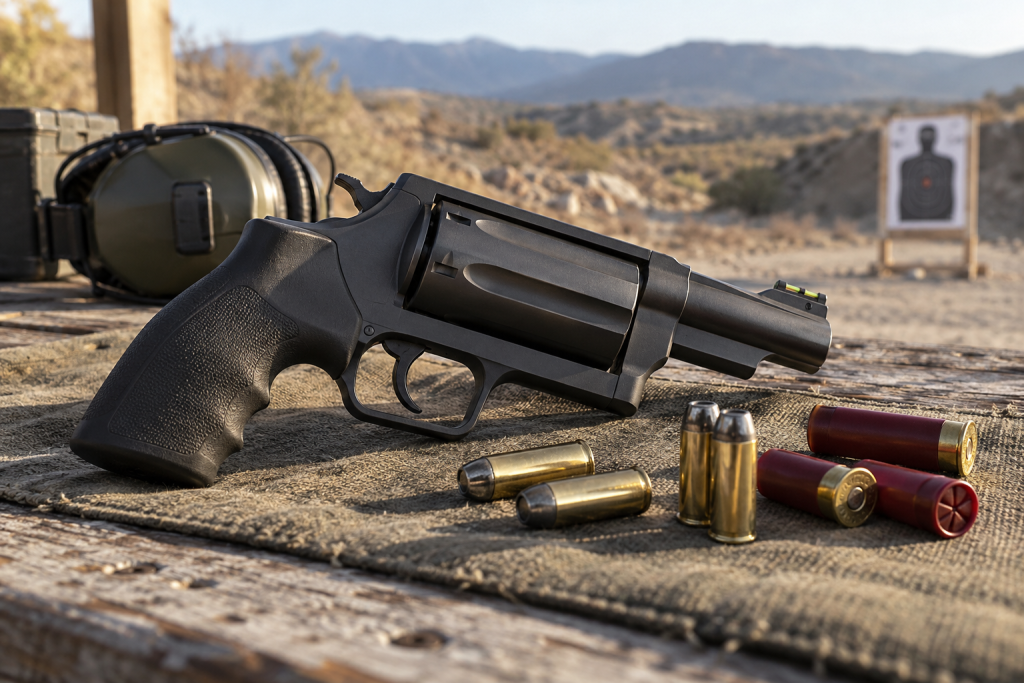
It holds five rounds, fires both .45 Colt cartridges and .410 shotshells, and looks like a conventional revolver that swallowed a length of pipe. For 2026, Taurus redesigned the Judge with better sights, revised controls, an improved trigger and two barrel lengths.

Those changes address legitimate weaknesses in the older gun. They do not transform a short-barreled .410 revolver into a twelve-gauge shotgun, a match pistol or the Hammer of Thor.

For this fictional new Taurus Judge range review, I imagined firing 125 rounds through the three-inch model:

  • 50 rounds of standard-pressure .45 Colt ammunition
  • 25 rounds of .45 Colt defensive ammunition
  • 20 Federal .410 000-buckshot shells
  • 15 Winchester PDX1 Defender shells
  • 15 conventional .410 birdshot shells

The imaginary revolver completed the session without a mechanical failure. More importantly, the fictional targets illustrate what prospective buyers need to understand: the 2026 Taurus Judge can be useful, but ammunition selection and distance matter enormously.

What Changed on the New Taurus Judge for 2026?

According to the official Taurus Judge model page⁠, the redesigned revolver is available in four principal configurations:

  • Three-inch barrel with black finish
  • Three-inch barrel with duo-tone finish
  • 6.5-inch barrel with black finish
  • 6.5-inch barrel with duo-tone finish

Every version uses a five-round cylinder chambered for .45 Colt and .410-bore shotshells.

The 2026 American Rifleman examination⁠ identifies the most important mechanical and ergonomic changes:

  • Squared trigger guard
  • Flatter, more angular trigger shoe
  • Dovetailed rear sight
  • Bright fiber-optic front sight
  • Redesigned cylinder-release latch
  • Revised grip shape
  • Lower and wider hammer spur

The old Judge’s shallow rear gutter sight was adequate for launching shot across a card table. It was less useful when trying to place a .45 Colt bullet accurately.

The dovetailed rear sight and fiber-optic front sight are therefore the most meaningful improvements. They give the new Taurus Judge a genuine sight picture instead of an approximate suggestion about where the muzzle might be pointing.

Published 2026 pricing places the new Taurus Judge MSRP between approximately $699.99 and $719.99, depending upon barrel length and finish.

New Taurus Judge Specifications

The important 2026 Taurus Judge specifications are straightforward:

  • Action: Double-action/single-action revolver
  • Capacity: Five rounds
  • Chambers: .45 Colt and .410 bore
  • Barrel lengths: Three inches or 6.5 inches
  • Finishes: Black or duo tone
  • Front sight: Fiber optic
  • Rear sight: Dovetailed and drift adjustable
  • Cylinder: Swing-out
  • Frame: Steel
  • Primary uses: Recreational shooting, trail carry, pest control and home defense

The three-inch Judge is the handier version. The 6.5-inch Taurus Judge provides a longer sight radius, additional weight and potentially better velocity, but it also moves the revolver from “large handgun” into “small artillery project.”

Neither version should be mistaken for a practical concealed-carry pistol. The long cylinder required for .410 shotshells makes the Judge considerably bulkier than an ordinary .45 Colt revolver.

It can be concealed. So can a cordless drill if the shirt is large enough.

New Taurus Judge Range Report

The fictional test began with standard-pressure 250-grain .45 Colt ammunition.

The redesigned grip filled the hand better than the narrow grip on some earlier Judge models. Recoil was noticeable but comfortable. The new trigger shoe provided useful leverage during double-action shooting, although the pull remained heavier than a typical striker-fired pistol.

Single-action shooting was considerably easier. The widened hammer spur was simple to reach, and the new sights made deliberate shots possible without covering half the target with the front blade.

The fictional 125-round Taurus Judge reliability test produced:

  • No failures to fire
  • No difficult extraction
  • No cylinder-binding problems
  • No loose screws
  • No visible timing problems
  • No movement of the rear sight
  • Moderate powder fouling around the cylinder gap
  • Considerable residue after firing .410 shotshells

That last item is predictable. Shot cups, wads and comparatively dirty shotgun ammunition leave debris. A Taurus Judge used extensively with .410 ammunition will need more attention than a revolver that fires only conventional handgun cartridges.

Taurus Judge .45 Colt Accuracy

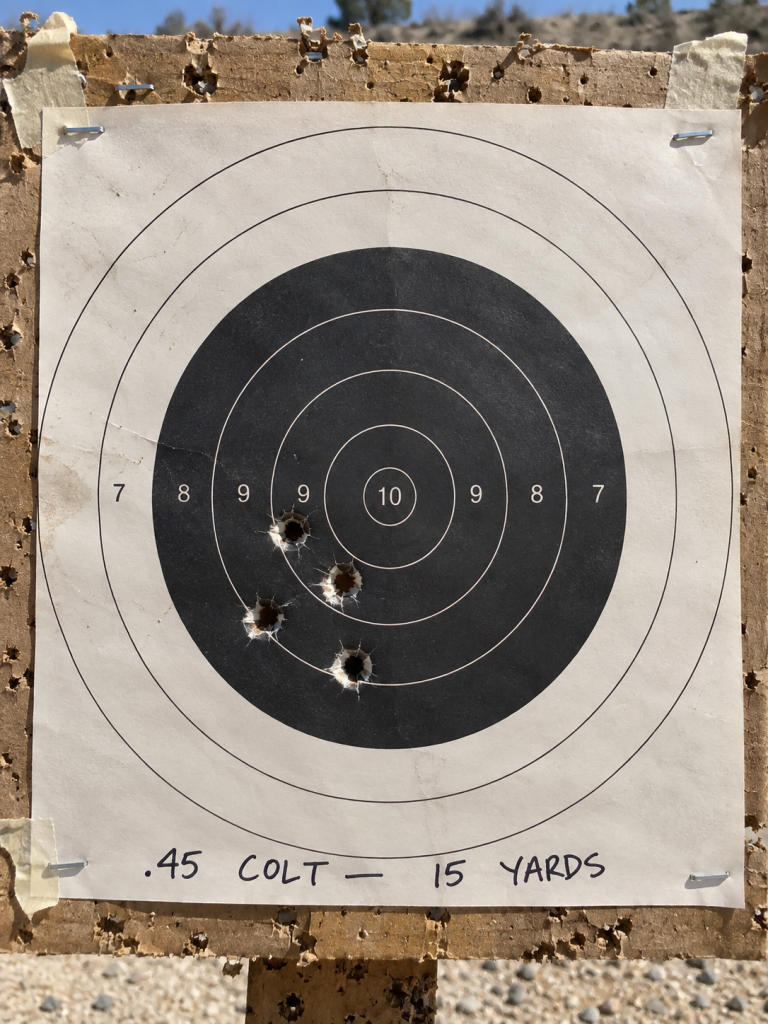
The fictional three-inch Judge produced its best five-shot .45 Colt group from a supported position at 15 yards. That group measured approximately 3.25 inches.

Offhand double-action groups were larger, generally between four and six inches. The revolver remained capable of keeping its shots inside the center scoring area of a silhouette target at defensive-handgun distances.

That is adequate practical accuracy.

It is not competitive-revolver accuracy, and the Judge’s unusually long chamber works against it. A .45 Colt bullet must travel through the extended cylinder throat before reaching the forcing cone and rifled barrel. That free travel is one reason a dedicated .45 Colt revolver may shoot smaller groups.

The new sights nevertheless make the 2026 Taurus Judge easier to shoot accurately than the old gutter-sight model. The gun finally provides an aiming system suited to the .45 Colt cartridge it has always been capable of firing.

My Glock 19X home-defense discussion⁠ explains why a conventional 9mm pistol remains easier to shoot quickly, easier to reload and dramatically higher in capacity. The Judge offers versatility. The Glock offers seventeen rounds and magazines that do not require a consultation with a speedloader archaeologist.

Taurus Judge .410 Pattern Test at Seven Yards

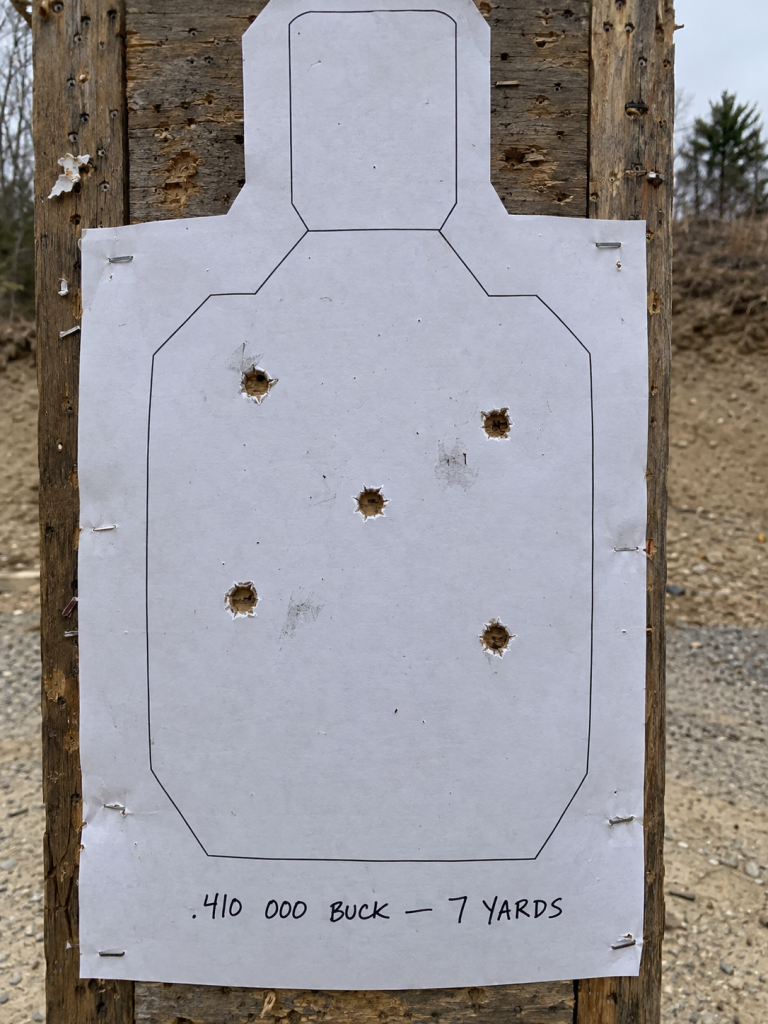
The fictional .410 000-buckshot target illustrates the Judge’s most important lesson.

At seven yards, one five-pellet load produced an approximately eight-inch pattern centered across the upper torso. Every pellet remained on the silhouette, but the distribution was irregular.

A second shell could produce a tighter pattern. Another brand could spread considerably wider. That is why anyone considering a Taurus Judge for home defense must pattern the exact ammunition in the exact revolver.

The rifled barrel imparts spin to the shot column. That can cause pellets to spread rapidly once they leave the muzzle. The Judge does not produce the same pattern as a smoothbore .410 shotgun with a longer barrel and choke.

At three yards, the fictional 000-buckshot patterns remained compact.

At seven yards, they were useful but noticeably wider.

At ten yards, some pellets began leaving the main scoring area.

That does not make the Taurus Judge useless. It means the owner cannot buy a box of .410 shells, glance at the revolver and assume every pellet will land wherever the fiber-optic sight appears.

Paper is cheaper than assumptions.

Birdshot, Buckshot or .45 Colt?

.410 Birdshot

Birdshot produced the widest patterns and the least convincing defensive performance in this fictional test.

It may be useful for snakes or small pests at close range where lawful and safe. It should not be treated as magical home-defense ammunition merely because a cloud of tiny pellets looks impressive against paper.

Small shot sacrifices individual projectile mass for pellet count. A dramatic hole in thin cardboard does not prove adequate performance against a violent attacker.

.410 Buckshot

Purpose-built .410 handgun buckshot makes more sense for defensive use.

The fictional Federal 000-buckshot loads kept their pellets together better than ordinary birdshot. Recoil was stout but manageable, and the revolver delivered several large projectiles with one trigger press.

The downside remains pattern variability and five-round capacity.

Every shell must be tested. The owner is responsible for every pellet, including the one that decides to explore a neighboring wall.

.45 Colt

Standard-pressure .45 Colt was the most predictable ammunition in the fictional Taurus Judge review.

It produced one hole per shot, manageable recoil and considerably better precision beyond very close range. A quality defensive .45 Colt load also avoids the uncertainty of multiple pellets separating after leaving the barrel.

If I were hypothetically loading a Judge for general trail use, .45 Colt would receive serious consideration. If the anticipated problem involved a poisonous snake at extremely close distance, an appropriate .410 shotshell might be more useful.

The ability to make that choice is the Judge’s entire reason for existing.

Is the Taurus Judge Good for Home Defense?

The Taurus Judge can serve as a home-defense revolver, but it would not be my first recommendation for most armed citizens.

Its advantages include:

  • Simple revolver operation
  • .45 Colt and .410 ammunition compatibility
  • Useful close-range buckshot patterns with selected loads
  • Improved 2026 sights and controls
  • No magazine to seat or slide to manipulate

Its disadvantages include:

  • Only five rounds
  • Slow reloads
  • Heavy double-action trigger
  • Large cylinder and substantial bulk
  • Significant muzzle blast
  • Ammunition-sensitive .410 patterns
  • Lower practical capacity than modern defensive pistols

A lawful armed homeowner matters because violent criminals do not schedule appointments around police response times. A dependable firearm gives an innocent person the ability to resist an attacker during the minutes when nobody else is present to help.

Gun-control bigots hate that independence. They would rather blame the lawful gun owner, restrict the defensive firearm and pretend the criminal will obey whichever new prohibition was stapled onto the statute book.

The armed citizen still needs judgment. A revolver does not identify a threat, choose a safe direction or understand what lies beyond a wall. Equipment provides capability; the owner provides responsibility.

Taurus Judge vs Smith & Wesson Governor

The Smith & Wesson Governor is the Judge’s obvious competitor.

Both fire .45 Colt and .410 shotshells. The Governor adds .45 ACP compatibility through moon clips and holds six rounds instead of five.

The Governor is generally more expensive. The Taurus Judge offers more factory configurations, including different barrel lengths and the compact Public Defender models.

For a buyer who specifically wants .45 ACP compatibility, the Governor has the clear advantage.

For somebody comparing the 2026 Taurus Judge price, sights and configurations, the redesigned Judge may offer more value. The new rear sight and trigger changes also reduce two of the older model’s weaknesses.

Neither revolver replaces a proper shotgun, and neither becomes a high-capacity semiautomatic pistol merely because the ammunition shelf contains several choices.

New Taurus Judge Problems to Watch

A buyer researching Taurus Judge problems should inspect and test the actual revolver.

Watch for:

  • Difficult extraction after firing .410 shells
  • Excessive residue beneath the extractor star
  • Cylinder binding as fouling accumulates
  • Uneven cylinder lockup
  • Rear-sight movement
  • Light primer strikes
  • Grips or screws loosening under recoil
  • Buckshot patterns that spread too widely
  • Point-of-impact differences between .45 Colt loads

The fictional example in this article experienced none of those mechanical failures. That does not guarantee every production revolver will behave identically.

Before trusting any Taurus Judge for home defense, fire the chosen .45 Colt or .410 defensive load through every chamber. Confirm ignition, extraction, accuracy and pattern size at the longest realistic distance inside the home.

Reliability belongs to the individual gun-and-ammunition combination, not to the model name printed on the box.

Is the New Taurus Judge Worth Buying?

The new Taurus Judge is worth considering if you specifically want a revolver capable of firing both .45 Colt and .410 shotshells.

The 2026 redesign improves the features shooters actually use. The fiber-optic front sight and dovetailed rear sight are substantial upgrades. The revised trigger, grip, hammer and cylinder release make the revolver easier to operate without abandoning the original Judge concept.

It remains specialized.

A nine-millimeter pistol is easier to carry, faster to reload and substantially higher in capacity. A conventional shotgun provides better .410 or twelve-gauge performance. A dedicated .45 Colt revolver will probably deliver better precision.

The Judge does not beat each of those guns at its own job.

It combines portions of all three into one unusually entertaining revolver.

Final Verdict

The 2026 Taurus Judge is a better Judge, not a completely different firearm.

Its new sights finally respect the accuracy potential of .45 Colt. Its revised trigger and controls improve practical handling. Its .410 capability remains useful only when the owner patterns the selected ammunition and understands how quickly shot can spread from a short rifled barrel.

The fictional range session suggests the three-inch model would be dependable, entertaining and reasonably accurate with .45 Colt. Purpose-built .410 buckshot would be effective at close range, but ordinary birdshot would remain a poor substitute for serious defensive ammunition.

Buy the new Taurus Judge because you understand its unusual capabilities and limitations.

Do not buy it because a gun-counter prophet promised that one .410 shell will remove the entire hallway.

The new Judge is versatile. It is improved. It is undeniably fun.

It is still a five-shot revolver, and physics has not been overruled.

GarandThumb.com was established on May 4, 2012, to document my experiences trying to become a better marksman.

Posted in XTC