New Taurus Judge Review | 2026 .410 and .45 Colt Range Report

The new Taurus Judge remains the strangest successful revolver in America.

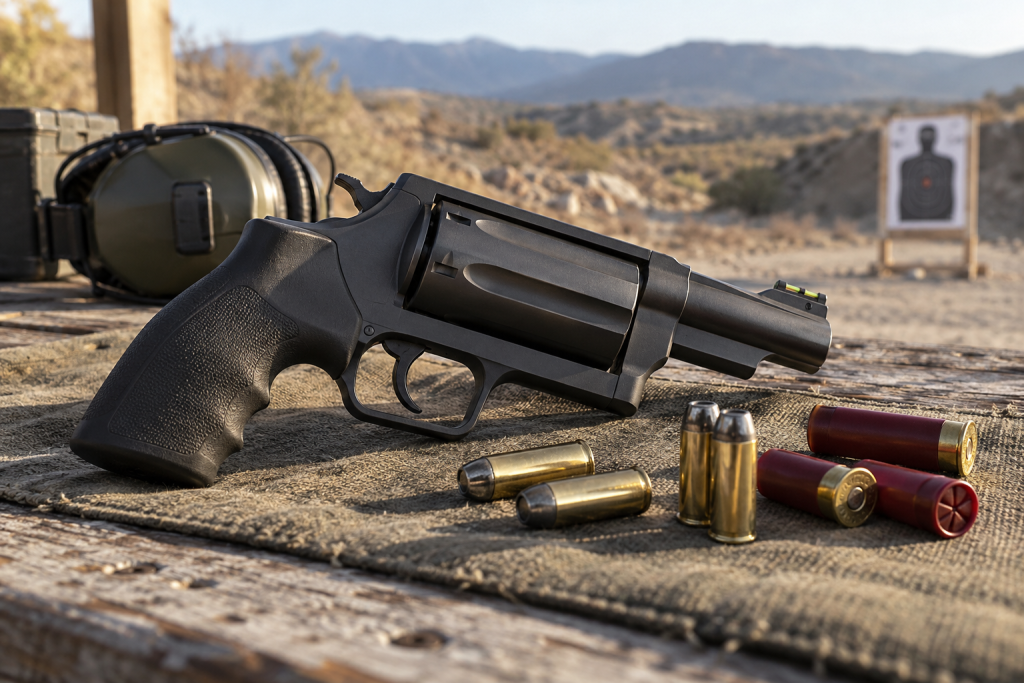
It holds five rounds, fires both .45 Colt cartridges and .410 shotshells, and looks like a conventional revolver that swallowed a length of pipe. For 2026, Taurus redesigned the Judge with better sights, revised controls, an improved trigger and two barrel lengths.

Those changes address legitimate weaknesses in the older gun. They do not transform a short-barreled .410 revolver into a twelve-gauge shotgun, a match pistol or the Hammer of Thor.

For this fictional new Taurus Judge range review, I imagined firing 125 rounds through the three-inch model:

  • 50 rounds of standard-pressure .45 Colt ammunition
  • 25 rounds of .45 Colt defensive ammunition
  • 20 Federal .410 000-buckshot shells
  • 15 Winchester PDX1 Defender shells
  • 15 conventional .410 birdshot shells

The imaginary revolver completed the session without a mechanical failure. More importantly, the fictional targets illustrate what prospective buyers need to understand: the 2026 Taurus Judge can be useful, but ammunition selection and distance matter enormously.

What Changed on the New Taurus Judge for 2026?
According to the official Taurus Judge model page⁠, the redesigned revolver is available in four principal configurations:

  • Three-inch barrel with black finish
  • Three-inch barrel with duo-tone finish
  • 6.5-inch barrel with black finish
  • 6.5-inch barrel with duo-tone finish

Every version uses a five-round cylinder chambered for .45 Colt and .410-bore shotshells.
The 2026 American Rifleman examination⁠ identifies the most important mechanical and ergonomic changes:

  • Squared trigger guard
  • Flatter, more angular trigger shoe
  • Dovetailed rear sight
  • Bright fiber-optic front sight
  • Redesigned cylinder-release latch
  • Revised grip shape
  • Lower and wider hammer spur

The old Judge’s shallow rear gutter sight was adequate for launching shot across a card table. It was less useful when trying to place a .45 Colt bullet accurately.

The dovetailed rear sight and fiber-optic front sight are therefore the most meaningful improvements. They give the new Taurus Judge a genuine sight picture instead of an approximate suggestion about where the muzzle might be pointing.

Published 2026 pricing places the new Taurus Judge MSRP between approximately $699.99 and $719.99, depending upon barrel length and finish.

New Taurus Judge Specifications

The important 2026 Taurus Judge specifications are straightforward:

  • Action: Double-action/single-action revolver
  • Capacity: Five rounds
  • Chambers: .45 Colt and .410 bore
  • Barrel lengths: Three inches or 6.5 inches
  • Finishes: Black or duo tone
  • Front sight: Fiber optic
  • Rear sight: Dovetailed and drift adjustable
  • Cylinder: Swing-out
  • Frame: Steel
  • Primary uses: Recreational shooting, trail carry, pest control and home defense

The three-inch Judge is the handier version. The 6.5-inch Taurus Judge provides a longer sight radius, additional weight and potentially better velocity, but it also moves the revolver from “large handgun” into “small artillery project.”

Neither version should be mistaken for a practical concealed-carry pistol. The long cylinder required for .410 shotshells makes the Judge considerably bulkier than an ordinary .45 Colt revolver.

It can be concealed. So can a cordless drill if the shirt is large enough.

New Taurus Judge Range Report

The fictional test began with standard-pressure 250-grain .45 Colt ammunition.

The redesigned grip filled the hand better than the narrow grip on some earlier Judge models. Recoil was noticeable but comfortable. The new trigger shoe provided useful leverage during double-action shooting, although the pull remained heavier than a typical striker-fired pistol.

Single-action shooting was considerably easier. The widened hammer spur was simple to reach, and the new sights made deliberate shots possible without covering half the target with the front blade.

The fictional 125-round Taurus Judge reliability test produced:

  • No failures to fire
  • No difficult extraction
  • No cylinder-binding problems
  • No loose screws
  • No visible timing problems
  • No movement of the rear sight
  • Moderate powder fouling around the cylinder gap
  • Considerable residue after firing .410 shotshells

That last item is predictable. Shot cups, wads and comparatively dirty shotgun ammunition leave debris. A Taurus Judge used extensively with .410 ammunition will need more attention than a revolver that fires only conventional handgun cartridges.

Taurus Judge .45 Colt Accuracy

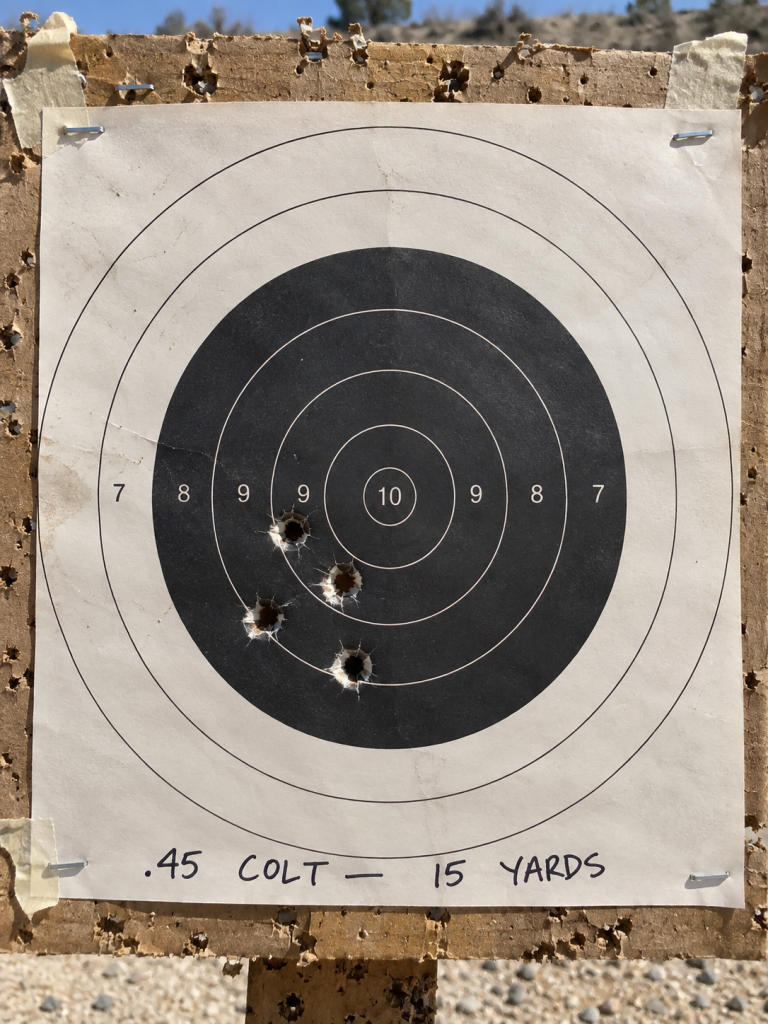
The fictional three-inch Judge produced its best five-shot .45 Colt group from a supported position at 15 yards. That group measured approximately 3.25 inches.

Offhand double-action groups were larger, generally between four and six inches. The revolver remained capable of keeping its shots inside the center scoring area of a silhouette target at defensive-handgun distances.

That is adequate practical accuracy.

It is not competitive-revolver accuracy, and the Judge’s unusually long chamber works against it. A .45 Colt bullet must travel through the extended cylinder throat before reaching the forcing cone and rifled barrel. That free travel is one reason a dedicated .45 Colt revolver may shoot smaller groups.

The new sights nevertheless make the 2026 Taurus Judge easier to shoot accurately than the old gutter-sight model. The gun finally provides an aiming system suited to the .45 Colt cartridge it has always been capable of firing.
My Glock 19X home-defense discussion⁠ explains why a conventional 9mm pistol remains easier to shoot quickly, easier to reload and dramatically higher in capacity. The Judge offers versatility. The Glock offers seventeen rounds and magazines that do not require a consultation with a speedloader archaeologist.

Taurus Judge .410 Pattern Test at Seven Yards

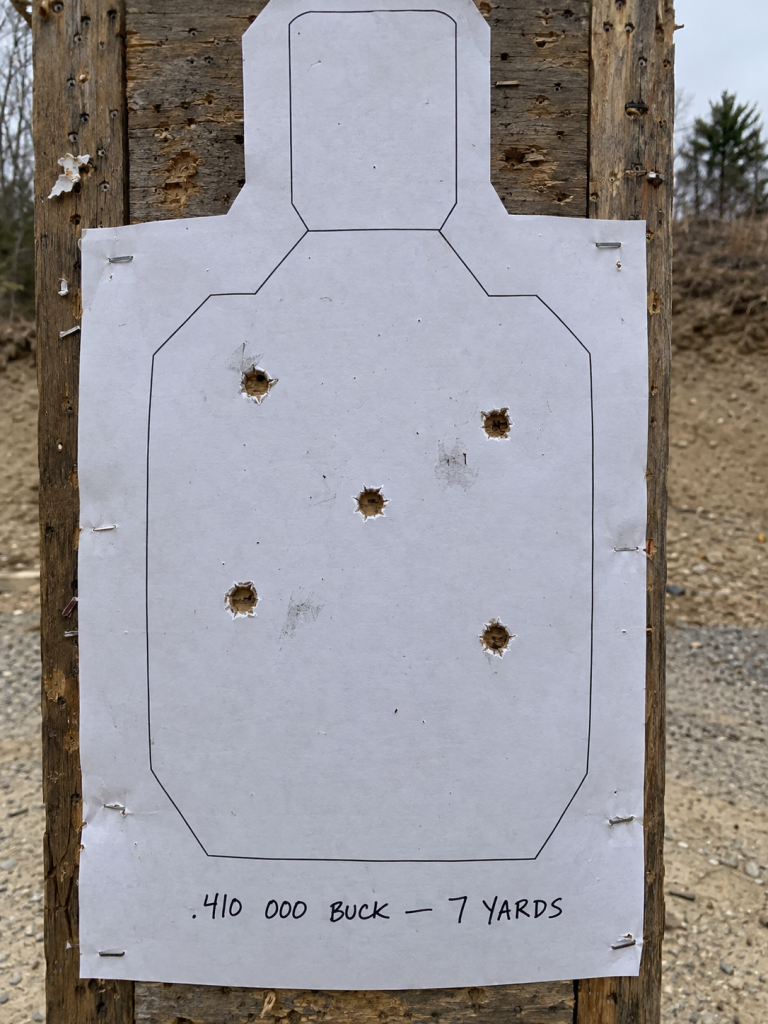
The fictional .410 000-buckshot target illustrates the Judge’s most important lesson.

At seven yards, one five-pellet load produced an approximately eight-inch pattern centered across the upper torso. Every pellet remained on the silhouette, but the distribution was irregular.

A second shell could produce a tighter pattern. Another brand could spread considerably wider. That is why anyone considering a Taurus Judge for home defense must pattern the exact ammunition in the exact revolver.

The rifled barrel imparts spin to the shot column. That can cause pellets to spread rapidly once they leave the muzzle. The Judge does not produce the same pattern as a smoothbore .410 shotgun with a longer barrel and choke.

At three yards, the fictional 000-buckshot patterns remained compact.

At seven yards, they were useful but noticeably wider.

At ten yards, some pellets began leaving the main scoring area.

That does not make the Taurus Judge useless. It means the owner cannot buy a box of .410 shells, glance at the revolver and assume every pellet will land wherever the fiber-optic sight appears.

Paper is cheaper than assumptions.

Birdshot, Buckshot or .45 Colt?

.410 Birdshot

Birdshot produced the widest patterns and the least convincing defensive performance in this fictional test.

It may be useful for snakes or small pests at close range where lawful and safe. It should not be treated as magical home-defense ammunition merely because a cloud of tiny pellets looks impressive against paper.

Small shot sacrifices individual projectile mass for pellet count. A dramatic hole in thin cardboard does not prove adequate performance against a violent attacker.

.410 Buckshot

Purpose-built .410 handgun buckshot makes more sense for defensive use.

The fictional Federal 000-buckshot loads kept their pellets together better than ordinary birdshot. Recoil was stout but manageable, and the revolver delivered several large projectiles with one trigger press.

The downside remains pattern variability and five-round capacity.

Every shell must be tested. The owner is responsible for every pellet, including the one that decides to explore a neighboring wall.

.45 Colt

Standard-pressure .45 Colt was the most predictable ammunition in the fictional Taurus Judge review.

It produced one hole per shot, manageable recoil and considerably better precision beyond very close range. A quality defensive .45 Colt load also avoids the uncertainty of multiple pellets separating after leaving the barrel.

If I were hypothetically loading a Judge for general trail use, .45 Colt would receive serious consideration. If the anticipated problem involved a poisonous snake at extremely close distance, an appropriate .410 shotshell might be more useful.

The ability to make that choice is the Judge’s entire reason for existing.

Is the Taurus Judge Good for Home Defense?

The Taurus Judge can serve as a home-defense revolver, but it would not be my first recommendation for most armed citizens.

Its advantages include:

  • Simple revolver operation
  • .45 Colt and .410 ammunition compatibility
  • Useful close-range buckshot patterns with selected loads
  • Improved 2026 sights and controls
  • No magazine to seat or slide to manipulate

Its disadvantages include:

  • Only five rounds
  • Slow reloads
  • Heavy double-action trigger
  • Large cylinder and substantial bulk
  • Significant muzzle blast
  • Ammunition-sensitive .410 patterns
  • Lower practical capacity than modern defensive pistols

A lawful armed homeowner matters because violent criminals do not schedule appointments around police response times. A dependable firearm gives an innocent person the ability to resist an attacker during the minutes when nobody else is present to help.

Gun-control bigots hate that independence. They would rather blame the lawful gun owner, restrict the defensive firearm and pretend the criminal will obey whichever new prohibition was stapled onto the statute book.

The armed citizen still needs judgment. A revolver does not identify a threat, choose a safe direction or understand what lies beyond a wall. Equipment provides capability; the owner provides responsibility.

Taurus Judge vs Smith & Wesson Governor

The Smith & Wesson Governor is the Judge’s obvious competitor.

Both fire .45 Colt and .410 shotshells. The Governor adds .45 ACP compatibility through moon clips and holds six rounds instead of five.

The Governor is generally more expensive. The Taurus Judge offers more factory configurations, including different barrel lengths and the compact Public Defender models.

For a buyer who specifically wants .45 ACP compatibility, the Governor has the clear advantage.

For somebody comparing the 2026 Taurus Judge price, sights and configurations, the redesigned Judge may offer more value. The new rear sight and trigger changes also reduce two of the older model’s weaknesses.

Neither revolver replaces a proper shotgun, and neither becomes a high-capacity semiautomatic pistol merely because the ammunition shelf contains several choices.

New Taurus Judge Problems to Watch

A buyer researching Taurus Judge problems should inspect and test the actual revolver.

Watch for:

  • Difficult extraction after firing .410 shells
  • Excessive residue beneath the extractor star
  • Cylinder binding as fouling accumulates
  • Uneven cylinder lockup
  • Rear-sight movement
  • Light primer strikes
  • Grips or screws loosening under recoil
  • Buckshot patterns that spread too widely
  • Point-of-impact differences between .45 Colt loads

The fictional example in this article experienced none of those mechanical failures. That does not guarantee every production revolver will behave identically.

Before trusting any Taurus Judge for home defense, fire the chosen .45 Colt or .410 defensive load through every chamber. Confirm ignition, extraction, accuracy and pattern size at the longest realistic distance inside the home.

Reliability belongs to the individual gun-and-ammunition combination, not to the model name printed on the box.

Is the New Taurus Judge Worth Buying?

The new Taurus Judge is worth considering if you specifically want a revolver capable of firing both .45 Colt and .410 shotshells.

The 2026 redesign improves the features shooters actually use. The fiber-optic front sight and dovetailed rear sight are substantial upgrades. The revised trigger, grip, hammer and cylinder release make the revolver easier to operate without abandoning the original Judge concept.

It remains specialized.

A nine-millimeter pistol is easier to carry, faster to reload and substantially higher in capacity. A conventional shotgun provides better .410 or twelve-gauge performance. A dedicated .45 Colt revolver will probably deliver better precision.

The Judge does not beat each of those guns at its own job.

It combines portions of all three into one unusually entertaining revolver.

Final Verdict

The 2026 Taurus Judge is a better Judge, not a completely different firearm.

Its new sights finally respect the accuracy potential of .45 Colt. Its revised trigger and controls improve practical handling. Its .410 capability remains useful only when the owner patterns the selected ammunition and understands how quickly shot can spread from a short rifled barrel.

The fictional range session suggests the three-inch model would be dependable, entertaining and reasonably accurate with .45 Colt. Purpose-built .410 buckshot would be effective at close range, but ordinary birdshot would remain a poor substitute for serious defensive ammunition.

Buy the new Taurus Judge because you understand its unusual capabilities and limitations.

Do not buy it because a gun-counter prophet promised that one .410 shell will remove the entire hallway.

The new Judge is versatile. It is improved. It is undeniably fun.

It is still a five-shot revolver, and physics has not been overruled.

GarandThumb.com was established on May 4, 2012, to document my experiences trying to become a better marksman.

Posted in XTC

The New Shooter, the CMP Garand and the Great Grand Thumb Incident

The new shooter arrived at the range with a CMP M1 Garand, a borrowed shooting mat and the expression of a man who had been told that military-surplus rifles were “simple.”

He set the rifle on the bench beside a box of .30-06 ammunition.

“Before we start,” he said, “what is Garand Thumb?”

That was a reasonable question.

Then he showed me his phone.

The message actually said, “What is Grand Thumb?”

“Close,” I said. “Garand thumb is what happens when the M1 Garand bolt closes on your thumb. Grand Thumb is probably a very small superhero.”

He tried again.

“M1 Grand Thumb.”

Then:

“M1 Garand Thimb.”

Then:

“Garand Thunb.”

His phone was becoming less accurate with every attempt.

The New Shooter Had Done His Research

He told me he had read about the Garand thumb meaning, watched a Garand Thumb YouTube video, looked at a Garand Thumb youtuber and visited the Garand Thumb website.

He had also watched videos about the M1 Carbine, standard products M1 Carbine history, CMP rifles, CMP firearms, CMP military surplus and the Civilian Marksmanship Program M1 Garand program.

This was encouraging until he admitted that he believed the M1 Garand had a “thumb saver setting.”

“That is not a setting,” I said.

“What about an M1 Garand thumb saver?”

“Also not a setting.”

He opened another note on his phone. The heading read:

Garand Thumb, Garand Thump, Garand Tumb and Garand Thumv

“Your phone is fighting you harder than the rifle is,” I said.

He nodded and began inspecting the action.

How Garand Thumb Happens

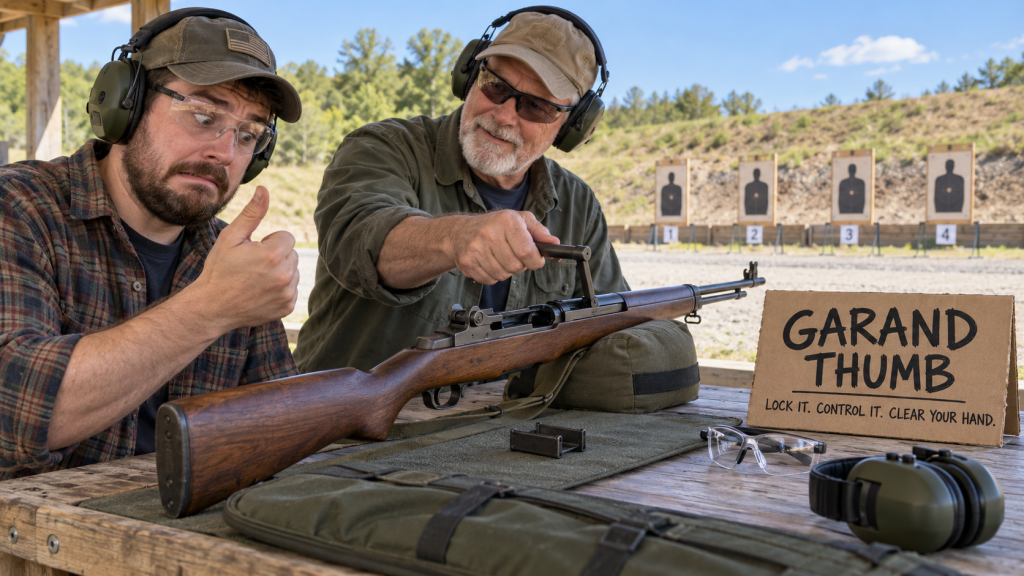
I pulled the operating rod fully rearward and showed him how the operating-rod catch positively locks the bolt open.

Then I eased the bolt forward until it rested against the follower without fully locking.

The two positions looked similar.

They were not.

“This is the important part,” I said. “Never trust an M1 Garand bolt just because it appears to be open. Make sure it is positively locked. If your thumb is inside the receiver, maintain control of the operating rod.”

The new shooter looked at the rifle.

“So how does Garand Thumb happen?”

“The bolt appears open. The shooter presses down the follower. The bolt releases. The thumb is still inside. The rifle wins.”

His phone translated my explanation into:

“How does Garant Thumb happen?”

Then:

“How does Gerand Thumb happen?”

Then:

“How does Garrand Thumb happen?”

By the time it produced “how does Garland Thumb happen,” the old man at the next bench had started laughing.

Loading the En Bloc Clip

We used an unloaded rifle first.

The new shooter pulled the operating rod completely rearward, confirmed that the bolt was locked open and pressed an eight-round en bloc clip into the internal magazine.

He kept the heel of his hand against the operating-rod handle as instructed.

That was good.

He removed his thumb and hand together.

That was better.

The bolt moved forward and chambered the first round.

He jumped anyway.

“That was supposed to happen,” I said.

“I thought that was the Garand thumb injury.”

“No. That was the rifle operating.”

He looked at his hand.

“Does Garand thumb hurt?”

“It does when you leave your thumb in the action.”

“How bad does Garand thumb hurt?”

“Usually less than the embarrassment of explaining to the whole firing line how it happened.”

He typed a note: “How bad does Garand thim hurt?”

I suggested he stop taking notes and keep his hand away from the bolt.

The Range Table Became a Spelling Bee

The range officer walked over to inspect the rifle.

“What model?”

“CMP Garand,” the new shooter answered.

The range officer nodded. “Nice rifle.”

The new shooter tried to explain the name of the injury.

“Garande Thumb.”

“Grand Thumb,” said the man with the Mosin PU sniper rifle.

“Grande Thumb,” said somebody behind us.

“Grant Thumb,” said the shooter loading a Glock 17.

A Glock 19 owner leaned over and asked whether Garand Thumb was related to the Garand Thumb EDC gear he had seen online.

“No,” I said. “This one is related to a spring-loaded bolt and poor hand placement.”

The new shooter’s phone produced “Garand Thub.”

The range officer took the phone away.

The M1 Garand SLED

For slow fire, the new shooter installed an M1 Garand SLED.

He called it an M1 Garand single shot sled, then an M1 Garand SLED clip, then an M1 Garand thumb saver.

The SLED is useful for loading individual cartridges in competition. My M1 Garand SLED guide⁠ explains the device and how it differs from a standard en bloc clip.

It does not eliminate the need to control the bolt.

It does not slow the operating rod.

It does not make the user immune to Garand finger.

It simply changes how the cartridge is presented to the action.

The rifle still contains a spring, a bolt and a long institutional memory of punishing careless thumbs.

A Brief Medical Consultation

The new shooter eventually did catch the edge of his thumb while practicing with the empty rifle.

It was not a serious injury. He had a small red mark and an expression suggesting that his entire family had been correct about him needing supervision.

We removed his ring, cleaned the minor scrape and applied an ice pack wrapped in cloth.

“Do not drill the nail,” I told him.

“I wasn’t going to.”

“You were absolutely going to.”

A real Garand thumb wound can include bruising, swelling, blood beneath the nail, nail-bed damage or a fracture. If the thumb becomes numb, deformed, badly swollen or difficult to move, medical care is appropriate.

A smashed finger is not improved by a heated paper clip, a cordless drill or a range member who claims to have learned medicine from a comment section.

The CMP History Lesson

While the shooter waited for the swelling to settle, we talked about CMP history.

The Civilian Marksmanship Program helped preserve access to military-surplus rifles and introduced generations of shooters to the M1 Garand. CMP Garands have become popular with collectors, competitors and people who simply want to own one of America’s most important service rifles.

My CMP history and surplus-rifle article⁠ covers that background.

We also discussed the M1 Carbine, the Standard Products M1 Carbine, the Winchester Garand and the differences between a service rifle, a collectible rifle and a rifle that has been sitting in a closet since the Eisenhower administration.

The new shooter asked if the rear sight was supposed to move that much.

I sent him to my article on setting the M1 Garand elevation knob⁠.

Then he asked whether the “Garand Thumb logo” was supposed to be a purple thumb.

“Only if the marketing department has a very specific sense of humor.”

The Final Score

By the end of the morning, the new shooter could:

  • Explain what Garand thumb means
  • Load an M1 Garand safely
  • Identify the difference between a locked bolt and a bolt resting against the follower
  • Use an M1 Garand SLED
  • Adjust the rear sight
  • Explain why the injury happens
  • Spell Garand correctly approximately half the time

His phone still insisted on Grand Thumb, Garamd Thumb, Garabd Thumb, Garand Thumn, Garand Tumb, Garand Thumv, Garand Thump, Garand Rhumb and Garand Thumb.

The range officer finally wrote the correct spelling on a piece of cardboard:

GARAND THUMB

The shooter photographed it.

His phone captioned the picture:

GRAND THUMBS

At that point, we gave up.

The M1 Garand is not difficult to operate, but it does require respect for the action. Positively lock the bolt. Control the operating rod. Keep the thumb clear before releasing the bolt.

Call it M1 thumb, M1 Garand thumb, Garand finger, Grand Thumb, Grande Thumb, Garand thimb or Garand thump.

Just do not put your thumb where the bolt is going.

GarandThumb.com was established on May 4, 2012, to document my experiences trying to become a better marksman.

Posted in XTC

Suppressor Form 4473 Transfers | What ATF Says Dealers Can Do Without a Form 4

A suppressor Form 4473 transfer without an ATF Form 4 is no longer merely a legal theory.

ATF Director Robert Cekada reportedly told firearms dealers on September 24, 2026, that agency inspectors have been instructed not to cite dealers for eligible suppressors transferred on an ordinary Form 4473. He also said written ATF suppressor guidance addressing interstate travel, short-barreled rifles and other unresolved questions should arrive within weeks.

That is an important development. It is not permission for every American to buy every suppressor from every dealer without NFA paperwork.

The federal government created this confusion by spending 92 years pretending a muffler was an exotic gangster weapon, reducing the suppressor transfer tax to zero and then trying to preserve the registry that supposedly existed to administer the tax.

Now gun owners, dealers and even ATF inspectors are waiting for the bureaucracy to explain the wreckage.

What Did ATF Say About Suppressor Form 4473 Transfers?

Cekada addressed the issue during an FFL compliance meeting in Dallas. According to reporting published by Outdoor Life⁠, he said ATF Industry Operations Investigators have been instructed not to count eligible suppressor transfers completed on Form 4473 as violations during dealer inspections.

That matters because many Federal Firearms Licensees have refused to transfer a suppressor without an approved Form 4 until ATF publishes written instructions.

The reported ATF position means a qualifying dealer should not lose points during an inspection merely because a covered suppressor was transferred using the same federal form and background-check process applied to an ordinary firearm.

However, the agency had not published that new written guidance as of September 29, 2026. The ATF firearms open-letter page⁠ still does not contain a nationwide letter explaining every Form 4473 suppressor transaction.

An oral statement at a compliance conference is encouraging. A written document identifying exactly which buyers, manufacturers, dealers and transactions are covered would be considerably more useful.

Can You Buy a Suppressor Without a Form 4?

Some buyers can purchase an eligible suppressor without an ATF Form 4, fingerprints, photographs or prior NFA approval when the transaction falls within the protection of the federal injunction.

The transaction still generally involves:

  • A suppressor legal to possess under state law
  • A dealer willing to complete the transfer
  • An ATF Form 4473
  • A federal background check unless a recognized exception applies
  • A qualifying connection to the parties protected by the court order
  • Compliance with federal laws outside the challenged NFA provisions

This is not a nationwide repeal of every federal suppressor law.

The August 5 judgment in Silencer Shop Foundation v. ATF permanently blocked enforcement of the challenged NFA registration requirements against specified plaintiffs and, where applicable, their members and customers. It did not issue a universal injunction covering every person and every suppressor transaction in America.

I explained the underlying decision in The NFA Just Lost in Federal Court⁠.

The important new information is that ATF leadership reportedly recognizes covered Form 4473 suppressor transfers and has instructed inspectors not to cite dealers for completing them.

Form 4473 vs. Form 4 for a Suppressor

ATF Form 4473 is the Firearms Transaction Record completed when a dealer transfers a firearm to an unlicensed buyer. It records the buyer’s identifying information, includes the prohibited-person questions and normally initiates a National Instant Criminal Background Check System inquiry.

An ATF Form 4 is the traditional application to transfer an existing NFA firearm. Before the injunction, a suppressor buyer ordinarily submitted a Form 4, fingerprints, a photograph and responsible-person information before waiting for ATF approval.

A covered Form 4473 suppressor transfer removes the separate NFA application and approval process. It does not eliminate the Gun Control Act, the background check or the federal prohibitions applying to particular buyers.

The difference is enormous:

  • Traditional Form 4 transfer: Apply first, enter the NFA process and wait for government approval.
  • Covered Form 4473 transfer: Complete the dealer transaction and background check without prior NFA registration.
  • Private or homemade suppressor: A different legal question that should not be assumed lawful merely because some dealer transfers are protected.
  • State-law restrictions: Still applicable regardless of the federal injunction.

An eligible suppressor customer may therefore complete a purchase much like a conventional rifle or handgun transaction. That is how suppressors should have been treated before Franklin Roosevelt’s administration decided hearing protection required federal registration.

Who Qualifies for a Suppressor Without a Form 4?

This remains the most important question—and the reason buyers should avoid relying on a five-minute Garand Thumb video, social-media screenshot or gun-counter rumor.

Coverage can depend on the transaction’s connection to the successful plaintiffs, including participating companies, protected organizations and their members or customers. Silencer Shop states that qualifying purchases involving its products and customers can proceed without the traditional Form 4 process.

Membership in a protected gun-rights organization may also matter in some transactions. The exact commercial chain can matter as well.

Before paying, ask the dealer:

  1. Is this specific suppressor covered by the injunction?
  2. What protected plaintiff, manufacturer, organization or customer relationship applies?
  3. Will the transfer be completed only on Form 4473?
  4. Does the dealer’s attorney or compliance specialist approve that procedure?
  5. Does state law separately require federal registration?
  6. What records will document that the transaction was protected?

The dealer may still refuse. A Federal Firearms Licensee is not required to become the test case simply because a customer arrives holding a screenshot and constitutional enthusiasm.

Can Any Dealer Transfer a Suppressor on Form 4473?

Not necessarily.

The ATF director’s reported statement concerns inspections and eligible transfers. It does not automatically establish that every suppressor in every dealer’s inventory may be transferred to every lawful buyer without a Form 4.

Some dealers have already completed covered Form 4473 suppressor sales. Others continue using Form 4 because they are waiting for formal ATF guidance or because their inventory, customers or state laws may fall outside the injunction.

That inconsistency is the government’s fault.

Lawful gun owners should not need to reverse-engineer a federal court judgment, trace a suppressor’s distribution chain and monitor conference remarks from an agency director to purchase a device that reduces noise.

Government excels at creating paperwork and then acting surprised when normal people cannot determine which paperwork the government still demands.

What About State Suppressor Laws?

The federal injunction does not erase state law.

Some states prohibit suppressors outright. Others allow possession but define a lawful suppressor by reference to federal registration. Those states may create an especially ugly problem when a federal court permits a transaction without placing the suppressor in the National Firearms Registration and Transfer Record.

A buyer must therefore determine:

  • Whether suppressors are legal in the state
  • Whether state law expressly requires federal registration
  • Whether the state recognizes a covered Form 4473 transfer
  • Whether local restrictions apply
  • Whether the suppressor may be possessed while hunting

A federal victory does not prevent a state legislature from maintaining its own stupid restriction.

Can You Travel Across State Lines With a Form 4473 Suppressor?

ATF’s expected written guidance should address interstate travel with suppressors transferred outside the traditional Form 4 process.

Suppressors historically did not require the same advance interstate-travel permission that generally applied to short-barreled rifles and short-barreled shotguns. The current problem is not simply travel approval. It is whether another jurisdiction recognizes the status of a suppressor that lacks an NFA registration record.

Until written guidance appears, owners should verify the law in every destination and avoid assuming one dealer’s transfer decision settles every later possession question.

Keep the sales receipt, completed transaction documentation and any written explanation identifying why the purchase was covered. Paperwork should not be necessary to prove innocence, but the government built a system where possessing the right piece of paper can prevent an expensive argument.

Does This Apply to SBRs and Short-Barreled Shotguns?

Do not automatically apply the suppressor Form 4473 procedure to an SBR or SBS.

The same federal judgment addressed untaxed short-barreled rifles, short-barreled shotguns and certain other NFA firearms, but separate Gun Control Act provisions complicate dealer transfers of short-barreled weapons.

Cekada reportedly said the forthcoming ATF guidance would address SBR and SBS transfers. Until that document appears, “my suppressor dealer used a 4473” is not a legal theory for placing a stock on an unregistered short-barreled rifle.

Machine guns and destructive devices are also outside the untaxed category at the center of this judgment because Congress retained their $200 NFA taxes.

Does a Form 4473 Suppressor Still Need Repairs Through a Dealer?

Transfer and repair rules are separate issues.

ATF recently expanded what qualified manufacturers may do when repairing or converting an already registered silencer. My article on ATF suppressor repairs and caliber changes⁠ explains replacement baffles, serialized housings, recoring and caliber conversions.

That repair letter assumes the suppressor is registered in the NFRTR. It does not clearly explain every repair involving a suppressor transferred solely under the injunction.

That is another subject the agency needs to address. A lawful suppressor should not become impossible to repair because the owner used a court-approved transfer procedure that did not generate an NFA registration entry.

Suppressors Should Be Ordinary Firearm Accessories

Suppressors protect hearing, reduce noise pollution and make shooting more tolerable for shooters, instructors, hunters, neighbors and range employees.

They do not make firearms silent. They do not eliminate the ballistic crack of a supersonic bullet. They do not transform peaceful gun owners into assassins.

The anti-gun mythology surrounding silencers was always driven more by Hollywood and ideological hostility toward gun ownership than mechanical reality.

Treating a threaded metal sound moderator as a heavily restricted NFA weapon never made innocent people safer. It made responsible shooters wait, pay and register while violent criminals continued ignoring the law.

For readers following Garand Thumb Blog suppressor coverage, the current answer is encouraging but qualified:

Eligible suppressors can be transferred without a Form 4 under the active injunction. ATF’s director reportedly says dealers will not be cited for completing those covered transfers on Form 4473. The background check, Gun Control Act and applicable state laws remain. Universal written guidance has not yet arrived.

That is a genuine victory for gun owners.

It is also another reminder that when government spends decades building a ridiculous system, dismantling it requires explaining exactly which pieces of the ridiculous system are still standing.

GarandThumb.com was established on May 4, 2012, to document my experiences trying to become a better marksman.
Posted in XTC

SIG MCX-LTAW Review | 500-Round Suppressed Range Report

The SIG MCX-LTAW is the civilian version of a rifle people have spent years trying to recreate from grainy military photographs, discontinued parts and financially irresponsible clone builds.

SIG finally took the basic idea behind the Low Visibility Assault Weapon, updated it with current MCX components and packaged it as a factory-produced .300 Blackout platform.

For this fictional SIG MCX-LTAW review, I fired 500 rounds through the complete Suppressor SBR Combo. That configuration combines a 6.75-inch barrel, SQX suppressor, LVAW-style heat-shield handguard, folding skeletonized stock and ROMEO4T-PRO red-dot sight.

The short verdict is simple: the MCX-LTAW is heavier and considerably more expensive than an ordinary .300 Blackout AR pistol, but it is compact, quiet, controllable and far more interesting than another black rifle assembled from the same twelve catalog parts.

SIG MCX-LTAW Specifications

According to SIG Sauer’s official MCX-LTAW page⁠, the Suppressor SBR Combo includes:

  • .300 AAC Blackout chambering
  • 6.75-inch cold-hammer-forged carbon-steel barrel
  • 1:5-inch barrel twist
  • 5/8×24 barrel threads
  • Short-stroke gas-piston operating system
  • Adjustable gas system
  • Factory-installed direct-thread SQX suppressor
  • Inconel suppressor core
  • Suppressor-compatible M-LOK handguard
  • Integrated handguard heat shield
  • Fully ambidextrous controls
  • Two-stage curved match trigger
  • Folding skeletonized stock
  • ROMEO4T-PRO red-dot sight
  • Arisaka hand stop, indexer, light mount and QD mount
  • One 30-round .300 Blackout magazine
  • 32-inch overall length
  • 23.5-inch folded length
  • Seven-pound published weight

SIG also offers an MCX-LTAW pistol⁠ with a folding brace and nonfunctional training suppressor. A conventional SBR version uses the folding stock but retains the training tube.

Buyers specifically wanting the complete suppressed MCX-LTAW need to distinguish the Suppressor SBR Combo from the cheaper configurations. The tube beneath the handguard may look convincing in photographs, but only the combo includes the functional SQX suppressor.

SIG MCX-LTAW 500-Round Test

My fictional ammunition breakdown was:

  • 200 rounds of 220-grain subsonic ammunition
  • 200 rounds of 125-grain supersonic ammunition
  • 100 rounds of 110-grain defensive ammunition

The test included slow five-shot groups, zero confirmation, magazine changes, shooting from standing and kneeling positions, and several magazines loaded with alternating subsonic and supersonic cartridges.

The MCX-LTAW completed all 500 fictional rounds without a stoppage.

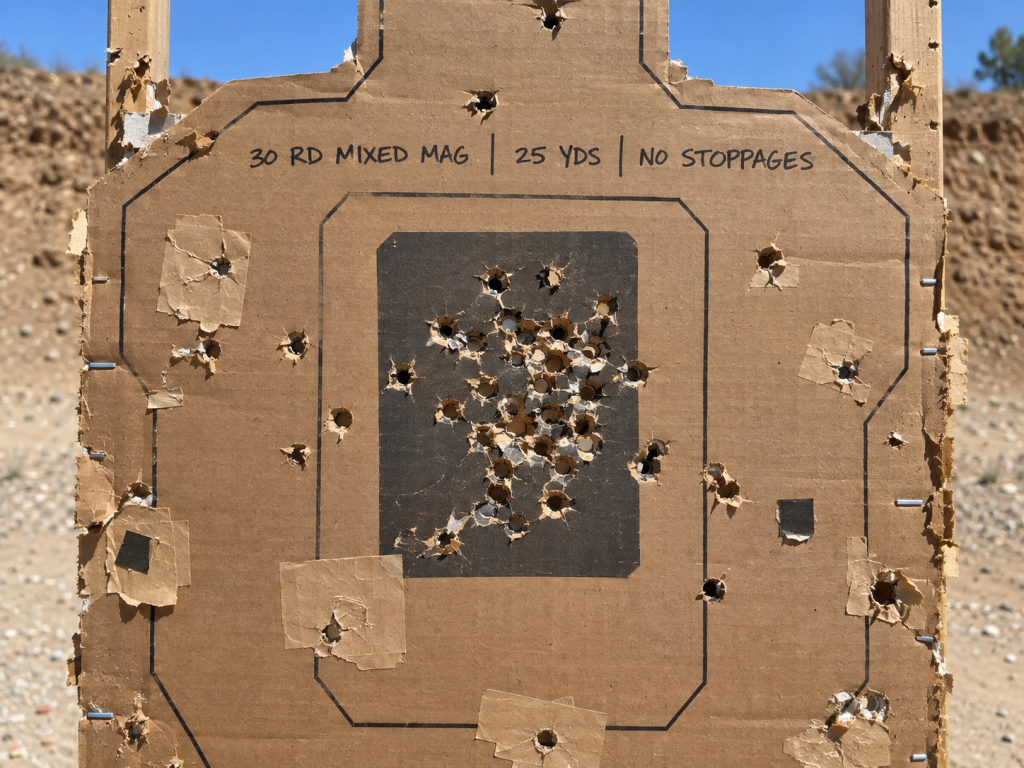
That includes a deliberately mixed 30-round magazine containing both subsonic and supersonic ammunition. The point was not to recommend mixing loads for defensive use. It was to determine whether the adjustable piston system would continue cycling as pressure and bolt velocity changed from one cartridge to the next.

It did.

Target photograph: Thirty-round mixed-magazine drill at 25 yards with no fictional stoppages.

SIG MCX-LTAW Accuracy

A 6.75-inch .300 Blackout rifle is not a benchrest gun. It is a compact suppressed firearm intended for short-range work.

That does not excuse poor accuracy.

220-Grain Subsonic Accuracy at 50 Yards

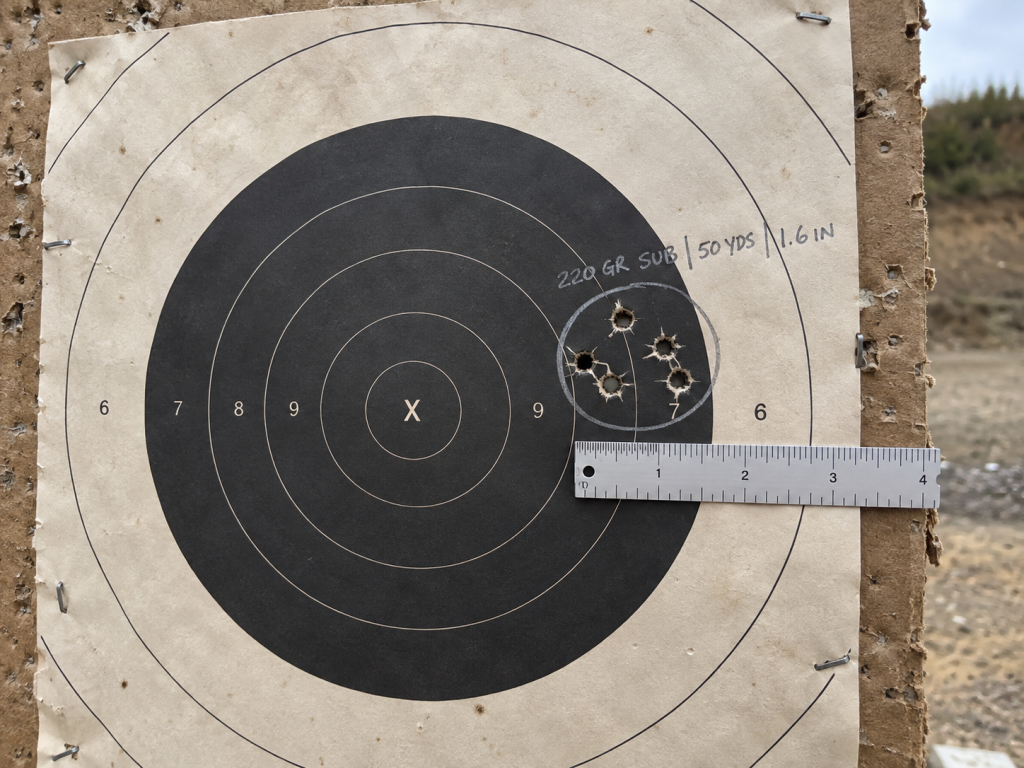
The 220-grain subsonic load produced five-shot groups averaging 1.9 inches at 50 yards. The smallest fictional group measured 1.6 inches.

Point of impact was slightly lower than the supersonic zero, which should surprise nobody. A heavy subsonic bullet leaving a short barrel does not possess enough velocity to negotiate with gravity.

The 1:5-inch twist appeared entirely appropriate for stabilizing heavy bullets. No target showed an elongated hole or other visible evidence of instability.

Target photograph: Best five-shot 220-grain subsonic group at 50 yards, measuring approximately 1.6 inches.

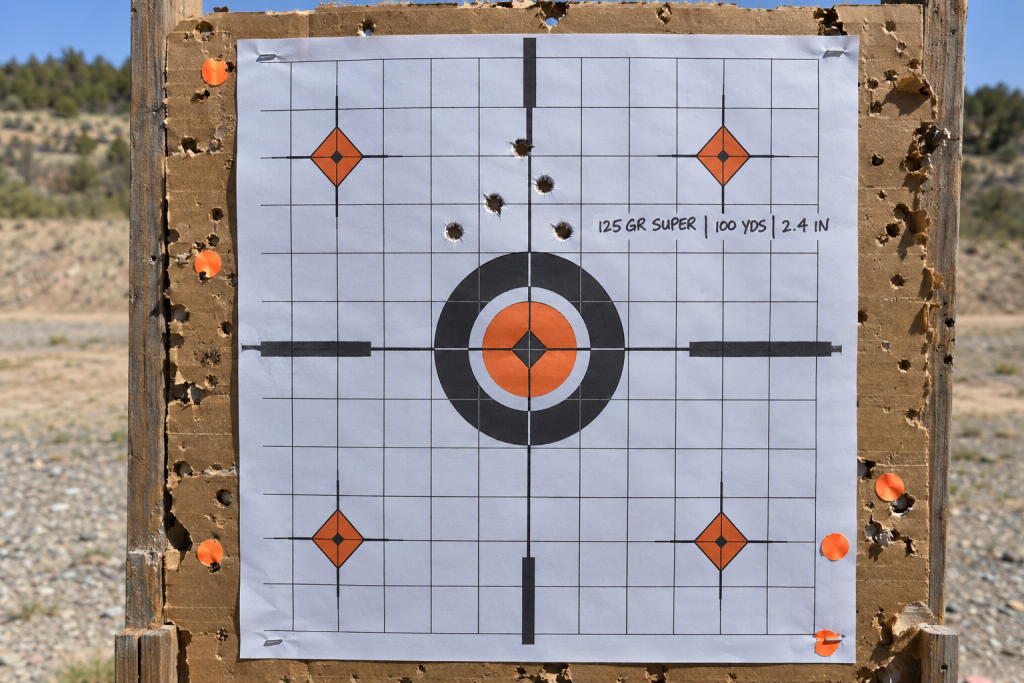
125-Grain Supersonic Accuracy at 100 Yards

The 125-grain supersonic ammunition averaged 2.9 inches for five-shot groups at 100 yards. The best group measured 2.4 inches.

That is respectable accuracy from an extremely short suppressed rifle using a red dot. A magnified optic and better support would probably shrink the groups, but installing a large precision scope on an LTAW would be like mounting a snowplow on a Corvette.

It could be done. It would also miss the point.

Target photograph: Best five-shot 125-grain supersonic group at 100 yards, measuring approximately 2.4 inches.

How Quiet Is the SIG MCX-LTAW?

The SIG SQX suppressor made the 220-grain ammunition substantially more comfortable to shoot than unsuppressed .300 Blackout.

It did not produce Hollywood silence.

The shooter still hears the action cycling, gas leaving the firearm and the bullet striking the berm. Supersonic ammunition retains its ballistic crack regardless of how expensive the suppressor becomes.

The direct-thread SQX is optimized around the platform and avoids an additional quick-detach mounting interface. That produces a clean, compact system, but it also makes the suppressor less convenient to move between firearms.

I would treat the SQX as a dedicated part of the MCX-LTAW rather than an expensive communal suppressor expected to serve six rifles.

My article on ATF suppressor repairs and caliber conversions⁠ explains current federal guidance affecting registered silencers. The government still treats a hearing-protection device like contraband requiring special permission because government stupidity develops institutional momentum.

Does the MCX-LTAW Handguard Get Hot?

Yes.

A suppressor beneath a handguard transfers heat into the surrounding aluminum. The integrated heat shield delays discomfort; it does not repeal thermodynamics.

After two quick magazines of supersonic ammunition, the forward section became noticeably warm. After four magazines, gloves became sensible equipment.

The included hand stop and indexer help keep the support hand in a consistent location without allowing fingers to drift toward the muzzle. That matters on a firearm whose actual barrel ends deep inside the handguard.

SIG deserves credit for including useful Arisaka accessories instead of shipping a premium rifle with an empty rail and an invoice large enough to qualify as a mortgage document.

SIG MCX-LTAW vs. MCX Rattler LT

The MCX-LTAW shares its fundamental operating system and 6.75-inch barrel length with the MCX Rattler LT⁠.

The important differences are the suppressor-compatible heat-shield handguard, LVAW appearance, available SQX suppressor package, skeletonized stock and included accessories.

The Rattler LT pistol weighs approximately 5.1 pounds before an optic and suppressor. The MCX-LTAW configurations weigh seven pounds as listed by SIG.

That difference is significant.

The LTAW is compact, but it is not especially light. The suppressor, extended handguard, heat shield, optic and accessories concentrate considerable weight toward the front.

Choose the Rattler LT if minimum weight and modularity matter most.

Choose the MCX-LTAW if you specifically want a factory-integrated suppressed .300 Blackout system and the LVAW configuration.

Is the MCX-LTAW a Real Civilian LVAW?

It is better described as a modern commercial interpretation than an exact clone.

The original SIG LVAW was developed for specialized military use and became famous among clone builders partly because authentic components were scarce, confusing and expensive.

The new MCX-LTAW uses current MCX-LT architecture, a redesigned suppressor-compatible handguard and commercially supported components. That makes it less historically exact but considerably easier to buy, maintain and repair.

A factory rifle also avoids the clone-builder ritual of paying $900 for a discontinued handguard because somebody on a forum identified three pixels in a 2014 photograph.

SIG MCX-LTAW Price and Release Date

SIG currently lists the MCX-LTAW pistol and Suppressor SBR Combo as “coming soon.”

The company has not published a final MCX-LTAW MSRP on the product pages.

Anyone claiming to know the settled street price is either looking at preliminary dealer information or performing traditional gun-counter divination.

The ordinary MCX Rattler LT already occupies the premium-firearm category. Adding an SQX suppressor, ROMEO4T-PRO optic, specialized handguard, stock and Arisaka accessories will not make the complete MCX-LTAW inexpensive.

The Suppressor SBR Combo also involves regulated-item transfer requirements. Buyers should confirm the current federal process, state law and dealer procedure before ordering. My article about the recent federal NFA ruling⁠ explains why exciting headlines do not automatically eliminate paperwork for every buyer in every state.

Is the SIG MCX-LTAW Good for Home Defense?

Mechanically, the MCX-LTAW has several useful home-defense characteristics:

  • Compact folded length
  • Short overall package with the suppressor attached
  • Ambidextrous controls
  • Red-dot sight
  • Thirty-round capacity
  • Reduced muzzle blast
  • Compatibility with subsonic and supersonic ammunition
  • Enough rail space for a white light

A suppressor does not make a defensive firearm silent. It reduces the blast produced inside confined spaces where permanent hearing damage is a real concern.

Private gun ownership matters because police cannot occupy every bedroom, hallway and rural driveway. When an innocent person faces an immediate violent threat, the firearm already in the home matters more than the government employee traveling toward it.

Equipment still requires judgment, training and secure storage. A $4,000 suppressed rifle does not supply competence through osmosis.

Final Verdict

The SIG MCX-LTAW is not merely a Rattler wearing a larger handguard, although the internet will repeat that description until everybody becomes tired.

It combines a proven short-stroke-piston system, 6.75-inch .300 Blackout barrel, suppressor-specific handguard, heat shield and factory SQX suppressor into a coherent package.

In this fictional 500-round SIG MCX-LTAW range report, it fired subsonic, supersonic and defensive ammunition without a stoppage. The best groups measured 1.6 inches at 50 yards with 220-grain subsonic ammunition and 2.4 inches at 100 yards with 125-grain supersonic ammunition.

The weaknesses are weight, heat and the price SIG has not yet announced.

The advantages are compactness, reliable suppressed operation and the absence of a three-year scavenger hunt for clone parts.

For somebody wanting the lightest .300 Blackout pistol, the MCX Rattler LT remains the better answer.

For somebody searching for a civilian SIG LVAW, MCX-LTAW review, suppressed .300 Blackout SBR, MCX-LTAW versus Rattler comparison or factory LVAW clone, this is the firearm SIG should have sold years ago.

It will be expensive.

It will be overhyped.

It will also sell.

GarandThumb.com was established on May 4, 2012, to document my experiences trying to become a better marksman.
Posted in XTC

Can 18-Year-Olds Buy Handguns Now? | DOJ Handgun Age Limit Decision Explained

Can 18-year-olds buy handguns now?

The Justice Department concluded on September 18, 2026, that the federal ban preventing licensed gun dealers from selling handguns to lawful adults between 18 and 20 years old is unconstitutional and cannot be criminally enforced.

That is a major victory for young-adult gun rights. It does not, however, guarantee that every 18-year-old can immediately buy a handgun from every FFL in every state.

The federal statutory language has not been repealed. State handgun age limits still apply. Buyers under 21 may still face an extended background check, and some gun stores may await updated ATF guidance before changing their policies.

Here is what the DOJ handgun decision actually means for 18-to-20-year-old gun buyers, ammunition sales, federal firearms licensees and Pennsylvania residents.

What Did DOJ Change About the Federal Handgun Age Limit?

Federal law traditionally prohibited a federally licensed firearms dealer from selling a handgun or handgun ammunition to anyone under 21.

An 18-year-old could buy a rifle or shotgun from an FFL, but not a handgun. Federal law also allowed certain lawful private handgun transfers to adults beginning at 18, depending on state law.

That created a ridiculous system in which a lawful 19-year-old could own a handgun but could not buy the same pistol from a licensed dealer conducting a federal background check.

The Justice Department’s Office of Legal Counsel finally admitted that the federal handgun age restriction cannot be reconciled with the Second Amendment.

The complete DOJ opinion concerning young-adult handgun purchases⁠ concludes that 18-to-20-year-olds are members of “the people” protected by the Constitution. Handguns are common arms used for lawful self-defense, and the government failed to identify an adequate historical tradition of disarming lawful adults merely because they had not reached 21.

The Justice Department’s official September 18 announcement⁠ says 18 U.S.C. §§922(b)(1) and 922(c)(1) cannot be criminally enforced against dealers selling handguns to otherwise lawful adults ages 18 through 20.

Can an 18-Year-Old Buy a Handgun From an FFL Today?

Potentially, but the practical answer depends on the dealer, current ATF implementation and state law.

DOJ has declared that prosecuting an FFL for selling a handgun to an otherwise lawful 18-to-20-year-old would be unconstitutional. The Bureau of Alcohol, Tobacco, Firearms and Explosives is part of the Justice Department, so that conclusion carries enormous weight inside the federal executive branch.

However, the old ATF minimum-age guidance⁠ still states that an FFL may not sell a handgun or handgun ammunition to anyone under 21.

That contradiction will not inspire confidence at the average gun counter.

Until ATF publishes clear updated instructions, some dealers may complete handgun sales to lawful adults ages 18 through 20, while others may refuse the transaction or wait for additional guidance.

A young buyer should contact the dealer before traveling and ask:

  • Does the store now sell handguns to lawful buyers ages 18 through 20?
  • Has the dealer received updated ATF instructions?
  • Will the transaction use the ordinary Form 4473 and NICS procedure?
  • Does the state impose a separate handgun purchase age?
  • Will the under-21 enhanced background check delay the transfer?

A constitutional right should not depend upon which compliance memo reached the gun store that morning, but that is where decades of badly written firearm law have left us.

Was the Under-21 Handgun Ban Repealed?

No. Congress has not repealed the federal handgun age-limit language.

The September 2026 DOJ decision is an Office of Legal Counsel opinion and executive-branch enforcement position. It is not a Supreme Court ruling, a nationwide injunction or a new federal statute.

The distinction matters:

  • The disputed federal provisions remain printed in the United States Code.
  • DOJ says they cannot constitutionally be enforced against otherwise lawful young adults buying handguns.
  • Federal courts are not automatically bound by an OLC opinion.
  • A future administration could attempt to reverse the position.
  • State minimum-age laws remain separate and enforceable unless successfully challenged.

The immediate legal result is still important. A criminal restriction becomes largely useless when the department responsible for prosecution concludes that enforcing it would violate the Constitution.

Congress should remove the unconstitutional language instead of leaving another legal corpse inside the federal firearm code for bureaucrats to trip over.

Do Buyers Under 21 Still Face an Enhanced Background Check?

Yes, the separate enhanced background-check process for buyers under 21 may still apply.

The Bipartisan Safer Communities Act created additional records checks for firearm purchasers younger than 21. The system may examine available juvenile-justice and mental-health records and can delay a transfer for as long as ten business days.

The DOJ opinion addresses the age-based prohibition on dealer handgun sales contained in §§922(b)(1) and 922(c)(1). It does not announce that every federal provision affecting buyers under 21 has vanished.

An 18-to-20-year-old handgun buyer should still expect to:

  • Complete ATF Form 4473
  • Pass the applicable NICS background check
  • Comply with the enhanced under-21 records-review process
  • Satisfy state background-check and transfer requirements
  • Comply with dealer policies while federal guidance develops

The decision means a lawful adult cannot be categorically denied a common defensive handgun merely because he is 18, 19 or 20. It does not exempt young buyers from the background checks applied by current law.

Can 18-Year-Olds Buy Handgun Ammunition?

DOJ’s announcement also addresses dealer sales of handgun ammunition to lawful adults ages 18 through 20.

Traditional federal policy prohibited an FFL from selling handgun ammunition to anyone under 21. Ammunition used in both rifles and handguns created additional confusion because the dealer sometimes had to determine the buyer’s intended use.

The DOJ decision undermines enforcement of that age-21 restriction against otherwise lawful young adults purchasing handgun ammunition.

Actual store policies may take time to change. Corporate retailers in particular may preserve a blanket age-21 rule as company policy even if federal prosecutors will no longer enforce the former statutory restriction.

A store may impose a policy stricter than federal law. That does not make the policy intelligent, fair or pro-Second Amendment.

Does the Decision Cover Frames, Receivers and Pistol-Grip Firearms?

Do not automatically assume it does.

Federal dealers traditionally treat a firearm frame, receiver and certain firearms classified as “other” as unavailable to buyers under 21 because those items are not completed rifles or shotguns.

The DOJ opinion specifically addresses young adults purchasing handguns and handgun ammunition under §§922(b)(1) and 922(c)(1). It should not be casually stretched into a claim that every firearm categorized as “other” is immediately available to an 18-year-old.

Buyers interested in stripped AR-15 receivers, pistol frames, Mossberg Shockwave-style firearms or other unusual classifications should wait for specific ATF guidance applicable to those products.

Firearm law is already full of traps created by definitions that contradict ordinary English. Guessing at how a new constitutional opinion applies to a stripped receiver is an excellent way to volunteer as an unpaid test case.

Can an 18-Year-Old Buy a Handgun in a Private Sale?

Federal law has long treated private handgun transfers differently from dealer sales.

An unlicensed person generally cannot transfer a handgun or handgun ammunition to someone the transferor knows or reasonably believes is under 18. State law may impose a higher minimum age, require dealer processing or prohibit private transfers.

Therefore, the federal minimum age for certain lawful private handgun transfers was already 18 rather than 21.

The absurdity was obvious: an 18-year-old could potentially acquire a handgun through a lawful private transaction but could not purchase one from an FFL with a federal license, permanent business records and a background-check system.

The federal government was steering young adults away from licensed dealers and pretending that was a safety policy.

Can an 18-Year-Old Buy a Handgun in Pennsylvania?

Pennsylvania generally prohibits firearm possession by people under 18, subject to exceptions listed in 18 Pa.C.S. §6110.1⁠. Lawful adults ages 18 through 20 are not covered by that general minor-possession prohibition.

Pennsylvania handgun transfers ordinarily must be processed by an FFL or county sheriff unless a statutory exception applies. The transaction includes state paperwork and a Pennsylvania Instant Check System background check.

The DOJ decision may remove the federal criminal-enforcement barrier that prevented an FFL from selling a handgun to a lawful Pennsylvania resident between 18 and 20. Actual dealer practice will depend on updated instructions and the dealer’s willingness to rely upon the DOJ opinion.

Pennsylvania’s concealed-carry age has not changed. The Pennsylvania State Police⁠ states that an applicant must be at least 21 to receive a License to Carry Firearms.

Buying or possessing a handgun is not the same legal question as carrying it concealed or transporting it in a vehicle. An 18-year-old should not read “DOJ handgun decision” and assume Pennsylvania’s carry restrictions disappeared with it.

Why the Federal Handgun Age Ban Was Unconstitutional

An 18-year-old is a legal adult.

He may vote, serve on a jury, sign contracts, enlist in the military and face adult criminal punishment. The government cannot logically claim that he is responsible enough to defend the country but too immature to buy an ordinary handgun for protecting his own home.

At the Founding, militia obligations commonly began at 18. Those young adults were expected to appear with arms.

The federal government failed to identify a comparable historical tradition of categorically preventing lawful 18-to-20-year-olds from acquiring common defensive weapons. That failure is fatal under the Supreme Court’s history-and-tradition test.

The age-21 dealer ban was ideological discrimination against young gun owners. It burdened the peaceful buyer while criminals ignored it, as criminals generally do with gun-control laws.

The need for self-defense does not begin on a person’s twenty-first birthday.

Police are not waiting inside every apartment, workplace or parking garage. An armed citizen may be the only person present when an attack begins. That is why private gun ownership and the good guy with a gun remain important regardless of how desperately anti-gun bigots try to mock the idea.

My article about the CDC restoring defensive-gun-use information⁠ explains why evidence of armed self-defense remains inconvenient to organizations selling civilian helplessness as public policy.

What Happens Next With the Under-21 Handgun Law?

Gun owners and dealers should watch for:

  • Updated ATF minimum-age guidance
  • Written instructions sent to federal firearms licensees
  • Changes to Form 4473 instructions
  • New dealer policies concerning handgun buyers under 21
  • State lawsuits challenging separate age-21 purchase bans
  • Litigation over ammunition, frames and receivers
  • Congressional efforts to repeal the unconstitutional statutory language

Expect anti-gun states to defend their own restrictions even after the federal government acknowledged the constitutional problem.

Government rarely surrenders power merely because the Constitution says it should never have possessed that power.

Final Verdict

The September 2026 DOJ handgun decision is a real victory for lawful adults ages 18 through 20.

It does not eliminate background checks, state handgun age restrictions, Pennsylvania transfer requirements or the Commonwealth’s age-21 carry-license rule. It also does not guarantee that every gun dealer has immediately changed its policy.

It does establish that the federal government cannot constitutionally prosecute an FFL merely for selling a common defensive handgun to an otherwise lawful adult between 18 and 20.

An adult is an adult.

Government does not get to demand taxes, military service, jury duty and adult accountability from an 18-year-old while treating him like a child when he wants the means to defend his life.

GarandThumb.com was established on May 4, 2012, to document my experiences trying to become a better marksman.