Taurus Brace-Ready TX22 Review | A 500-Round Suppressed Range Report

The new Taurus Brace-Ready TX22 answers a question nobody needed government permission to ask: what happens when you give a lightweight .22 LR pistol a rear Picatinny rail, folding stabilizing brace, threaded barrel, red-dot cut and 22-round magazine?

The answer, according to our completely scientific 500-round range session, is that somebody will burn through an entire brick of .22 ammunition while insisting each magazine is the last one.

This Taurus Brace-Ready TX22 review examines its specifications, price, magazines, optics compatibility, suppressor options, accuracy, reliability and possible problems. More importantly, it determines whether the braced TX22 is useful training equipment or merely an efficient machine for turning money into empty rimfire cases.

Taurus Brace-Ready TX22 Specifications

Taurus offers the new pistol in two primary configurations:

  • TaurusTX 22 Brace Ready: Rear Picatinny rail without a brace installed
  • TaurusTX 22 With Brace: Strike Industries FSA Lite folding brace installed at the factory

According to the official Taurus Brace-Ready TX22 specifications⁠, the standard-capacity model has a 4.6-inch threaded barrel, aluminum slide, polymer frame and single-action-only operating system. It ships with one 16-round magazine and one 22-round magazine.

Specification

Brace-Ready TX22

TX22 With Brace

Caliber

.22 LR

.22 LR

Barrel length

4.6 inches

4.6 inches

Overall length

10 inches

19.5 inches

Unloaded weight

17.3 ounces

24.9 ounces

Magazines included

One 16-round and one 22-round

One 16-round and one 22-round

Optics footprint

RMSc pattern

RMSc pattern

Muzzle

Threaded

Threaded

Rear attachment

Picatinny rail

Strike Industries FSA Lite

Action

SAO

SAO

The full Taurus TX22 With Brace⁠ measures 19.5 inches with the brace extended and weighs only 24.9 ounces unloaded. That is remarkably light for something resembling a science-fiction submachine gun left unattended near a shrink ray.

Initial launch coverage lists the Brace-Ready TX22 price at approximately $416.99 MSRP, while the factory-braced version carries an MSRP of approximately $507.99. Actual dealer prices will vary.

Setting Up the Taurus TX22 With Brace

Our pistol arrived with the Strike Industries FSA Lite already attached. The brace folds alongside the receiver, keeping the package compact enough for an ordinary range bag. Extended, it provides considerably more stability than firing the TX22 as a conventional handgun.

A compact RMSc-pattern red dot went directly onto the T.O.R.O. optics cut. The optic sat low enough that finding the dot never became a fishing expedition.

The threaded barrel received a Taurus TTX22 suppressor. Taurus lists the TTX22⁠ as a 5.5-inch, 3.71-ounce titanium suppressor with 1/2×28 direct-thread attachment. It is rated for .22 LR, .22 WMR, .17 HMR and 5.7×28mm, with advertised sound reduction of up to 30 decibels.

The suppressor’s low weight matters. Heavy rimfire suppressors can make a light pistol feel muzzle-heavy, but the titanium TTX22 kept the test gun balanced between the hands.

Once assembled, the pistol had:

  • A folding brace
  • A compact red dot
  • A 22-round magazine
  • A titanium suppressor
  • Enough Picatinny rail to encourage at least one bad accessory decision

Taurus Brace-Ready TX22 Accuracy

We started at 15 yards from a bench using bulk 40-grain ammunition. The first five-round group measured just under an inch, excluding one shot that was absolutely caused by ammunition, wind, atmospheric pressure or somebody talking during the trigger press.

At 25 yards, the better loads consistently stayed inside roughly two inches when the shooter did his part. The brace made the largest difference from unsupported positions. It reduced movement around the target and allowed faster recovery between shots without making the pistol feel like a conventional rifle.

Steel silhouettes placed at 35 and 50 yards were easy work once the red dot was confirmed. Hits became quick enough that the range officer wandered over, watched one magazine and asked the dangerous question: “Can I try it?”

He fired 22 rounds and then immediately loaded another magazine. This is how rimfire ammunition disappears.

The Taurus TX22 is not a precision target pistol, and a folding brace does not transform bulk-pack ammunition into Eley Tenex. It does, however, produce an exceptionally forgiving plinking and training platform.

Taurus TX22 Reliability During the 500-Round Test

Our ammunition pile included:

  • 200 rounds of 40-grain high-velocity ammunition
  • 150 rounds of 36-grain plated hollow points
  • 100 rounds of standard-velocity ammunition
  • 50 rounds of subsonic hollow points

The Brace-Ready TX22 completed the first 214 rounds without a stoppage. At round 215, a bulk cartridge failed to fire despite a visible firing-pin strike. It discharged after being rotated and tried again.

A second malfunction appeared near round 390 when a badly waxed cartridge hesitated on the feed ramp. A quick tap to the rear of the slide chambered it.

The final count was 500 rounds with two ammunition-related interruptions and no broken parts. The pistol became visibly dirty around the breech face and suppressor mount, but it continued cycling.

That is a strong reliability result, especially for suppressed rimfire ammunition. Blowback-operated .22 pistols become filthy quickly because suppressors increase the amount of debris pushed back toward the action. Anyone buying a suppressed Taurus TX22 should expect more frequent cleaning than an unsuppressed pistol requires.

Taurus TX22 Magazines and Compatibility

The standard-capacity package includes one 16-round and one 22-round TX22 magazine. Both worked with the brace folded or extended, and neither interfered with the shooter’s support hand.

The 22-round magazine was the obvious favorite. It offered enough capacity for long steel-target strings without extending so far that it became awkward. Loading 22 rounds of .22 LR repeatedly does become tedious, so a compatible loading tool would be a sensible addition.

Taurus also lists state-compliant Brace-Ready TX22 versions. Depending on the model, these may use reduced-capacity magazines or omit the threaded barrel. Buyers need to check the exact item number instead of assuming every TX22 package contains the same features.

Brace-Ready TX22 Problems and Complaints

The biggest potential Taurus Brace-Ready TX22 problems are not dramatic mechanical failures. They are practical concerns created by the configuration.

First, the factory-braced pistol is much larger than a normal TX22. At 19.5 inches extended, it is a range-bag firearm rather than a holster pistol.

Second, the brace adds cost. Shooters who already own a standard TX22 cannot assume that every existing frame, holster, chassis or accessory will fit the newly extended Brace-Ready frame.

Third, suppressed .22 LR remains dirty. Carbon, unburned powder and bullet lubricant accumulate quickly, particularly around the chamber, breech face and magazines.

Finally, federal and state firearm rules remain unsettled enough that owners should verify the current law before changing the brace, stock or overall configuration. GarandThumb.com’s guide to buying a suppressor without a tax stamp⁠ explains the current federal enforcement policy, Form 4473 requirements and continuing state-law concerns.

The Second Amendment does not contain an exception for firearms that federal bureaucrats consider too short or too quiet. Nevertheless, an owner should understand the law that authorities may attempt to enforce rather than learning it during a roadside conversation.

Is the Taurus Brace-Ready TX22 Worth Buying?

The Taurus Brace-Ready TX22 occupies the entertaining space between a rimfire pistol, compact training firearm and suppressed plinker.

Its strongest features are straightforward:

  • Lightweight construction
  • Factory rear Picatinny rail
  • Optional Strike Industries folding brace
  • RMSc-pattern optics cut
  • Threaded 4.6-inch barrel
  • 16- and 22-round magazines
  • Compatibility with lightweight rimfire suppressors

The brace makes the TX22 easier to stabilize, the red dot makes it faster to aim and the suppressor makes it more pleasant to shoot. That combination should appeal to new shooters, experienced handgun owners, inexpensive-training enthusiasts and anyone who believes 22 rounds is the proper magazine capacity for a .22.

The standard Brace-Ready model is the better choice for someone who already owns a compatible brace or wants to choose a different rear accessory. The factory-braced TX22 makes more sense for a buyer who wants a complete configuration without assembling parts.

After 500 rounds, the test pistol had consumed every cartridge on the bench, converted two adults into temporary ammunition hoarders and created an immediate demand for more magazines.

That is probably the most serious Taurus Brace-Ready TX22 problem: buying one may require buying .22 LR by the case.

GarandThumb.com was established on May 4, 2012, to document my experiences trying to become a better marksman.

Posted in XTC

Supreme Court AR-15 Ban Case | December 2 Arguments Could Reshape Gun Laws Nationwide

The Supreme Court AR-15 ban case is no longer a speculative future fight. On December 2, 2026, the justices will hear Viramontes v. Cook County and Grant v. Higgins, two consolidated challenges asking whether the Second and Fourteenth Amendments protect the right to possess AR-15-platform and similar semiautomatic rifles.

That is the exact question identified in the Supreme Court’s official case record⁠. It is difficult to imagine a cleaner opportunity for the Court to decide whether politicians may prohibit one of America’s most commonly owned rifle platforms by attaching the manufactured label “assault weapon.”

The answer should be no.

An ordinary civilian AR-15 is a semiautomatic rifle. It fires one cartridge with each trigger pull. It is not a machine gun, and ergonomic features such as an adjustable stock, pistol grip, handguard or muzzle device do not transform it into one.

When Is the Supreme Court AR-15 Case?

The official December argument calendar⁠ schedules Viramontes v. Cook County, No. 25-238, and Grant v. Higgins, No. 25-566, for Wednesday, December 2, 2026.

The Court consolidated the cases and allotted one hour for oral argument. The Cook County case comes from the Seventh Circuit, while the Connecticut case comes from the Second Circuit.

The challengers filed their merits brief on August 28. The United States filed a brief supporting the gun owners on September 4, and numerous gun-rights organizations, law-enforcement groups, firearms manufacturers, scholars and state officials have submitted amicus briefs. Cook County and Connecticut currently have until October 21 to submit their merits briefs.

A final Supreme Court AR-15 ruling would ordinarily be expected before the Court’s term concludes in 2027.

What Are Viramontes and Grant About?

Cook County prohibits rifles it classifies as “assault weapons.” Connecticut maintains a broader state prohibition covering named rifle models and firearms meeting specified feature tests.

The challengers are not asking whether governments may punish murder, assault, robbery, threatening conduct or criminal misuse of a firearm. Those acts are already crimes.

They are asking whether a peaceful citizen may possess a common semiautomatic rifle for lawful purposes, including home defense, hunting, competition, training and recreational shooting.

The Court’s official docket for Viramontes⁠ shows that it granted both cases on June 30, 2026. Future filings for the consolidated dispute are being placed primarily on the Viramontes docket.

Is an AR-15 Protected by the Second Amendment?

The challengers’ Supreme Court merits brief⁠ begins with the obvious point: an AR-15 is an “arm.”

Under District of Columbia v. Heller, firearms commonly possessed for lawful purposes receive constitutional protection. Under New York State Rifle & Pistol Association v. Bruen, the government must justify a modern firearm restriction through the nation’s historical tradition of firearm regulation.

That creates two enormous problems for AR-15 bans.

First, AR-15 rifles are owned in the tens of millions. They are not rare curiosities or specialized destructive devices. The Supreme Court itself previously described the AR-15 as America’s most popular rifle.

Second, founding-era governments did not maintain a tradition of banning commonly owned firearms because those arms were technologically effective. The Second Amendment would be worthless if the government could protect obsolete arms while outlawing the modern firearms citizens actually select.

The Government Supports the AR-15 Owners

The United States’ Supreme Court brief⁠ supports the challengers and argues that categorical AR-15 bans violate the Second Amendment.

According to the federal government’s filing, AR-15 rifles qualify as arms, are in common lawful use and cannot be removed from constitutional protection merely because they share characteristics with military firearms. The government also criticizes lower-court tests that allow judges to decide whether citizens supposedly “need” a particular firearm.

The government is correct in this case.

That does not make the Justice Department a permanent friend of private gun ownership. It means the constitutional defect in these bans is so severe that even the federal government has asked the Supreme Court to strike them down.

Rights are not limited to equipment a judge considers necessary. The First Amendment does not protect only the printing press, and the Second Amendment does not protect only flintlocks, break-action shotguns or Grandpa’s deer rifle.

An AR-15 Is Not a Machine Gun

A civilian AR-15 normally fires one round per trigger pull. The trigger must reset and be pressed again before the rifle fires another cartridge.

A select-fire M16 can fire automatically when placed in its automatic setting. That is a meaningful mechanical and legal distinction—not a technicality invented by gun owners.

The letters “AR” derive from ArmaLite Rifle. They do not stand for “assault rifle.”

Gun-control politicians and friendly media outlets routinely blur these categories because “ordinary semiautomatic rifle” does not generate the same emotional response as “military-style assault weapon.”

Appearance is doing most of their argumentative work.

A pistol grip aids control. An adjustable stock allows the rifle to fit different shooters. A handguard prevents contact with a hot barrel. An optic helps the shooter aim and identify a target. A sling helps retain and carry the firearm.

Banning features that improve control does not make the public safer. It burdens the people who obey the law while criminals remain criminals.

Why AR-15 Rifles Are Commonly Chosen for Defense and Competition

The AR-15 offers manageable recoil, useful accuracy and an adjustable fit. Owners can equip it with a dependable light, optic and sling while retaining a familiar manual of arms.

Those characteristics make the rifle suitable for home defense, especially for citizens who find a traditional shotgun’s recoil or length difficult to manage. An attacker does not become less dangerous because politicians prefer that the intended victim possess a less effective defensive firearm.

The platform is equally established in competition. My original White Oak Service Rifle⁠ was built around the same AR-15 operating system used throughout modern High Power competition. My Crosman MAR177 upper review⁠ explains how the AR lower, trigger and rifle geometry can even support indoor marksmanship practice.

The actual American AR-15 is a defensive rifle, match rifle, hunting rifle, ranch rifle and recreational firearm. The cartoon presented by gun-control organizations bears little resemblance to how millions of owners use the platform.

Could the Supreme Court End Assault-Weapons Bans Nationwide?

A strong ruling could place every state and local AR-15 ban in immediate constitutional jeopardy.

The case directly reviews Cook County’s ordinance and Connecticut’s law. Other jurisdictions use different model lists, definitions and prohibited-feature tests, so even a victory may not erase every restriction automatically on decision day.

The wording of the opinion will matter.

If the Court clearly holds that AR-15-platform rifles are protected arms in common use for lawful purposes, hostile jurisdictions should not be able to preserve their bans by changing a model name or rearranging a cosmetic-feature test.

A narrower ruling could produce years of additional lawsuits as anti-gun officials search for ways around it. That is why the December 2 questioning will matter almost as much as the eventual vote. Watch whether the justices focus on common ownership, military resemblance, the “dangerous and unusual” standard, historical analogues and the improper balancing of constitutional rights against government policy claims.

What Changes for Gun Owners Right Now?

Nothing changes merely because oral argument has been scheduled.

Existing state and local laws remain in effect unless a court blocks them or the responsible government repeals them. Gun owners should not assume that the Supreme Court’s decision to hear the cases authorizes possession prohibited by current law.

The immediate development is legal, not operational: the Supreme Court has accepted the fundamental question that lower courts repeatedly tried to avoid.

Final Verdict

The Supreme Court should hold that the Second and Fourteenth Amendments protect AR-15-platform and similar semiautomatic rifles.

The government cannot turn a constitutional right into a museum exhibit. A rifle does not lose protection because it is modern, effective, modular or politically unpopular in jurisdictions whose officials distrust private gun ownership.

Millions of peaceful Americans chose the AR-15. That widespread lawful ownership is not evidence supporting prohibition. It is one of the strongest reasons the bans are unconstitutional.

December 2 will not immediately decide the case, but it will reveal how directly the Court is prepared to confront a simple question: if the Second Amendment does not protect America’s most popular rifle, what meaningful rifle does it protect?

GarandThumb.com was established on May 4, 2012, to document my experiences trying to become a better marksman.

Posted in XTC

SIG P385 MACH3D Review | Price, Release Date and 500-Round Range Report

The SIG P385 MACH3D is the compensated flagship of SIG Sauer’s new P385 pistol family. We brought one to the range for a 500-round SIG P385 MACH3D review covering accuracy, recoil, reliability, concealed-carry practicality, P320 magazine compatibility and the differences between the P385 MACH3D and P385 Comp.

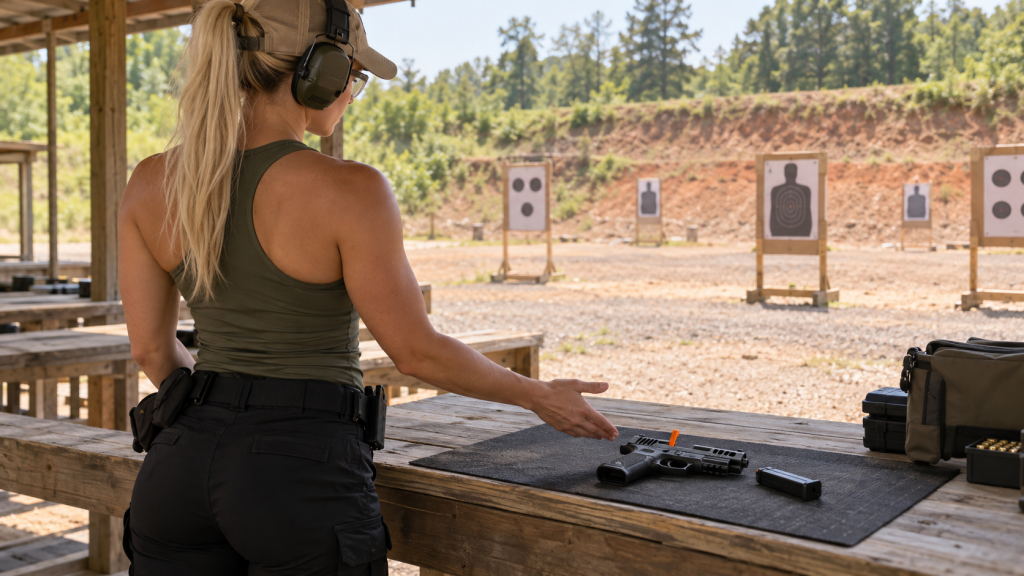
Our range influencer arrived wearing her usual tan cap, olive range top and black tactical pants. She placed the new pistol on the bench, inspected its chamber and announced that the compensator appeared “expensive enough to frighten a Glock.”

That seemed like a reasonable starting point.

What Is the SIG P385 MACH3D?

SIG Sauer introduced the P385 family⁠ on September 22, 2026. The new striker-fired 9mm pistol is built around a removable fire-control unit, but it is not merely a renamed P320.

The complete lineup includes:

  • SIG P385 MACH3D
  • SIG P385 Comp
  • SIG P385 Full
  • SIG P385 Carry
  • SIG P385 Compact

Every version has fully ambidextrous controls, SIG-LOC optics compatibility and an optional manual thumb safety. SIG plans to offer black and coyote-brown finishes.

The P385 also introduces SIG’s Recoil Dampening System, Trigger Block and MagStrap grip module. The low bore axis and recoil system are intended to reduce muzzle movement, while the interchangeable MagStrap components let the owner alter grip length and fit.

SIG claims at least a 20-percent reduction in muzzle rise, depending upon the model. The company says the MACH3D compensator pushes that reduction beyond 30 percent.

SIG P385 MACH3D Specifications

Our test pistol used the full-length MagStrap grip and accepted standard P320 magazines. The controls were easy to reach from either side, and the grip placed the firing hand noticeably higher than a conventional P320.

The headline feature is the additively manufactured MACH3D compensator. It gives the pistol an aggressive profile and directs expanding gas to counter muzzle rise. It also provides a useful answer to anyone who thought ordinary machined compensators were insufficiently futuristic.

The new P385 fire-control unit is serialized and removable, but it is not interchangeable with a P320 FCU. The P385 has its own internal architecture, recoil system, grip modules, slides and barrels.

That distinction matters. The SIG P385 uses P320 magazines; it does not magically transform a box of P320 parts into another pistol.

SIG P385 MACH3D 500-Round Range Report

We brought 500 rounds of 9mm ammunition:

  • 200 rounds of 115-grain full-metal-jacket ammunition
  • 200 rounds of 124-grain full-metal-jacket ammunition
  • 50 rounds of 147-grain subsonic ammunition
  • 50 rounds of common jacketed hollow-point defensive ammunition

The first magazine went to our influencer. She settled behind the bench, established a firm two-handed grip and fired five rounds at a ten-yard bullseye.

Her initial group measured just over two inches, with four rounds clustered tightly and one shot wandering left after she noticed the camera.

“That was a content flyer,” she explained.

We moved between seven, ten, fifteen and twenty-five yards. The P385 MACH3D handled the 124-grain ammunition best, producing consistent groups and mild recoil. The 115-grain loads felt slightly sharper, while the 147-grain ammunition produced more of a rolling push.

The compensator made the largest difference during quick pairs. The front sight returned rapidly, and the pistol remained remarkably level when fired with a strong grip. It did not eliminate recoil because physics remains stubbornly opposed to firearms marketing, but it made the recoil easier to manage.

SIG P385 MACH3D Reliability

We experienced one failure to feed during the first 100 rounds. It occurred with a fully loaded 21-round magazine and inexpensive 115-grain ammunition. A tap and rack returned the pistol to service, and the problem did not reappear.

The remaining 499 rounds fired without another stoppage. All four ammunition types locked the slide open on empty magazines, and the defensive loads fed correctly.

That is a good first result, but 500 rounds cannot establish the lifetime reliability of a new pistol platform. It can expose an obvious lemon and provide a useful first impression. It cannot tell us how the recoil system, compensator, extractor and optic mounting interface will look after 5,000 or 10,000 rounds.

Carbon accumulated around the compensator, especially after the 147-grain ammunition. Cleaning was not unusually difficult, although the MACH3D’s complex muzzle design has more corners than a conventional slide. People who become emotionally distressed by carbon should probably avoid compensated pistols and firearms generally.

SIG P385 MACH3D Accuracy

Our best five-shot group at fifteen yards measured approximately 1.7 inches with the 124-grain ammunition. At twenty-five yards, deliberate groups generally stayed between three and four inches.

The carbon-steel barrel and predictable trigger made careful shooting straightforward. The trigger had a defined wall, clean break and short reset. It was not a tuned competition trigger, but it was better than the vague, springy trigger found in too many factory striker-fired pistols.

Our influencer blamed the two wide shots on humidity, ammunition temperature and “an unexpected shift in the Earth’s magnetic field.” We blamed her.

SIG P385 MACH3D vs P385 Comp

The SIG P385 Comp uses a four-inch barrel and integrally compensated slide. The MACH3D uses SIG’s more elaborate additively manufactured compensator and occupies the premium position in the lineup.

The standard Comp is likely the sensible choice for most buyers. It should reduce muzzle movement without carrying the flagship model’s expected price premium. Its simpler muzzle design may also be easier to clean and accommodate in a holster.

The MACH3D is the choice for shooters who want the flattest factory P385, the most distinctive appearance and the newest manufacturing technology. During our range session, it remained remarkably level during rapid fire, but the practical difference between the two compensated configurations will require a direct side-by-side test.

SIG P385 vs P320

The P385 retains two of the P320’s strongest ideas: modularity and widely available magazines. SIG then built a new platform around a lower bore axis and redesigned FCU.

The principal differences include:

  • The P385 uses a new fire-control unit.
  • The P385 places the shooter’s hand higher.
  • The P385 incorporates its own recoil-dampening system.
  • The P385 uses the adjustable MagStrap grip.
  • The P385 is SIG-LOC optic-ready.
  • The P385 retains P320 magazine compatibility.

Buyers should not assume that P320 slides, barrels, FCUs, holsters or grip modules will fit. If SIG supports the P385 with replacement parts and grip options, the new platform could eventually offer the P320’s flexibility without inheriting all its baggage.

Readers comparing other new service-size pistols should see my FN 309 MRD review and Glock 19 comparison⁠.

SIG P385 MACH3D Price and Release Date

SIG announced that the P385 family would reach stores during fall and early winter 2026. The SIG P385 MACH3D release date is expected toward the later portion of that window.

Base P385 models reportedly start around $599, while early P385 Comp prices have appeared closer to $750. SIG did not publish a firm MACH3D price in its initial announcement.

The MACH3D will almost certainly cost more than the Full, Carry, Compact and ordinary Comp. Until an orderable production SKU appears with official pricing, precise numbers are speculation wearing a necktie.

SIG P385 Optics and Holster Compatibility

Every P385 is SIG-LOC optic-ready. Buyers should verify the exact interface before ordering an optic rather than assuming an existing P320 plate fits.

Holster compatibility presents the same problem. The trigger guard, slide geometry and MACH3D compensator differ from established P320 configurations. A defensive holster must protect the trigger completely and safely retain the exact pistol model.

Trying to force a new pistol into an “almost compatible” holster is how someone ends up explaining a preventable accident to an emergency-room nurse who has already heard every stupid excuse.

Final SIG P385 MACH3D Review

After 500 rounds, the SIG P385 MACH3D delivered soft recoil, little muzzle rise, useful accuracy and only one early stoppage. Its new FCU, low bore axis, P320 magazine compatibility and adjustable grip give it legitimate advantages over another cosmetic variation of an existing pistol.

The unresolved issues are price, long-term durability, holster availability and SIG’s willingness to provide magazines, spare parts and multiple MagStrap options. A modular platform is only genuinely modular when ordinary gun owners can purchase the components.

Our influencer gave the P385 MACH3D an enthusiastic recommendation, packed the pistol away and spent another twenty minutes photographing its compensator beside an energy drink.

Her final assessment was concise: “It is flatter than my range-review thumbnail.”

For once, she was correct.

GarandThumb.com was established on May 4, 2012, to document my experiences trying to become a better marksman.

Posted in XTC

Buying a Suppressor Without a Tax Stamp | Form 4473, SBRs and ATF’s New Rules⁠

Buying a suppressor without a tax stamp is now possible under ATF’s nationwide enforcement policy that took effect October 9, 2026. Individuals generally no longer need an approved Form 4 before acquiring a commercially manufactured suppressor, and ATF says an unlicensed individual no longer needs an approved Form 1 before privately making a suppressor, short-barreled rifle, short-barreled shotgun or “any other weapon.”

That does not mean silencers, SBRs and short-barreled shotguns have become completely unregulated.

The Gun Control Act still applies. Dealers still use Form 4473 and NICS. State and local restrictions remain in force. Interstate transfers and transportation still have rules. Machine guns and destructive devices remain fully subject to the National Firearms Act.

Most importantly, this is an ATF nonenforcement policy resting on a federal district-court decision, not a complete congressional repeal of the NFA. Anyone buying, making or transporting an unregistered firearm needs to understand what could happen if the policy changes.

Can You Buy a Suppressor Without a Tax Stamp?

Yes, at the federal level, ATF says it will no longer enforce the NFA’s prior-approval, registration and tax-stamp requirements for suppressors.

A dealer transferring a suppressor to an ordinary buyer should process the transaction under the Gun Control Act. That generally means:

  • Completing ATF Form 4473
  • Receiving an approved NICS background check unless an exemption applies
  • Confirming that the buyer is not prohibited from possessing firearms
  • Maintaining the dealer’s required transaction records
  • Complying with the buyer’s state and local laws

The transfer no longer requires an approved Form 4 under ATF’s current policy. The traditional $200 suppressor tax has also been reduced to zero.

That makes the process resemble an ordinary over-the-counter firearm purchase, although a suppressor remains a statutory firearm under federal law.

My earlier article on suppressor Form 4473 transfers without a Form 4⁠ examined the initial dealer guidance. The October 9 announcement is broader because ATF has now published a national policy covering transfers, possession, private making and interstate transportation.

Do You Still Need a Form 4 for a Suppressor?

ATF will continue accepting Form 4 applications voluntarily, but it no longer requires prior Form 4 approval for covered suppressor transfers under its present enforcement policy.

Voluntary registration may still interest buyers who live in states whose laws specifically depend upon federal NFA registration. It may also offer documentation if the federal government later changes its position.

That decision deserves careful thought. ATF says an owner may ask to remove an existing item from the National Firearms Registration and Transfer Record, but an item removed from the registry cannot simply be registered again later. Re-registration would generally require the attorney general to declare an amnesty.

In other words, deleting an existing registration is not a reversible protest button.

Do You Need a Form 1 to Make a Suppressor or SBR?

According to ATF’s October 9 guidance and FAQ⁠, an unlicensed individual no longer needs prior ATF approval under the NFA before privately making a suppressor, short-barreled rifle, short-barreled shotgun or qualifying “any other weapon.”

ATF will still accept voluntary Form 1 applications.

The agency’s language does not erase the rest of federal firearm law. An individual cannot manufacture firearms as a business without the necessary federal license and special occupational tax. A prohibited person cannot possess the resulting item. Interstate transfers remain restricted, and state or local law may forbid the project entirely.

The federal change is not permission to start cutting barrels or manufacturing suppressors before checking every law that applies where you live. “ATF is not enforcing this NFA provision” and “nothing can legally go wrong” are very different statements.

Can an FFL Transfer a Suppressor on Form 4473?

Yes. ATF directs FFLs to handle suppressor and AOW transactions as transfers of statutory firearms under the Gun Control Act.

That means a dealer must obtain Form 4473, conduct the required NICS check, keep the appropriate records and follow state residency restrictions.

ATF says dealers may also transfer suppressors between qualified FFLs without mandatory Form 3 approval. A Form 3 may still be submitted voluntarily.

Dealers engaged in manufacturing, importing or selling NFA firearms must continue paying the applicable special occupational tax. Congress eliminated the making and transfer taxes on covered items, but it did not eliminate those business taxes or federal licensing obligations.

What About SBR and Short-Barreled Shotgun Purchases?

Short-barreled rifles and short-barreled shotguns present an additional Gun Control Act problem.

Federal law generally prohibits an FFL from transferring an SBR or SBS without authorization from the attorney general. Historically, the approved NFA transfer supplied that authorization. The district court enjoined the NFA approval process without creating a replacement procedure under the Gun Control Act.

ATF says it is developing new forms and regulations. Until that system exists, the agency says it will exercise enforcement discretion and will not enforce the affected Gun Control Act transfer restriction.

That allows dealers to transfer covered SBRs and short-barreled shotguns under the current policy, but the legal structure is less clean than the process for suppressors. Buyers should expect dealers to proceed cautiously while ATF develops its replacement system.

Can You Travel With an Unregistered Suppressor?

ATF says it will not enforce the NFA prohibition against interstate transportation of an unregistered suppressor or other covered $0-tax item.

That does not override state law. A suppressor that is lawful in the state where a trip begins may be prohibited at the destination or in a state crossed along the way.

Short-barreled rifles and short-barreled shotguns have another requirement. ATF says individuals must continue filing Form 20 before transporting an SBR or SBS across state lines, even when the firearm is unregistered.

The practical distinction is:

  • Suppressor: No Form 20 requirement identified in ATF’s new FAQ, but every applicable state law still matters.
  • SBR or SBS: Form 20 remains required for interstate transportation.
  • Machine gun or destructive device: The complete NFA system remains applicable.

Moving, attending an out-of-state match, hunting across state lines or sending a firearm to a manufacturer for repair can all create interstate issues. Check the law before the item enters the vehicle, not while explaining the situation beside the highway.

Can You Privately Sell an Unregistered Suppressor?

ATF says an unlicensed individual may transfer a covered item without prior NFA approval under the agency’s present policy.

The Gun Control Act still prohibits an unlicensed person from transferring a firearm to someone the seller knows or reasonably believes is prohibited. An unlicensed person also generally cannot directly transfer a firearm to a resident of another state.

State laws may require dealer involvement, background checks, permits or federal registration. Some states prohibit suppressors, SBRs or short-barreled shotguns entirely. Others define lawful possession by reference to compliance with the NFA, creating uncertainty when an item is federally unregistered but tolerated under an ATF enforcement policy.

ATF expressly says it cannot promise that state authorities will consider an unregistered item lawful.

Are Machine Guns and Destructive Devices Included?

No.

Machine guns and destructive devices remain taxable NFA firearms. Their transfer, making, registration and possession requirements remain in force.

The October 9 policy applies to the categories for which Congress reduced the making and transfer taxes to zero:

  • Suppressors or silencers
  • Short-barreled rifles
  • Short-barreled shotguns
  • “Any other weapons” as defined by federal law

This does not turn a CMP M14 receiver into a transferable semiautomatic rifle. The federal government’s “once a machine gun, always a machine gun” position remains separate from the new treatment of $0-tax items. My article on the CMP M14 sale and machine-gun classification⁠ covers that issue.

What Happens if ATF Starts Enforcing the NFA Again?

This is the largest unanswered question.

ATF states that enforcement could resume if:

  • The district court’s injunction is reversed or dissolved
  • Congress imposes another tax
  • The Department of Justice rescinds the national enforcement policy
  • Other legal or factual circumstances change

The NFA treats unregistered firearms as contraband and provides felony penalties and forfeiture. ATF’s FAQ does not promise automatic grandfathering for people who acquire or manufacture unregistered items under the new policy.

It also does not promise a future registration window. The attorney general could declare a temporary amnesty, but federal law does not require one.

That is why the October 9 change is simultaneously a major victory and a calculated risk for owners who choose to remain outside the voluntary registry.

The government created this uncertainty. Congress reduced the tax to zero, a federal court rejected continued enforcement of the tax-based registration system, and ATF responded with national enforcement discretion instead of a durable statutory solution.

Private gun owners should not have needed federal permission to possess ordinary suppressors and short-barreled firearms in the first place. Nevertheless, pretending the remaining legal uncertainty does not exist would be irresponsible.

Bottom Line on Buying a Suppressor Without a Tax Stamp

Under ATF’s policy effective October 9, 2026:

  • A buyer can acquire a suppressor from a dealer using Form 4473 and NICS without mandatory Form 4 approval.
  • An unlicensed individual does not need prior Form 1 approval to make a covered item under the NFA.
  • NFA registration remains available voluntarily.
  • SBR and SBS interstate transportation still requires Form 20.
  • State and local firearm laws still apply.
  • Machine guns and destructive devices remain fully regulated under the NFA.
  • The policy could change, and ATF does not promise grandfathering or a future amnesty.

The tax stamp may be gone for covered firearms, but judgment is still required. Read the official guidance, verify the law where you live and preserve records showing when and how the item was lawfully acquired.

The Second Amendment does not contain a barrel-length chart, a suppressor waiting period or an exception allowing unelected agencies to ration ordinary arms. October 9 was a substantial step toward treating peaceful gun owners like citizens rather than applicants. Congress should finish the job by repealing the remaining federal restrictions instead of leaving Americans dependent upon enforcement discretion.

GarandThumb.com was established on May 4, 2012, to document my experiences trying to become a better marksman.

Posted in XTC

CZ DUTY Review | Specs, Price, Optics, Magazines and CZ P-10 Comparison⁠

The CZ DUTY is a new modular, striker-fired 9mm pistol built around a serialized internal chassis. Introduced in October 2026, the American lineup includes compact and full-size configurations, optional manual safeties, direct-mounted optics and a $729 manufacturer’s suggested retail price.

This CZ DUTY review examines the verified specifications, CZ DUTY price, magazine compatibility, optics footprint, holster availability, concealed-carry potential, reliability claims and potential problems. I have not fired the pistol, so this is not a manufactured “500-round review” assembled from a press release and three photographs.

The important question is whether the CZ DUTY offers enough practical improvement to compete with the CZ P-10 C, Glock 19, SIG P320 and other established defensive pistols.

CZ DUTY Review: Four Launch Models

CZ introduced four initial 9mm configurations:

  • CZ DUTY 4.0C: Compact configuration without a manual safety
  • CZ DUTY 4.0C MS: Compact configuration with an ambidextrous manual safety
  • CZ DUTY 4.0F: Full-size configuration without a manual safety
  • CZ DUTY 4.0F MS: Full-size configuration with an ambidextrous manual safety

The compact CZ DUTY 4.0C accepts 15-round and 17-round magazines. The full-size CZ DUTY 4.0F accepts 17-round and 19-round magazines. Ten-round versions are available for jurisdictions that punish ordinary gun owners for possessing standard-capacity magazines.

All four configurations have a $729 MSRP. United States availability began October 6, 2026, according to the CZ DUTY launch announcement⁠.

CZ says the DUTY is a separate pistol family rather than a replacement for the P-10 series.

CZ DUTY Specifications and Modular Chassis

The defining CZ DUTY feature is its serialized internal chassis.

On a conventional polymer pistol, the frame is normally the regulated firearm. The CZ DUTY places the serialized fire-control components inside a removable chassis. That should allow an owner to install compatible grip modules while retaining the same legally controlled component.

It places the CZ DUTY in the same broad modular-pistol category as the SIG P320 and other chassis-based designs. It does not mean that parts are interchangeable among those platforms.

CZ lists small, medium and large grip configurations intended to change palm fit and trigger reach. The standard frame is fiberglass-reinforced polymer, while the cold-hammer-forged barrel receives a nitride finish.

Published CZ DUTY features include:

  • Removable serialized chassis
  • Striker-fired operating system
  • Cold-hammer-forged barrel
  • Nitride-finished metal components
  • Fully ambidextrous slide releases
  • Ambidextrous magazine controls
  • Optional ambidextrous manual safety
  • Trigger-free disassembly
  • Interchangeable grip modules
  • Loaded-chamber indicator
  • Lower-third co-witness sights
  • Luminescent or tritium sight options
  • Accessory rail
  • Replaceable magazine sleeves and baseplates
  • Factory accuracy testing and zeroing at 25 yards

CZ also claims a 50,000-round service life, a 10,000-round no-parts-replacement period and successful testing with 25,000 DM51 overpressure cartridges producing approximately 30 percent more pressure than standard ammunition.

Those are manufacturer claims, not independent Garand Thumb testing. Still, they establish the durability standard CZ says it designed the DUTY to meet.

CZ DUTY Optics Footprint

The CZ DUTY optics system is more interesting than another generic “optics-ready” slide.

Instead of requiring one universal adapter plate, CZ designed the slide to accept several popular red-dot footprints directly with an included pin system.

CZ identifies direct compatibility with:

  • Trijicon RMR-pattern optics
  • Shield RMSc-pattern optics
  • Holosun K-pattern optics
  • Leupold DeltaPoint Pro-pattern optics

CZ says aftermarket plates will support additional enclosed-emitter sights, including the Aimpoint ACRO and Holosun HE509T.

Direct mounting can position an optic lower on the slide while eliminating a separate adapter plate. Fewer components also mean fewer screws and mating surfaces that can loosen. However, owners must still use the correct pins, screws and torque specifications for their selected optic.

Do not assume that every sight advertised as “RMR compatible” includes screws of the proper length. An excessively long screw can interfere with internal components. A short screw may provide inadequate thread engagement.

Anyone preparing a CZ DUTY for defensive use should follow CZ’s instructions, degrease the specified threads, apply the recommended thread-locking compound, witness-mark the screws and confirm zero after firing.

My EOTECH EXPS3 HD review⁠ makes the same larger point about electronic sights: features are useful, but installation, battery maintenance and zero confirmation remain the owner’s responsibility.

CZ DUTY Magazines and Compatibility

The CZ DUTY uses 15-round, 17-round and 19-round magazine configurations, along with restricted 10-round versions.

The compact DUTY 4.0C can accept the longer magazines with matching sleeves. CZ also advertises interchangeable baseplates, including extended-capacity options.

The important unanswered question is whether CZ DUTY magazines are compatible with the CZ P-10, P-09 or other CZ pistols.

CZ’s introductory material describes them specifically as CZ DUTY magazines and does not promise backward compatibility with existing P-10 magazines. Until CZ publishes an explicit compatibility chart, buyers should assume that older magazines may not fit or function correctly.

Physical insertion is not proof of safe compatibility. Magazine-catch geometry, feed-lip dimensions, follower design, insertion depth and slide-lock engagement all matter.

This could substantially change the practical CZ DUTY price. A $729 pistol becomes more expensive if the buyer also needs five proprietary magazines, another holster and additional grip modules.

CZ DUTY Holster Compatibility

The CZ DUTY is a new pistol with a different frame, slide and control arrangement. Owners should not assume that a CZ P-10 C holster will properly retain a DUTY 4.0C.

A loose holster can release the pistol unintentionally. A poorly fitted holster can interfere with the trigger, magazine release, manual safety or optic.

Weapon-mounted lights complicate the matter because many light-bearing holsters index primarily on the light. That may permit a new pistol to enter an existing holster, but it does not guarantee proper retention or complete trigger-guard coverage.

Buy a holster specifically identified for the exact CZ DUTY model, optic configuration, safety arrangement and weapon light. Test retention with the unloaded pistol before carrying it.

The aftermarket will probably respond quickly if the CZ DUTY sells, but buyers should verify actual availability instead of purchasing the pistol because a manufacturer says holsters are “coming soon.”

CZ DUTY 4.0C for Concealed Carry

The CZ DUTY 4.0C is the obvious concealed-carry configuration.

Its 15-round magazine provides compact dimensions, while the compatible 17-round magazine offers additional capacity. A larger magazine can also serve as a practical spare.

Potential concealed-carry advantages include:

  • Compact slide and grip configuration
  • 15-round standard capacity
  • Direct-mounted optic options
  • Ambidextrous controls
  • Trigger-free disassembly
  • Optional manual safety
  • Adjustable grip fit
  • Compatibility with larger CZ DUTY magazines

The manual-safety model may appeal to shooters who prefer a positive external control. The standard 4.0C will feel more familiar to people accustomed to striker-fired pistols without thumb safeties.

Neither arrangement excuses careless handling. A defensive handgun belongs in a rigid holster that completely covers the trigger guard. A manual safety supplements proper handling; it does not replace it.

CZ DUTY vs CZ P-10 C

The CZ DUTY does not make the CZ P-10 C obsolete.

Both are polymer-framed, striker-fired defensive pistols, but the DUTY adds:

  • A removable serialized chassis
  • Replaceable grip-module possibilities
  • Broader direct-mount optics support
  • Optional manual safeties
  • Trigger-free disassembly
  • A newly designed magazine system

The P-10 C has the advantage of maturity. Magazines, replacement parts, holsters and years of owner experience already exist. Discounted P-10 pistols may also cost substantially less than the CZ DUTY’s $729 MSRP.

The DUTY offers more modularity. The P-10 offers an established support network.

Someone who already owns numerous P-10 magazines and holsters should not switch merely because CZ released something new. A first-time CZ buyer interested in chassis modularity, direct optic mounting or an optional thumb safety has a stronger reason to consider the DUTY.

CZ DUTY vs Glock 19

The CZ DUTY 4.0C will inevitably be compared with the Glock 19.

The Glock’s advantages include an enormous supply of magazines, replacement parts, sights and holsters. Its reliability record comes from decades of military, police and private use.

The CZ DUTY counters with:

  • A removable fire-control chassis
  • Multiple factory grip configurations
  • Optional ambidextrous manual safety
  • Direct support for several optic footprints
  • Trigger-free disassembly
  • More extensive factory ambidextrous controls

The DUTY may provide more features directly from the factory. The Glock 19 provides an unmatched support system and a thoroughly documented service history.

A specifications table cannot decide which grip, trigger or recoil impulse works better for an individual shooter. Those require handling and live fire.

Readers comparing new defensive pistols may also find my FN 309 MRD review⁠ useful. The FN takes a different approach with an internal hammer, compact dimensions and a lower suggested retail price.

CZ DUTY Reliability, Accuracy and Reported Problems

The pistol is too new for an honest long-term CZ DUTY reliability verdict.

CZ’s endurance claims are impressive, but manufacturer testing cannot replace years of independent use. Early CZ DUTY reviews should be examined for documented ammunition types, actual malfunctions, multiple magazines and measurable accuracy rather than dramatic thumbnails.

Potential CZ DUTY problems to watch include:

  • Magazine availability and price
  • Unconfirmed compatibility with older CZ magazines
  • Limited model-specific holster selection
  • Availability of replacement grip modules
  • Improper optic screws or mounting pins
  • Replacement-parts availability
  • Aftermarket support
  • Street price compared with discounted P-10 pistols
  • Long-term chassis and frame fit
  • Reliability with defensive hollow-point ammunition

There is currently no verified basis for declaring the CZ DUTY unreliable. There is equally little basis for declaring it the new king of defensive pistols.

The correct answer requires ammunition, magazines, time and transparent reporting.

Is the CZ DUTY Worth $729?

The CZ DUTY appears to be a serious modern service pistol rather than a cosmetic P-10 update.

Its serialized chassis, direct optics system, four launch configurations and optional manual safety give it a useful identity. The compact CZ DUTY 4.0C may be particularly attractive for concealed carry, while the CZ DUTY 4.0F better suits home defense, duty use and shooters who prefer a full-size grip.

Still, the $729 MSRP places it against proven pistols with cheaper magazines and far more holster support. The DUTY must demonstrate that its modularity provides practical value rather than merely giving owners additional pieces of polymer to purchase.

For now, the CZ DUTY is promising, intelligently configured and worth watching. It is not yet proven. That distinction matters when choosing a firearm intended to protect your life.

GarandThumb.com was established on May 4, 2012, to document my experiences trying to become a better marksman.

Posted in XTC