
The revived Smith & Wesson Model 22 Classic is a four-inch, fixed-sight N-frame revolver capable of firing both .45 ACP and .45 Colt. The .45 ACP cartridges require moon clips, while rimmed .45 Colt ammunition loads directly into the cylinder.
That dual-caliber arrangement makes the new Model 22 considerably more interesting than another expensive historical reproduction. It can digest ordinary .45 ACP at the range, fire traditional .45 Colt loads without clips and still look like a proper blued Smith & Wesson revolver.
We brought the four-inch Model 22 Classic, 120 rounds of ammunition and the five supplied full-moon clips to the range to determine whether the practical model deserves its $1,299 suggested price.
Smith & Wesson Model 22 Classic Specifications
Smith & Wesson announced the Model 22 Classic alongside the longer Model 22 of 1917 Classic on October 27, 2026.
The four-inch revolver has the following factory specifications:
- Chambering: .45 ACP and .45 Colt
- Capacity: six rounds
- Action: double-action and single-action
- Frame: blued carbon-steel N-frame
- Barrel: four inches
- Twist rate: 1:16-inch right hand
- Front sight: black serrated ramp
- Rear sight: fixed frame trench
- Overall length: 9.38 inches
- Height: 5.38 inches
- Width: 1.71 inches
- Weight: 34.6 ounces
- Grips: smooth walnut
- Included moon clips: five
- Internal lock: none
- MSRP: $1,299
The cylinder is cut for moon clips and configured to accept both .45 ACP and .45 Colt. Smith & Wesson’s announcement confirms that the shorter Model 22 loads .45 ACP with clips while .45 Colt can be inserted normally.
The absence of an internal lock is especially welcome. A blued N-frame with walnut stocks and a lanyard loop does not need a lock hole drilled into its side like a government-mandated beauty mark.
Model 22 Range-Test Ammunition
The range bag contained:
- 72 rounds of 230-grain .45 ACP full-metal-jacket ammunition
- 48 rounds of standard-pressure 250-grain .45 Colt lead round-nose flat-point ammunition
- Five factory-supplied full-moon clips
- A basic moon-clip unloading tool
- Paper bullseye targets
- A sandbag rest
We fired the revolver both double-action and single-action from seven, 15 and 25 yards. The measured accuracy groups were fired single-action from a supported position.
The Model 22 received only a quick inspection and light lubrication before shooting. No polishing, spring changes or sight work was performed.
Loading .45 ACP With Moon Clips
The supplied moon clips held six .45 ACP cartridges apiece. Once loaded, each clip dropped into the cylinder as a single unit. That makes a full reload dramatically faster than inserting six individual cartridges.
Extraction was equally positive. Pressing the ejector rod removed all six fired cases and the clip together without leaving one stubborn case behind.
Loading the clips by hand was manageable. Removing fired cases without the unloading tool was less entertaining. After sacrificing enough thumbnail to prove the point, we used the tool for the remainder of the session.
None of the five clips produced cylinder drag, light primer strikes or failures to seat. Nevertheless, moon clips are thin pieces of spring steel. Tossing them loose into a range bag beneath ammunition cans is an excellent way to turn dependable equipment into a bent nuisance.
Smith & Wesson Model 22 .45 ACP Accuracy
The Model 22 immediately showed why large-frame Smith & Wesson revolvers remain pleasant range guns.
Recoil from standard 230-grain .45 ACP was a broad rearward push rather than a sharp snap. The revolver’s 34.6-ounce weight and full-size grip absorbed enough movement that the sights returned naturally after each shot.
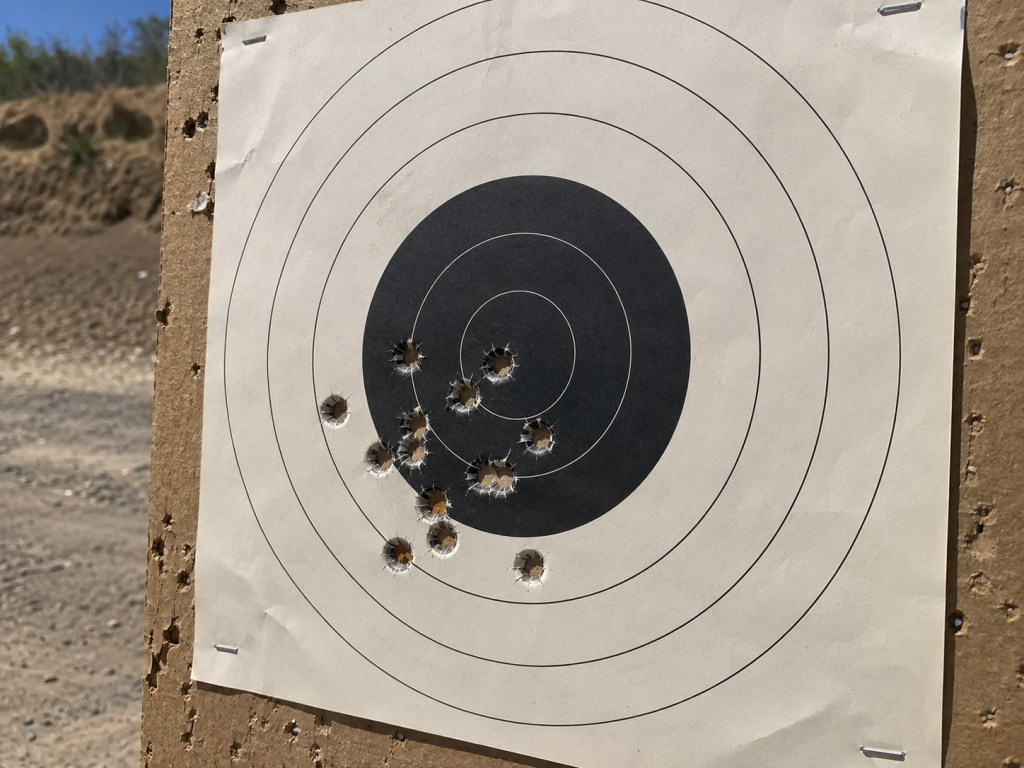
At 15 yards, three supported six-shot groups averaged 2.9 inches. The best measured 2.4 inches, with five shots clustered tightly and one opening the group along the lower edge.
Target photo: Three cylinders of 230-grain .45 ACP fired single-action at 15 yards.
The fixed sights placed the .45 ACP load slightly below the center of the bullseye when using a conventional center hold. That is preferable to a large unexplained horizontal correction and easy to accommodate once confirmed.
Double-action shooting at seven yards produced a fist-sized center group when the trigger was pressed continuously. Staging the trigger made the sights wobble more, not less. The Model 22 rewarded a smooth pull and punished attempts to negotiate with it halfway through the stroke.
Shooting .45 Colt From the Same Cylinder
Switching to .45 Colt required no moon clips and no mechanical changes. Open the cylinder, load six rimmed cartridges and close it.
The longer cartridges made the Model 22 feel like a different revolver. Recoil remained comfortable with the standard-pressure load, but the gun rolled farther upward than it did with .45 ACP. The sensation was slower and heavier without becoming abusive.
The .45 Colt cases extracted cleanly. Because their rims provide the ejector something to push against, the star lifted all six cases normally without clips.
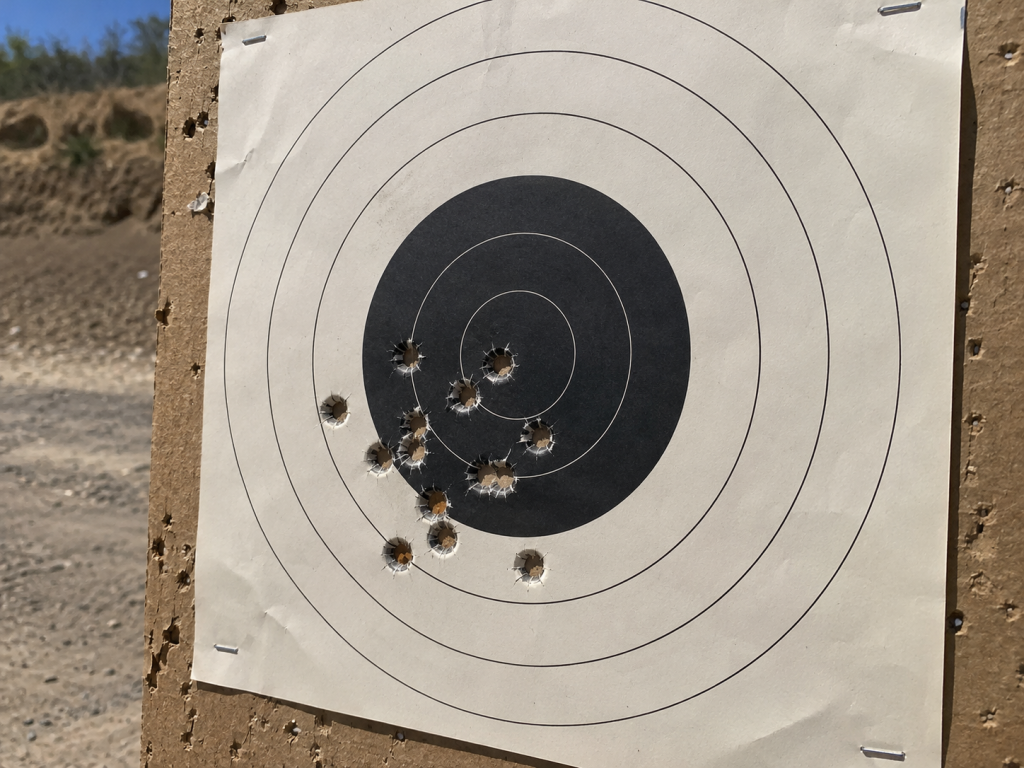
At 25 yards, three supported six-shot groups averaged 4.4 inches. The best group measured 3.8 inches. The .45 Colt load struck approximately three inches higher and slightly right of the .45 ACP point of impact.
Target photo: Three cylinders of 250-grain .45 Colt fired single-action at 25 yards.
That shift is important because the Model 22 uses fixed sights. The revolver cannot be instantly adjusted when changing cartridges, bullet weights or velocities. An owner should test the actual ammunition intended for field use instead of assuming every .45-caliber load will land in the same place.
Model 22 Trigger and Handling
The single-action trigger broke cleanly after a small amount of movement. It was not a fragile target trigger, nor should it be on a general-purpose fixed-sight revolver, but it allowed precise shooting without disturbing the sights.
The double-action stroke was heavier and substantially longer. It remained consistent throughout the cylinder, with no obvious stacking near the end of the pull.
Smooth walnut stocks certainly look correct. Under recoil, however, their lack of texture allowed the revolver to shift slightly in the hand. That was barely noticeable with .45 ACP and more apparent with .45 Colt.
The four-inch barrel balanced well. It kept enough weight forward to settle the sights without making the revolver feel like it wanted to dive out of the holster. The serrated ramp front sight was also easier to see than the rounded half-moon blade used on the longer 1917-style model.
Reliability and Reported Model 22 Problems
The revolver completed all 120 rounds without a misfire, sticky case or failure to rotate.
We found no obvious timing problem, excessive endshake or inconsistent lockup. The ejector rod remained tight, the grips did not move and all five moon clips continued to fit properly.
That does not establish long-term reliability for an entire production line. These revolvers are new, and a single range session cannot reveal what thousands of rounds or years of carry might uncover.
Prospective buyers should inspect:
- Timing in every chamber
- Cylinder lockup
- Barrel-to-cylinder gap
- Ejector-rod operation
- Moon-clip fit
- Clearance between loaded clips and the recoil shield
- Point of impact with the intended ammunition
- Finish condition around the cylinder and sideplate
A bent moon clip can imitate a revolver problem by dragging against the frame. Check the clip before blaming the gun.
Is the New Smith & Wesson Model 22 Worth $1,299?
The Model 22 Classic is expensive for a fixed-sight revolver. It also offers something few current handguns provide: a traditionally finished, lock-free N-frame that fires both .45 ACP and .45 Colt.
The .45 ACP capability makes regular practice easier and provides remarkably fast revolver reloads. The .45 Colt chambering eliminates the need for clips and gives the Model 22 the character expected from a large American revolver.
Buy the longer Model 22 of 1917 Classic if historical appearance matters most. Buy the four-inch Model 22 Classic if the gun will spend more time at the range, in a field holster or beside a box of ammunition than it will inside a display case.
This is not a polymer carry pistol, a competition revolver or an optics-ready tactical contraption. It is a blued, walnut-stocked sixgun chambered for two of America’s great .45-caliber cartridges.
Smith & Wesson did not attempt to make the Model 22 modern. It made the revolver useful again.
GarandThumb.com was established on May 4, 2012, to document my experiences trying to become a better marksman.