CMP M14 Rifles Are Finally Coming. Here’s Why This Could Be the Biggest CMP Release in Years.

If your social media feed has been full of CMP M14 posts today, you’re not imagining it.

After years of rumors, the Civilian Marksmanship Program has confirmed that authentic U.S. military M14 rifles are headed to the CMP. Before they’re sold, they’ll be permanently converted to semi-automatic configuration in accordance with federal law. While the CMP hasn’t released pricing or ordering details yet, the announcement has already set the firearms community on fire.

For many shooters, this is the announcement they’ve been waiting decades to hear.

The M14 Is Different

The M14 has always occupied a special place in American firearms history.

It was America’s last standard-issue battle rifle chambered in 7.62 NATO before the military transitioned to the M16. It served with distinction, remained in military service long after its official replacement, and continues to be recognized at matches like the CMP’s M14 Heritage Match.

Unlike commercial M1A rifles, these are expected to begin life as genuine U.S. military M14s before conversion.

That’s a big deal.

Everyone Wants to Know One Thing

How much will they cost?

It’s probably the biggest debate online right now.

Some shooters hope the CMP prices these rifles far below market value so more people can own one.

Personally, I hope they don’t.

Why I Hope the CMP Charges Market Value

That might sound strange coming from someone who’d love to own one.

But here’s the thing.

The CMP isn’t supposed to be the cheapest place to buy military rifles.

The Civilian Marksmanship Program exists to promote marksmanship, firearm safety, and competition. Rifle sales are simply how that mission is funded.

Every dollar the CMP earns goes back into things that actually grow the shooting sports, junior marksmanship, Camp Perry, the National Matches, affiliated clubs, coaching, range improvements, and safety education.

If these rifles are worth market value, then the CMP should receive market value.

Otherwise someone else will.

Don’t Fund Flippers

We’ve seen this movie before.

A collectible rifle gets priced well below what it’s could sell for.

Within days, they’re listed online for thousands more.

The buyer profits.

The reseller profits.

The CMP, the organization that actually supports competitive shooting and preserves America’s marksmanship tradition, loses out.

I’d rather see every extra dollar go toward junior shooters than toward someone’s GunBroker listing.

If anyone should benefit from the value of these rifles, it should be the organization that will use those funds to keep American marksmanship alive.

What Happens Next?

Right now we still don’t know:

  • Official pricing
  • Purchase limits
  • Rifle grades
  • Ordering procedures
  • How many rifles will ultimately be available

Those answers will come directly from the CMP over the coming months.

Until then, expect plenty of speculation.

Final Thoughts

The CMP M14 announcement isn’t just another surplus rifle release.

It’s an opportunity.

An opportunity to preserve history.

An opportunity to strengthen the Civilian Marksmanship Program.

And an opportunity to invest in the next generation of American shooters.

If the CMP prices these rifles at their true market value, I’ll be perfectly happy knowing those dollars are helping fund Camp Perry, junior programs, the National Matches, and the future of competitive marksmanship.

That’s exactly what the Civilian Marksmanship Program was created to do.

We’ll continue following the CMP M14 release here on GarandThumb.com as more information becomes available.

Keywords: CMP M14, CMP M14 rifles, Civilian Marksmanship Program, M14 for sale, Camp Perry, National Matches, M14 Heritage Match, U.S. military M14, military surplus rifles, Service Rifle, marksmanship, CMP news

Going Distinguished At Camp Perry!

In 2015 a earned my first 4 “Introductory Leg Points” during small arms firing school at Camp Perry. Four years, and thousands of rounds down range later I’ve completed my journey to become a Distinguished Rifleman on the very same range I found my first points.

If you are not familiar with the Distinguished Rifleman badge you can find more information here: http://thecmp.org/competitions/distinguishedbadges/.

To earn a Distinguished Rifleman’s Badge one must earn 30 “leg” points by competing in CMP sanctioned excellence in competition (EIC) matches and scoring in the top 10%. Competitors are limited to 5 matches a year along with the National Trophy Match at camp Perry.

I ended last season with 26 points, which included a “Hard Leg” so “all I needed” was to cut any points. Which I knew was easier said than done. I shot the All Navy Matches at Quantico in the spring posting a 481, a good score, but not even good enough for first leather! The cut went for 486!

Anyway I decided to give the KTS Targets another chance and drove out to Perry to shoot a double-header 800 agg and EIC. I have had some “not so great” experiences with KTS Targets, including the last time o drove to Perry for this June EIC Match. I was a little hesitant to shoot a leg match on KTS again but in the end I’m glad I did.

The 800 agg went well we had some connection issues and a delay at 200 but it was nice to take a little break.

The leg match started off terrible for me. I lost focus half way though off hand and broke a 6 on the approach. Then decided to get mad about it and shoot another 6. Good times.

I shook it off, which was easy as it was not nearly the first time I threw a leg match off hand. I stuck with it and I took my in sitting for a 99, I cleaned rapid prone, which is a fairly rare occasion for me, and squeezed out a 196 at 600. I am sure my sigh was audible from Canada when my last shot came up an X!

From the rubble of my terrible first string I was able to pull a 480-19 which was good enough for 7th of the 8 legs given out that day! I was in shock for a while afterwards, after the high cut at fleet week I didn’t want to get “too sure” until the numbers were official. But after the dust settled it turned out both myself and one of my buddies who came out with me legged out on Viale!

It was a long but great day! It felt good to leg out at Camp Perry which is a special place to a lot of shooters. As much trouble as they have given me over the years never thought I’d be saying I legged out on KTS Targets!

It’s been a long road to Distinguished. My wife asked me “what will you do now can you leg back in?” Keep shooting that’s what I’ll do!

SCATT Trainer: More Trigger Time More Often!

Over the winter before the 2016 season, I bought a SCATT USB Trainer. Which is a nifty program that allows me to see where my dry fire shots actually go. As it turns out they are not all Xs.

How It Works

I have the USB model. I went with this one for 2 reasons. First, It was the cheapest, but more than that I knew I wouldn’t keep the battery charged in the wireless version.

The system consists of a target frame, a sensor, a target controller, software and wires to connect them all together.

The rifle mounted unit uses an optical sensor to track where it’s being pointed at on the target, and a microphone to tell the software when the user clicks the trigger.

It’s a nice simple design that allows the user to focus on practice not messing with the setup. I use the rail mount for the sensor which allows me to put it back on the same spot quickly so I can just take a couple of sighters, move the spotter to where my call was and get back to practicing.

Why Should I Get This?

The way I see it there are 3 key benefits of SCATT Shooter Training Systems.

1. More trigger time, more often. This is the biggest advantage of the SCATT trainer in my option . Even if I leave all my Highpower stuff in my truck ready to go, and I’m lucky enough to live 23 minutes from the nicest range on the East Coast. There is still an hour wasted in logistics, driving, and setting up targets. With SCATT, 5 minutes and I’m “shooting.” Which let’s me squeeze in trigger time whenever I can.

2. Ammo and costs This one is obvious but it saves on a wear of your rifle as well. Even handloading isn’t free.

3. Instant feedback with the equipment you use for matches. It has helped me work on parallax, rebuild my positions which would have taken days at the range. The traces have really helped me “get to know” my shots to the point now when I make a bad shot on a real target, I can picture the trace in my head.

When I first got this system it was so I could see if my dry fire shot was a 10 or a 7. But I’ve noticed, after using it for 2 years, as my shooting slowly improves, the traces make more sense and show me things I can work on.

Tips For SCATT users.

1. Find a dedicated place you can keep it set up and ready to use.

For awhile I horsed around with a windows tablet, then using my primary laptop, but I end up buying a cheap windows laptop to dedicate to just the SCATT. If I only have to put on my jacket and pick up my rifle I’m much more likely to make time to practice

2. Point a bright light at the target. This is an easy way to help boost contrast for both your eyes and the target sensor.

3. Commit to using it as much as you can. Personally I try to shoot a quick string of 10, just like a match between work and dinner.

What model should I get?

There are 3 versions, Basic, USB, wireless and a live fire version. I recommend the USB to people when they ask for a few reasons. First, as I mentioned, I don’t have to worry about charging it. The basic doesn’t include Service Rifle Targets, but if all you can afford is the basic, get it, it’s better than a dot on the wall!

The live fire version looks neat and I’d love to play with one, but it was out of budget for me. I wouldn’t try to use it in a match but it would be neat to use while practice.

Garand Thumb Goes West: 2017 Creedmoor Cup at Ben Avery

GTB Shooting Team (aka my shooting buddy and I) has traveled to distant matches in the past, including flying to Ben Avery in 2015. This time, however, we drove the 5000 mile round trip to Ben Avery. The drive itself was an epic adventure. We saw The Great Smoky Mountains, the Ozarks, the Plains, the desert, Table Mesa and the Grand Canyon. As an added bonus I now know what its like to travel 40 hours straight without sleep… weird.

The Creedmoor Cup at Ben Avery 

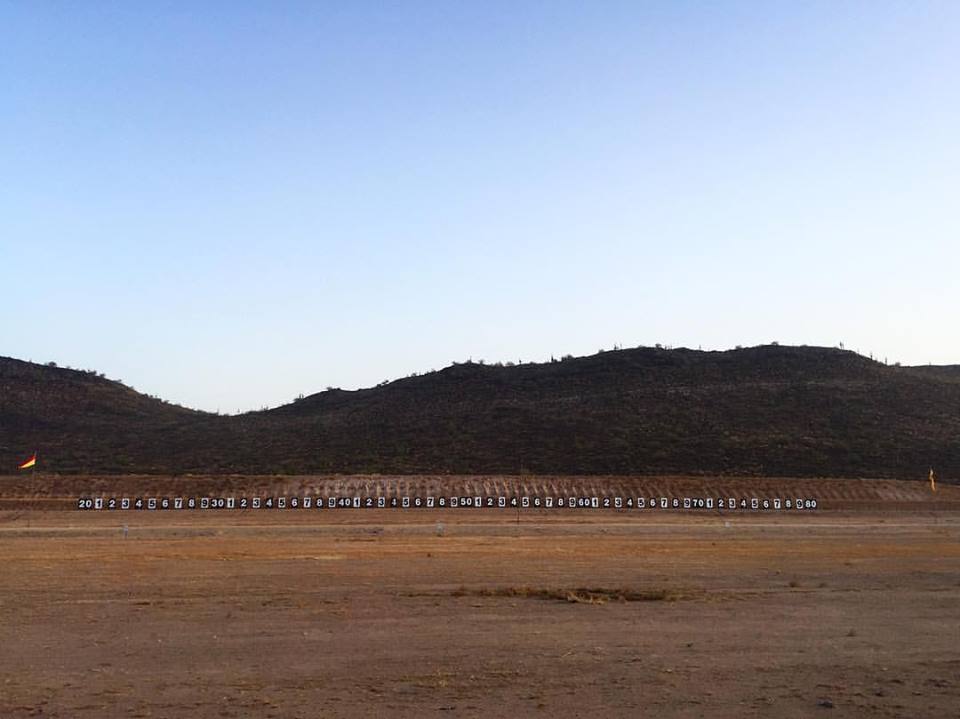
Ben Avery is a beautiful facility, 150 firing points, a shaded pit, easy to use cantilever target carriers, and all the sun you could ask for. The Creedmoor Cup consists of three 800 aggs on Thursday, Friday, Saturday, followed by an EIC on Sunday.

The matches were a lot of fun and I learned a lot while I was out there. Ben Avery has some sporty wind. At one point there were 5 minute wind shifts between shots at 600. Reading the mirage was a lot more useful than the flags. The wind was generally a head or tail wind so trying to determine angle from a flag was a futile exercise.  The mirage off the 300 yard berm did not lie, of course one has to take their eyes off the spotting scope to squeeze the trigger.

Phoenix is a beautiful place and Creedmoor Sports ran a great match. Dennis Demille, the GM of Creedmoor Sports, announced that this was the last Creedmoor Cup. I’ve shot in 3 of them now and I will miss the Cup next year.  CMP will be absorbing the Cup Matches into their “CMP Cup” format using KTS targets. I have mixed feelings about this change as my experience with the CMP KTS targets has been very poor. However I look forward to shooting at Ben Avery again in the future.

Revenge Of The 100,000 CMP 1911s: It Could Happen This Time

Back in 2015 there was an attempt to surplus the Army’s stock of 1911s to CMP the short version is it never happened due to Obama Administration pressure.

Fast forward to 2017 and CMP just posted a surprise update on this.

It is not a done deal…. BUT.

In my humble opinion it has a good chance this time. However, what’s left of the Democratic Party could attempt to filibuster the NDAA again.

Last time around the CMP had a plan in place to sell the 1911s, Prices would likely still be around $1000.00 as CMP stated in 2015. I’d speculate that would be for service grade, with field and rack grades being less and collector and correct being more. More or less inline with market prices for USGI 1911s.