ATF Ends NFA Registration Enforcement Nationwide | What the October 9, 2026 Guidance Means for Suppressors, SBRs, CMP Rifles and M14s⁠

Effective October 9, 2026, ATF says it will no longer require prior approval or National Firearms Registration and Transfer Record registration for silencers, short-barreled rifles, short-barreled shotguns and “any other weapons.” The new ATF NFA guidance applies nationwide as an enforcement policy, not merely to the plaintiffs who won the underlying Texas lawsuit.

This is a historic defeat for federal gun control, but it is not a repeal of every federal or state firearm law. Machine guns and destructive devices remain fully regulated under the National Firearms Act. Form 4473, NICS background checks, federal dealer records and state restrictions also remain in place.

For Garand Thumb Blog readers, the practical questions extend beyond “Can I buy a suppressor without a tax stamp?” Collectors also want to know what the NFA ruling means for M1 Garands, M1 Carbines, M14 receivers, military-surplus rifles, CMP sales and interstate transportation.

What Did ATF Change on October 9, 2026?

Congress reduced the NFA making and transfer taxes to $0 for four categories:

  • Silencers and suppressors
  • Short-barreled rifles
  • Short-barreled shotguns
  • “Any other weapons,” commonly abbreviated AOW

In Silencer Shop Foundation v. ATF, the United States District Court for the Northern District of Texas held that the NFA’s registration and approval system could no longer be sustained through Congress’s taxing power after Congress eliminated the relevant tax.

The court’s injunction directly protected the plaintiffs, their members and certain associated customers. The Department of Justice and ATF have now gone considerably further through nationwide enforcement discretion.

According to the official ATF guidance⁠, ATF will cease enforcing:

  • The requirement to obtain approval before making an SBR, SBS, silencer or AOW
  • The requirement to obtain approval before transferring those items
  • Mandatory registration in the NFRTR
  • Criminal prohibitions based on possessing an unregistered covered item
  • NFA marking requirements for these items
  • The prohibition against transporting an unregistered covered item through interstate commerce

ATF will continue accepting voluntary registrations and NFA forms. That gives an owner the option of maintaining a registration record, although ATF also warns that an item removed from the registry generally cannot be registered again without an amnesty.

Government built a massive permission system around a $200 tax and then discovered that eliminating the tax removed the constitutional foundation identified by the court. That is a remarkably government way to spend 92 years regulating barrels, tubes and pieces of metal.

Are Suppressors Legal Without a Tax Stamp Now?

At the federal level, ATF says individuals no longer need a Form 4, $200 tax stamp or NFA registration to acquire a commercially manufactured suppressor, provided the transaction otherwise complies with the Gun Control Act and applicable state law.

A dealer must still:

  • Complete an ATF Form 4473
  • Conduct a NICS background check unless a recognized exception applies
  • Maintain the required dealer records
  • Confirm that the buyer may legally possess firearms
  • Comply with the buyer’s state and local laws

Silencers remain “firearms” under the Gun Control Act. This is not the same as buying an unregulated muzzle brake through the mail.

The removal of mandatory Form 4 approval could nevertheless eliminate one of the most pointless delays in American firearms ownership. Hearing protection should never have required fingerprints, photographs, federal registration and months of bureaucratic waiting.

Anyone interested in a modern suppressed rifle configuration can see my earlier SIG MCX-LTAW suppressor SBR range report⁠ and the specifications for the US Palm EOS suppressor family⁠.

Do You Still Need a Form 1 to Make an SBR?

ATF’s October 9 FAQ says an unlicensed individual no longer needs to file a Form 1 or obtain ATF approval before making a short-barreled rifle, short-barreled shotgun, silencer or AOW.

That is the federal enforcement position as of October 9, 2026. It does not erase state law, the Gun Control Act or the possibility that the federal policy could change later.

ATF specifically warns that future events could restart enforcement. Congress might impose a new tax, another court could reverse the decision, or DOJ could rescind its enforcement policy. Federal law does not promise automatic grandfathering for an unregistered NFA firearm if enforcement returns.

In other words, the government created a situation in which it says registration is voluntary today but admits that possessing an unregistered item could become a felony problem if the legal weather changes tomorrow. That uncertainty is the direct product of Congress writing bad law and federal agencies spending decades stretching it.

Form 20 Interstate Transportation Is Still Required for SBRs and SBSs

One important detail is already being lost in social-media celebrations.

ATF says an individual transporting a short-barreled rifle or short-barreled shotgun across state lines must continue filing an ATF Form 5320.20, commonly called a Form 20. That requirement comes from the Gun Control Act rather than the NFA provisions covered by the new nonenforcement policy.

ATF says it will not enforce the NFA interstate-transportation provision against unregistered silencers or AOWs. SBRs and SBSs are different because the separate GCA transportation restriction remains.

Do not assume “no Form 1” means “no federal paperwork under any circumstances.”

Are Machine Guns Legal Without NFA Registration Now?

No.

Machine guns and destructive devices remain taxable at $200 and remain subject to the complete NFA system. The October 9 ATF guidance repeatedly excludes both categories.

That means the new NFA ruling does not legalize unregistered machine guns, repeal the Hughes Amendment or reopen civilian registration of newly manufactured machine guns. It does not convert a military machine-gun receiver into an ordinary semiautomatic receiver.

This distinction matters enormously when discussing M14s, M2 Carbines and military-surplus parts.

What the NFA Ruling Means for M14 Rifles and Receivers

The original United States M14 was designed as a selective-fire military rifle. Under the federal definition, a machine gun includes a weapon that fires automatically with one trigger function, a weapon designed to do so, a receiver of such a weapon and certain conversion parts or combinations of parts.

Consequently, an authentic machine-gun M14 receiver does not become an unrestricted receiver because ATF stopped requiring registration for suppressors and short-barreled rifles. Machine guns were specifically left out of both the congressional tax reduction and ATF’s new nationwide policy.

The familiar collector shorthand, “once a machine gun, always a machine gun,” still communicates the practical problem. Removing selector components or assembling an M14 receiver with semiautomatic parts does not automatically erase its federal machine-gun classification.

That is different from a commercially manufactured semiautomatic M14-style rifle such as an M1A or another receiver originally produced as a semiautomatic firearm. A legitimate semiautomatic M14-pattern rifle is ordinarily treated as a rifle, not as a machine gun merely because it resembles the military M14.

Collectors examining an M14 parts kit should therefore pay attention to the receiver and machine-gun-specific components. A torch-cut or otherwise destroyed receiver is not the same thing as an intact USGI M14 receiver, and a pile of military-surplus parts is not a legal magic trick.

The federal regulatory definition⁠ expressly includes a machine-gun receiver, conversion parts intended exclusively for automatic fire and certain combinations of parts from which a machine gun can be assembled.

What About M1 Garands From the CMP?

The ATF NFA guidance makes almost no direct change to ordinary CMP M1 Garand sales.

A standard M1 Garand has a barrel longer than 16 inches, an overall length exceeding 26 inches and a semiautomatic operating system. It was not an NFA firearm before October 9 and does not suddenly become one now.

The Civilian Marksmanship Program can continue selling eligible buyers M1 Garands, surplus ammunition, parts and other authorized material under its existing federal charter and sales procedures. Buyers must still satisfy CMP purchase eligibility requirements⁠, including citizenship, age, affiliated-club membership, marksmanship participation and legal eligibility to possess a firearm.

CMP’s rules are not the NFA. Eliminating mandatory suppressor and SBR registration does not eliminate CMP documentation, purchase limits or eligibility standards.

The change could matter if an owner wants to attach a suppressor to a suitable rifle or build a separate short-barreled host, but it does not transform a service-grade Garand into a newly unrestricted firearm. Cutting up a historic Garand to exploit an SBR policy would also be an excellent way to destroy collector value for almost no practical benefit.

M1 Carbines, M2 Carbines and Other Surplus Rifles

A semiautomatic M1 Carbine remains an ordinary rifle under federal law. The selective-fire M2 Carbine is a machine gun and remains subject to the NFA.

That single numeral matters.

The same general analysis applies across the military-surplus market:

  • Standard M1 Garands remain ordinary rifles.
  • Standard M1903 and M1903A3 Springfields remain ordinary rifles.
  • Standard M1917 Enfields remain ordinary rifles.
  • Semiautomatic M1 Carbines remain ordinary rifles.
  • Actual M2 Carbines remain machine guns.
  • Semiautomatic M14-pattern commercial rifles remain ordinary rifles unless another characteristic changes their classification.
  • Authentic M14 machine-gun receivers remain machine guns.
  • Registered transferable machine guns remain registered NFA firearms.
  • Destructive devices remain fully regulated.

CMP has also been selling rifles built with professionally reclaimed drill-rifle receivers. CMP says these receivers undergo weld removal, re-machining, magnetic-particle inspection, final quality-control inspection and test firing. The new ATF NFA policy does not alter that program or turn reclaimed CMP Garands and M1903A3 rifles into NFA firearms.

For collectors, provenance, receiver status and original configuration still matter more than internet declarations that “the NFA is gone.”

Can FFLs Sell SBRs and Suppressors Like Ordinary Firearms?

Suppressors and AOWs are now processed much more like other Gun Control Act firearms: dealer records, Form 4473, NICS and state-law compliance remain.

SBR and SBS transfers contain an additional complication. Federal law separately prohibits an FFL from transferring an SBR or SBS without authorization from the attorney general. The old NFA approval served as that authorization.

ATF admits that no replacement regulatory system currently exists. Until it creates one, the agency says it will exercise enforcement discretion and temporarily decline to enforce that GCA restriction.

Dealers engaged in manufacturing, importing or selling these items must also continue paying the applicable special occupational taxes. The court did not eliminate those business taxes.

Is the NFA Overturned?

Not completely.

The most accurate description is that ATF has ended nationwide enforcement of major NFA approval, registration and transfer provisions for silencers, SBRs, SBSs and AOWs. The underlying Texas injunction is narrower than the nationwide policy, and the statutory language has not vanished from the United States Code.

Machine guns and destructive devices remain fully regulated. State laws remain enforceable. Federal background-check and dealer-record requirements remain. Form 20 transportation approval remains applicable to interstate movement of SBRs and SBSs.

Still, this is one of the largest federal retreats from gun registration in modern American history. Lawful citizens no longer face mandatory federal registration merely because a rifle barrel is 15.9 inches instead of 16 inches or because they want to protect their hearing.

The fight is not finished, but October 9, 2026, is a very good day for private gun ownership and a very bad day for the idea that Americans need government permission to possess ordinary arms.

GarandThumb.com was established on May 4, 2012, to document my experiences trying to become a better marksman.
Posted in XTC

Derya EX1400 Coach Review | Is the $699 Side-by-Side a Serious Home-Defense Shotgun?⁠

The Derya EX1400 Coach review comes down to a practical question: does a $699, 18-inch side-by-side shotgun offer anything beyond Old West styling? Announced on October 8, 2026, the EX1400 Coach combines two-round simplicity with interchangeable chokes, Turkish walnut, an extra grip and unusually compact dimensions.

Derya promotes the shotgun for home defense, Cowboy Action shooting, vehicles, boats, brush hunting and general utility. Those are plausible roles, but they are not interchangeable. This evaluation uses verified manufacturer specifications rather than pretending that specifications equal a documented firing test.

Derya EX1400 Coach Specifications

According to Derya’s announcement⁠, the EX1400 Coach is manufactured in Türkiye and supported through Derya’s American operation in Jacksonville, Florida.

Specification

Derya EX1400 Coach

Gauge

12 gauge

Action

Break-action side-by-side

Barrel length

18 inches

Overall length

35 inches

Unloaded weight

6.61 pounds

Capacity

Two shells

Length of pull

14.3 inches

Published trigger pull

4.4 pounds

Sights

Fixed front bead

Receiver

Mono-block steel

Finish

Black chrome

Stock

Turkish walnut

Choke system

Mobilchoke threads

Included chokes

Full, Modified and Improved Cylinder

Safety

Tang-mounted

MSRP

$699

Model

EX1400.12.18

UPC

810216300609

Warranty

Limited lifetime warranty for the original owner

Derya also includes an additional grip and buttstock. The company lists the shotgun as compliant in California, Maryland and Massachusetts, although buyers remain responsible for checking current state and local laws.

The $699 figure is MSRP, not necessarily the eventual Derya EX1400 Coach street price. Availability, dealer inventory and introductory demand will determine what buyers actually pay.

What Is an 18-Inch Coach Gun?

A traditional coach gun is a short side-by-side shotgun inspired by the double-barrel guns associated with stagecoaches, lawmen, guards and settlers. Modern examples remain popular because they are compact, mechanically straightforward and undeniably American in spirit, even when manufactured overseas.

The EX1400 Coach measures 35 inches overall. That makes it shorter than many defensive pump-action shotguns without venturing below the ordinary federal minimum barrel length for a non-NFA shotgun. Its 6.61-pound weight is substantial enough to prevent it from feeling like a toy but light enough that stout 12-gauge ammunition may produce noticeable recoil.

An open break action also provides an immediate visual and physical indication of whether the chambers are empty. That simplicity has real value when teaching a new shooter or moving around a range with the shotgun opened and visibly safe.

Its limitation is equally obvious: two shells are two shells. A side-by-side home-defense shotgun cannot match the ammunition capacity of most pump-action or semiautomatic defensive shotguns.

Derya EX1400 Coach vs. EX1400 Field

The EX1400 Coach uses the same basic receiver as the 24-inch EX1400 Field. The principal difference is the shorter 18-inch barrel assembly and the Coach model’s additional grip.

The EX1400 Field measures approximately 41 inches overall, six inches longer than the Coach. Both carry a published $699 MSRP, so the decision is primarily about handling and intended use rather than saving money.

Choose the EX1400 Field if the primary purpose is wing shooting, clays or conventional field use. The longer barrels provide a more traditional sighting plane and forward balance.

The EX1400 Coach is the more natural choice for compact storage, Cowboy Action competition, dense brush or a maneuverable utility shotgun. Cutting six inches from the overall package will matter inside a vehicle, cabin or confined storage area.

Is the Derya EX1400 Coach Good for Home Defense?

The EX1400 Coach has several credible home-defense characteristics:

  • Compact 35-inch overall length
  • Simple break-action controls
  • Ambidextrous tang safety
  • Two independently chambered shells
  • Interchangeable Mobilchoke tubes
  • A conventional stock offering multiple points of contact
  • No detachable magazine to lose or leave unloaded

However, buyers should not confuse mechanical simplicity with proven reliability. A meaningful Derya EX1400 Coach reliability judgment requires extensive firing with multiple ammunition types. Until independent shooters accumulate real round counts, claims that the EX1400 is flawless or plagued with failures would be speculation.

Capacity is the unavoidable compromise. A break-action shotgun requires the shooter to open the action, remove or eject the spent shells, retrieve fresh ammunition, load both chambers and close the action. That is considerably slower than operating a quality pump or semiautomatic shotgun.

For a homeowner who values uncomplicated operation and willingly trains around two-shell capacity, the EX1400 Coach may be defensible. For someone expecting a prolonged confrontation, a higher-capacity shotgun or carbine offers an obvious advantage. Private citizens should be free to make that choice for themselves instead of having politicians dictate which lawful defensive tool they are permitted to own.

Chokes, Ammunition and Patterning

The Mobilchoke system is one of the EX1400 Coach’s strongest advantages over inexpensive fixed-choke coach guns. Derya supplies Full, Modified and Improved Cylinder tubes.

Improved Cylinder is the logical starting point for close-range pattern testing, but there is no universal “best choke for home defense.” Pattern size depends on the specific barrel, choke and ammunition combination. Owners should test their chosen defensive load on paper at realistic distances rather than relying on folklore about shotgun spread.

Full and Modified tubes extend the shotgun’s usefulness for hunting and informal clay shooting, although the short sighting plane still distinguishes the Coach from a dedicated field gun.

Prospective buyers should verify ammunition requirements in the official EX1400 manual⁠ before firing the shotgun. Heavy loads in a 6.61-pound double gun may be unpleasant for recoil-sensitive shooters. There is no prize for choosing unnecessarily punishing ammunition when a controllable load patterns properly and functions as intended.

Derya EX1400 Coach Suppressor Compatibility

Derya states that Mobilchoke-threaded models, including the EX1400 family, can accept certain 12-gauge suppressors through an appropriate Beretta/Benelli Mobil-style adapter or mount. That does not mean every shotgun suppressor attaches directly or that every barrel-and-suppressor combination is approved.

Consult Derya’s suppressor compatibility guidance⁠ and the suppressor manufacturer before installation. Confirm the exact adapter, choke-thread pattern, ammunition restrictions and alignment requirements.

A suppressed side-by-side shotgun is an unusual concept, but unusual firearms are part of the fun. Readers curious about another oversized suppressor host can also see my threaded-barrel Desert Eagle .50 AE review⁠.

Derya EX1400 Coach vs. Stoeger Coach Gun

The Stoeger Coach Gun is the obvious established competitor.

Stoeger’s standard 12-gauge Coach Gun⁠ uses 20-inch barrels, measures 36.5 inches overall and weighs approximately 6.5 pounds. Its standard walnut model has a $549 MSRP, while other finishes vary in price.

That makes the Derya approximately $150 more expensive at MSRP. In exchange, the EX1400 Coach is 1.5 inches shorter overall and includes three Mobilchoke tubes, an additional grip and buttstock, and a black-chrome finish.

The Stoeger Coach Gun Supreme⁠ closes the price gap with a $649 MSRP and interchangeable chokes. At that point, the decision becomes a matter of control layout, finish, stock fit, warranty support and verified long-term durability.

Shoppers may also compare the Derya EX1400 Coach with side-by-side shotguns from CZ and Cimarron. Compare the exact configurations rather than assuming every “coach gun” has interchangeable chokes, the same trigger system or identical chamber specifications.

Potential Derya EX1400 Coach Problems

The most important unanswered questions are not cosmetic:

Long-term durability

The design is new, so there is not yet a large public record documenting high-round-count wear, hinge tightness, firing-pin durability or extraction performance.

Parts and service

Derya began direct American consumer support in 2025. The limited lifetime warranty is encouraging, but buyers should watch how quickly replacement parts and warranty repairs are handled.

Stock fit

A 14.3-inch length of pull may feel long for smaller shooters or users wearing bulky clothing. Buyers should shoulder the shotgun safely before assuming its compact overall length guarantees a compact fit.

Holsters and accessories

This is not an accessory-driven defensive platform. Owners will have fewer ready-made ammunition carriers, compact cases and specialized aftermarket components than they would for a Mossberg 500, Remington 870 or Beretta 1301.

Turkish shotgun quality concerns

“Made in Türkiye” is neither proof of poor construction nor proof of quality. The correct response is to judge the specific shotgun by machining, regulation of the barrels, point of impact, extraction, trigger consistency, parts availability and warranty performance. Internet slogans cannot replace evidence.

Derya EX1400 Coach Review Verdict

The Derya EX1400 Coach is more than a chopped novelty. Its 18-inch barrels, 35-inch overall length, interchangeable Mobilchoke tubes, steel receiver and included furniture create a versatile short side-by-side shotgun.

At $699, it is not the cheapest coach gun. The standard Stoeger undercuts it, while pump-action shotguns provide greater capacity for less money. The Derya instead appeals to someone who specifically wants compact side-by-side handling without accepting fixed chokes or bare-bones construction.

For home defense, two-shell capacity remains the defining weakness. For Cowboy Action shooting, brush hunting, cabin use or anyone who simply wants a modern 18-inch coach gun, the EX1400 deserves attention. The final verdict on reliability must wait for documented independent testing, but its verified specifications make it one of the more interesting new double-barrel shotguns of 2026.

GarandThumb.com was established on May 4, 2012, to document my experiences trying to become a better marksman.
Posted in XTC

M1 Garand vs. M2 AP: Black Tips, Bad Decisions, and the ATF Records Department

There are hot days at the range, and then there are days when God apparently decides Pennsylvania needs to experience the climate of a rice paddy

This was the latter.

By 9:30 in the morning, the thermometer was reading 94 degrees, the humidity was somewhere around 85 percent, and the air was so thick you could practically chew it.

Naturally, we decided this was the perfect weather to spend six hours shooting an M1 Garand with surplus .30-06 M2 armor-piercing ammunition.

Our guest for the day was a blonde shooting influencer who had agreed to help photograph the test, shoot the rifle, and provide commentary on the questionable assortment of junk we’d assembled downrange.

She arrived wearing a tan baseball cap, olive-green tank top, black tactical pants, and a ponytail that would spend the remainder of the afternoon getting progressively more disheveled.

She looked at the targets.

Then she looked at the ammunition.

Then she looked at me.

“Why is there a filing cabinet out there?”

“Government records.”

“Of course.”

The Rifle: Springfield Armory M1 Garand

Today’s rifle was a Springfield Armory M1 Garand chambered in .30-06 Springfield.

Nothing particularly exotic. Just eight rounds of American mechanical excellence, walnut furniture, iron sights, and the distinctive PING that has been making grown men smile since World War II.

Our ammunition was M2 AP, recognizable by its black-painted bullet tips.

Unlike ordinary M2 ball ammunition, M2 AP uses a hardened steel penetrator intended to defeat resistant targets.

It’s the sort of ammunition that makes you look at an abandoned engine block and wonder whether it has any plans for the afternoon.

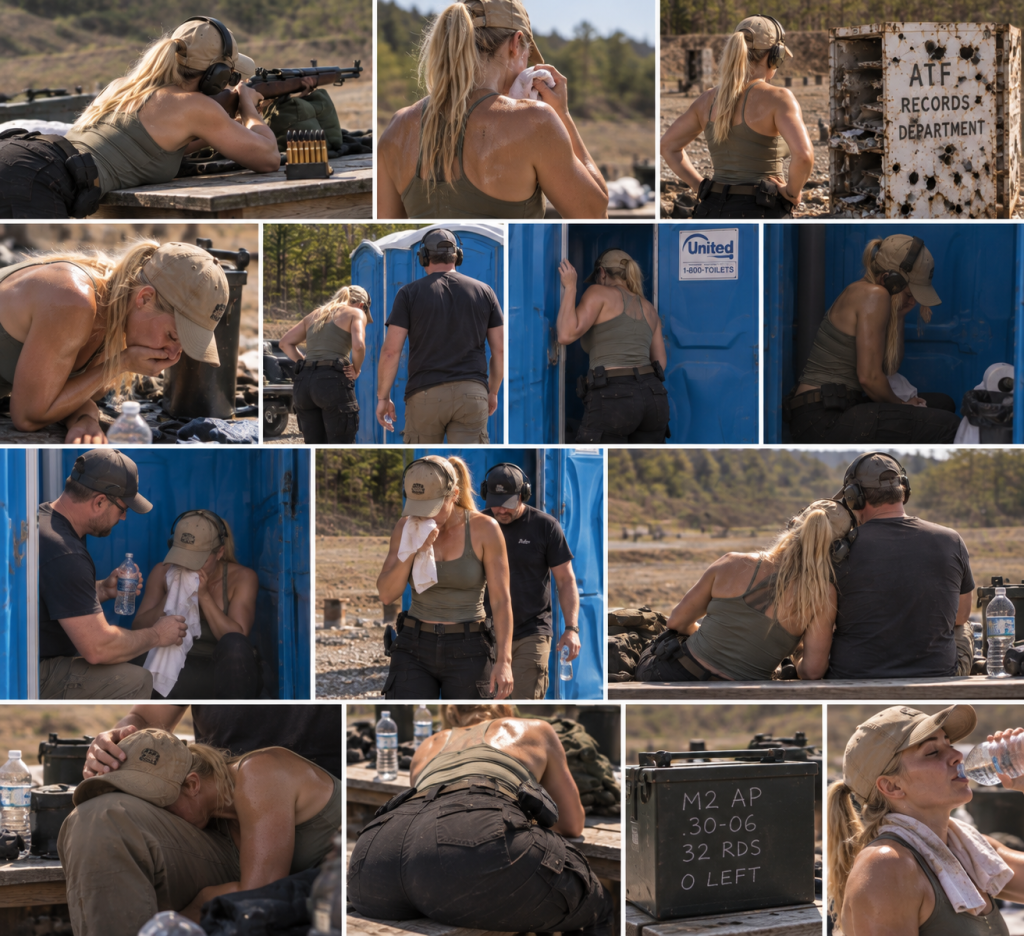
We had 32 rounds.

Four en-bloc clips.

And an entire collection of things that had already outlived their usefulness.

Target One: The Steel Plate

The first target was an old steel plate that looked like it had survived three wars, two divorces, and at least one government procurement contract.

Our blonde guest settled behind the rifle, adjusted her hearing protection, and leaned into the stock.

The Garand barked.

Dust rose from the berm.

She fired again.

And again.

By the time the clip ejected, the plate had acquired several impressive new holes.

She walked downrange after the ceasefire, hands on her hips, examining the damage.

“Well, that’s ruined.”

“It was already ruined.”

“Now it’s officially ruined.”

Fair assessment.

Target Two: The Engine Block

Next came an old V8 engine block.

Nobody knew precisely what vehicle it had come from. Someone claimed Chevrolet. Someone else insisted Ford.

The engine had been sitting behind a barn for approximately fifteen years, which probably made it the most reliable piece of automotive equipment on the property.

The Garand went to work.

The first few impacts threw up clouds of rust and dirt. Later shots chipped the casting and left fresh scars across the exposed metal.

Our photographer moved around collecting pictures while our guest inspected the remains.

By this point, her olive tank top was darkened with sweat across the back, and her ponytail had begun sticking to her neck.

She wiped her forehead.

“How much longer are we doing this?”

“We haven’t gotten to the ATF yet.”

She smiled.

“Oh, well, obviously we can’t leave now.”

Target Three: ATF RECORDS DEPARTMENT

The centerpiece of the afternoon was an enormous white steel filing cabinet.

Four drawers.

Approximately forty years of rust.

And three words painted down the side in large black letters:

ATF RECORDS DEPARTMENT

We’d found it abandoned in a scrap pile, and somebody had suggested it would make an excellent target.

For the sake of realism, we stuffed the drawers with old telephone directories, expired appliance warranties, blank forms, and several hundred pages of instructions for assembling Swedish furniture.

We also included a sheet labeled:

FORM 1: REQUEST FOR PERMISSION TO REQUEST PERMISSION

Underneath, in smaller letters:

Estimated processing time: 11–14 business years.

Our guest nearly fell over laughing when she read it.

“That’s actually pretty accurate.”

The Garand came up.

Eight rounds later, the cabinet was considerably less organized.

The upper drawer had collapsed inward. The lower drawer was hanging at an angle, and paper was scattered across the gravel.

One particularly unfortunate appliance warranty had become confetti.

We walked downrange after clearing the line.

She pulled a mangled sheet of paper out of the wreckage.

“Look. They finally processed something.”

“Only took eighty years and an armor-piercing round.”

She posed beside the cabinet for several photographs, one hand resting on her hip, the other holding a shredded piece of paperwork.

It was probably the most efficient afternoon the ATF Records Department had ever experienced.

The Heat Finally Wins

By approximately 2:00 PM, the temperature had climbed to 97 degrees.

There wasn’t a cloud in the sky.

The gravel radiated heat. The wooden shooting benches were almost too hot to touch, and even the shade under the range shelter offered little relief.

Our guest had been unusually quiet for the previous twenty minutes.

She was sitting on the edge of the bench, elbows resting on her knees, holding a bottle of water.

“You all right?”

“Yeah. Just hot.”

She took another sip.

Then she stopped.

“Oh, shit.”

“What?”

“I don’t feel good.”

She stood up, took two steps, and immediately bent forward with her hands on her knees.

The photographer was beside her in seconds.

“Bathroom?”

She nodded.

At the far end of the parking area stood a bright blue portable toilet that had been baking in direct sunlight since sunrise.

Under normal circumstances, entering it would have constituted a punishment prohibited by the Geneva Conventions.

Unfortunately, circumstances were no longer normal.

The Blue Porta-Potty Incident

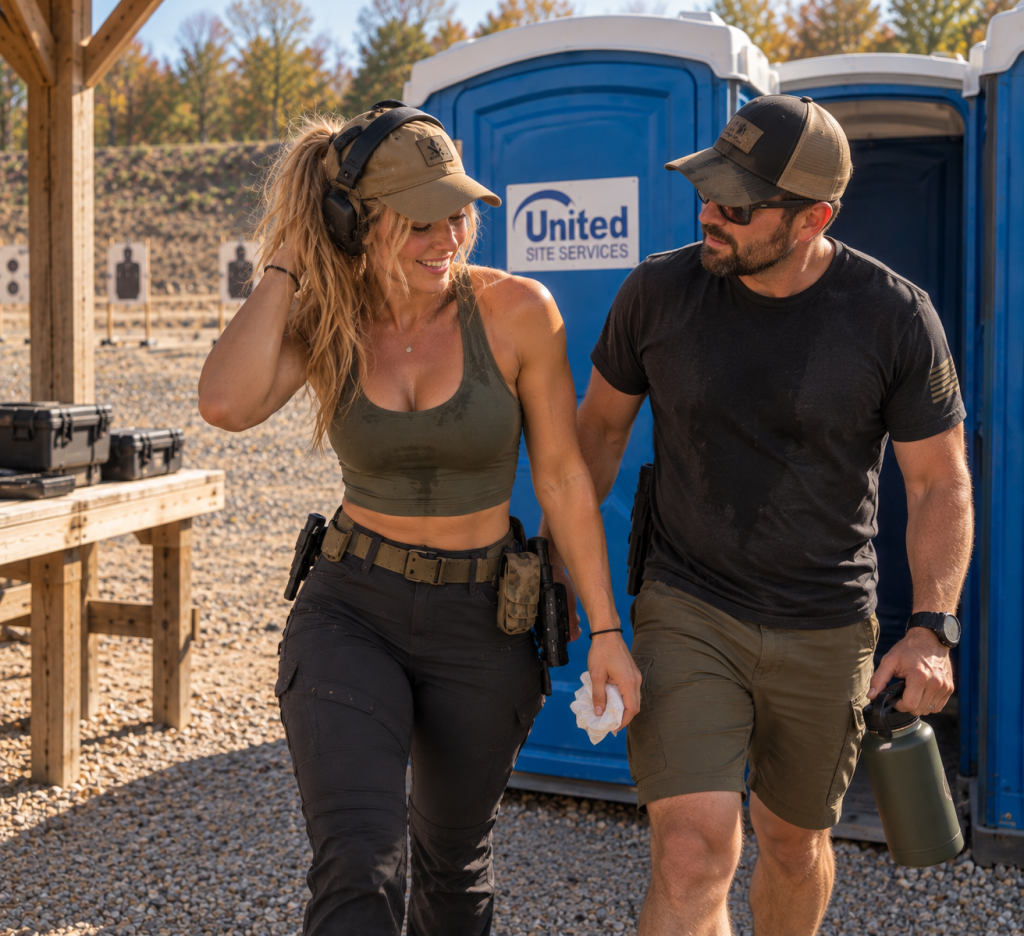
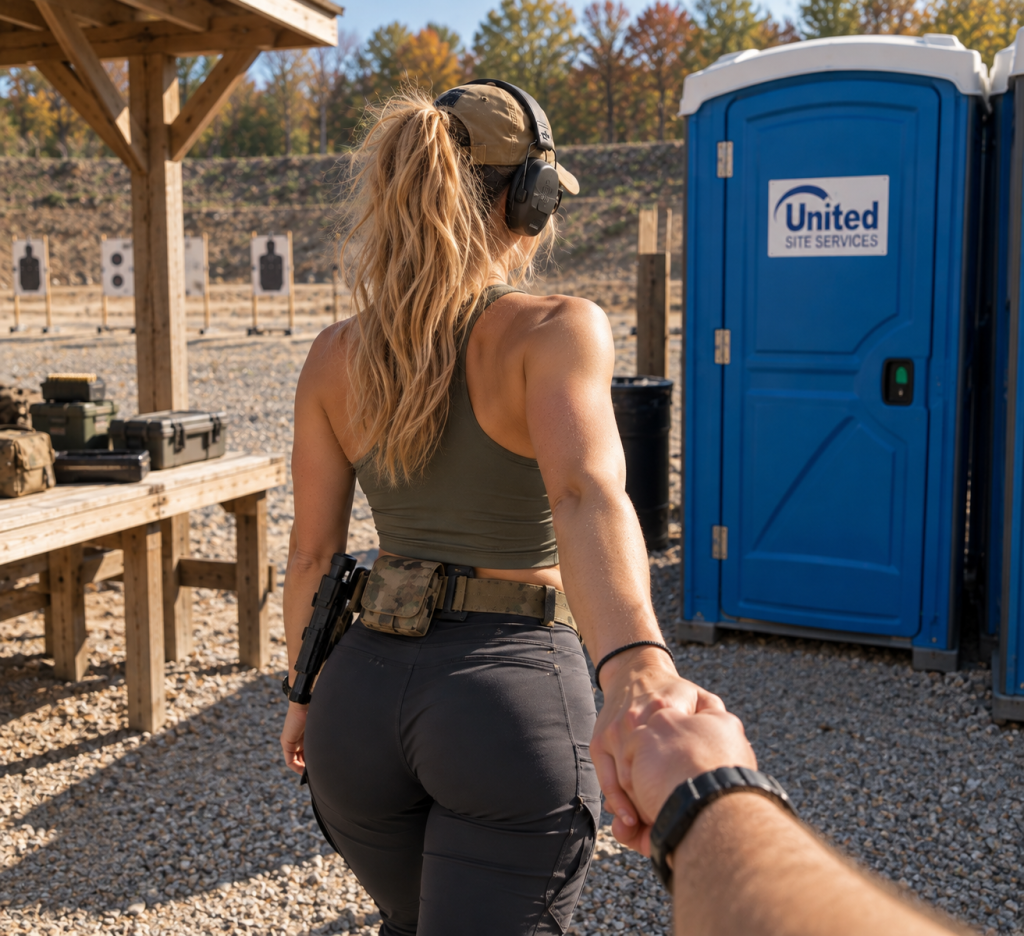
She grabbed the photographer’s hand and started walking toward the blue plastic structure.

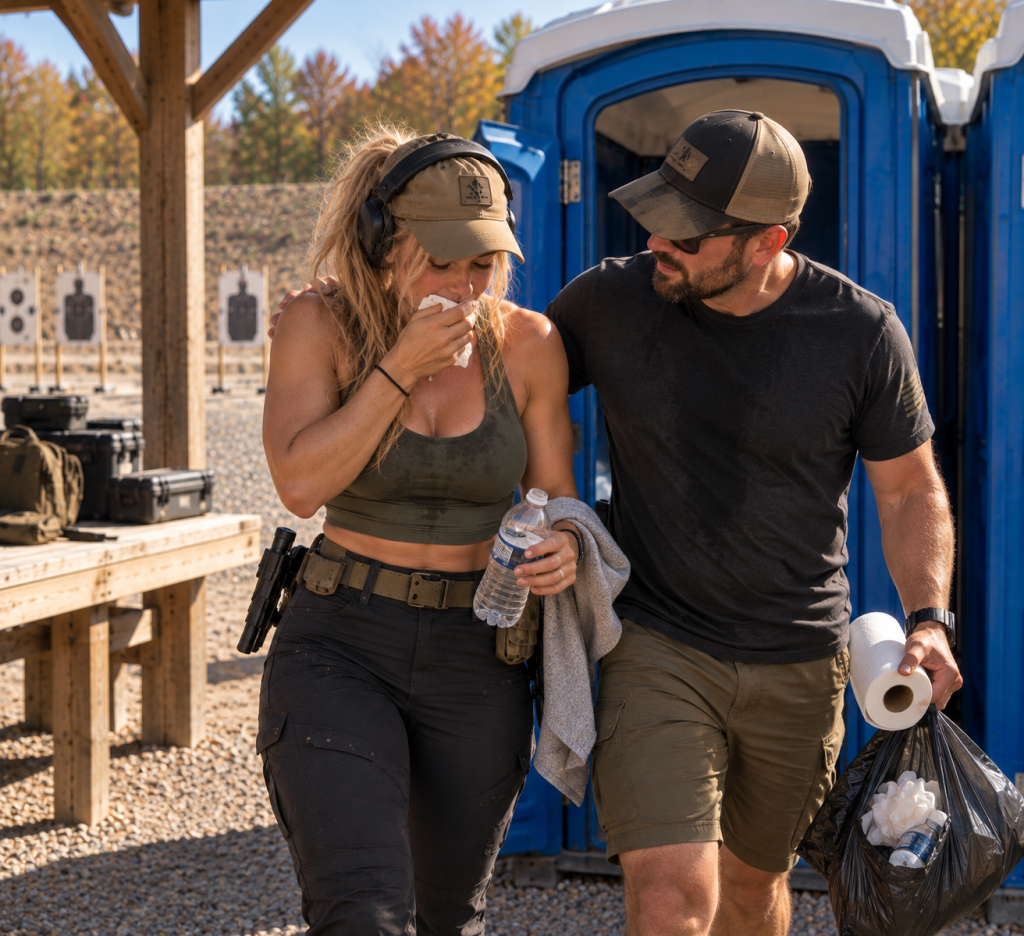
He followed, carrying a water bottle and a clean towel.

“Are you seriously coming in there?” she asked.

“You’re about to pass out.”

“Fair point.”

The door swung open.

A wave of hot, humid air escaped.

“Oh, Jesus Christ,” she muttered.

They disappeared inside.

The door closed.

For the next twenty minutes, the rest of us sat under the range shelter contemplating the fact that two adults were voluntarily occupying what was essentially a plastic greenhouse containing a toilet.

At one point, somebody asked whether we should check on them.

“Give them a minute.”

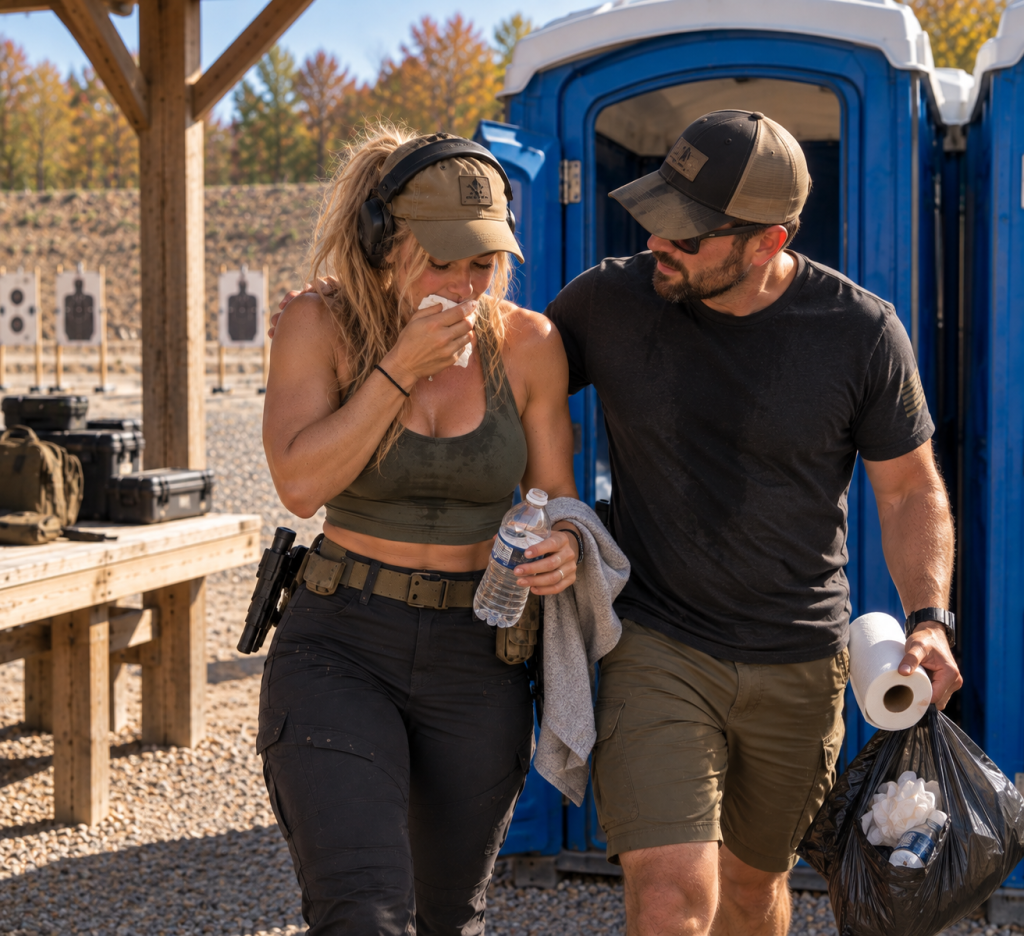
Five minutes later, the photographer called out that she was awake and they needed more water.

We brought it over.

She’d thrown up, and he’d helped her clean herself up. He was trying to keep her comfortable while she recovered enough to get outside.

When the door finally opened, she emerged looking thoroughly miserable.

Her cap was crooked, strands of blonde hair were plastered against her forehead, and she was clutching the towel.

The photographer followed immediately behind her.

Both looked like they’d just survived an expedition into the Amazon.

She glanced back at the portable toilet.

“Burn it.”

“What?”

“That thing. Burn it.”

“We can’t burn the porta-potty.”

“Then put it next to the ATF filing cabinet.”

Recovery at the Shooting Bench

We shut down the range for the afternoon and got her into the air-conditioned clubhouse.

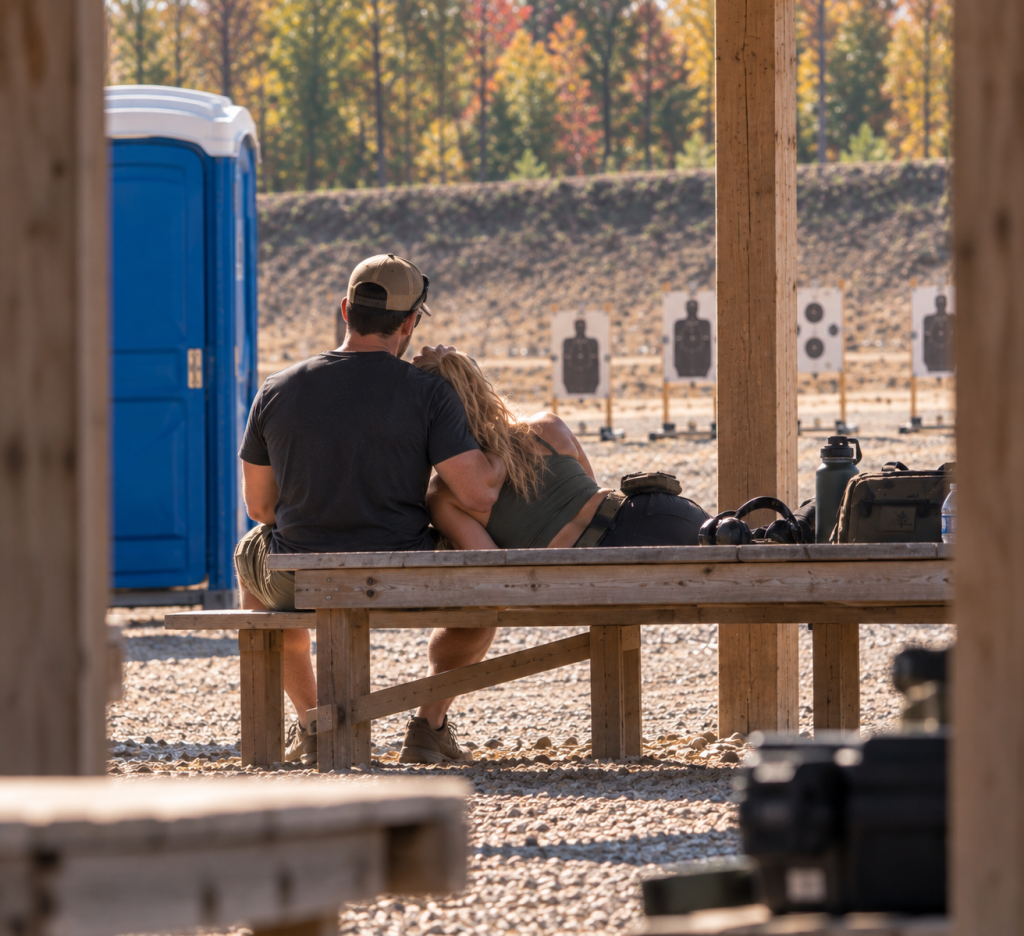
Once she was feeling better and had cooled down, she insisted on sitting outside under the shaded pavilion for a few minutes.

The photographer sat beside her.

She leaned against him, then gradually lowered her head onto his lap.

He rested a hand on her shoulder while she closed her eyes.

From about twenty yards away, somebody took one last photograph.

The late-afternoon sunlight filtered through the trees. The Garand lay unloaded on the bench, and the wrecked filing cabinet stood in the distance.

“Feeling better?” the photographer asked.

“Somewhat.”

“Want anything?”

She considered the question.

“Air conditioning. A shower. And about twelve hours of sleep.”

“Anything else?”

She opened one eye.

“Never make me go in that blue thing again.”

The Morning After

The next morning, the barracks were quiet.

Sunlight came through the windows, illuminating a pile of range bags, boots, and discarded clothing beside the bunks.

Our guest was still asleep, wearing an oversized T-shirt and a pair of shorts, her blonde hair spread across the pillow.

The photographer was already awake, reviewing the previous day’s pictures on his laptop.

He’d captured everything.

The Garand.

The engine block.

The ATF filing cabinet.

The blue porta-potty.

And the exhausted blonde who had somehow managed to become the main character in what was supposed to be an ammunition test.

She eventually woke up, rolled over, and squinted at him.

“Did you get good pictures?”

“Yeah.”

“Of the rifle?”

“Yeah.”

“The filing cabinet?”

“Definitely.”

She stared at him.

“Not the bathroom, right?”

He hesitated.

She picked up a pillow.

“Delete them.”

Final Range Report

Category

Results

Rifle

Springfield Armory M1 Garand

Ammunition

.30-06 M2 AP black tip

Rounds fired

32

Malfunctions

0

Steel plate

Perforated

Engine block

Severely damaged

ATF Records Department

Permanently closed

Paperwork processed

More than usual

Temperature

97°F

Humidity

Absolutely miserable

Porta-potty experience

0/10

Photographer’s dedication

Questionable but impressive

Overall range day

10/10

Conclusion

The M1 Garand remains one of the finest American military rifles ever produced.

M2 armor-piercing ammunition remains a fascinating piece of military history.

And somewhere in rural Pennsylvania, a battered filing cabinet marked ATF RECORDS DEPARTMENT stands as a monument to the remarkable efficiency of the United States government.

Our blonde guest has already agreed to return for another range report.

She has, however, established three conditions.

There must be air conditioning.

There must be cold water.

And under absolutely no circumstances is anyone allowed to mention the blue porta-potty.

Naturally, we’ve already ordered a commemorative plaque for it.

ATF FIELD OFFICE — RECORDS PROCESSING ANNEX

GarandThumb.com | M1 Garand | .30-06 Springfield | M2 AP Black Tip | Springfield Armory | CMP | Military Surplus Rifles | Range Reports

Posted in XTC

SIG MCX-LTAW Suppressor SBR Combo | Range Report: Short Barrel, Big Expectations

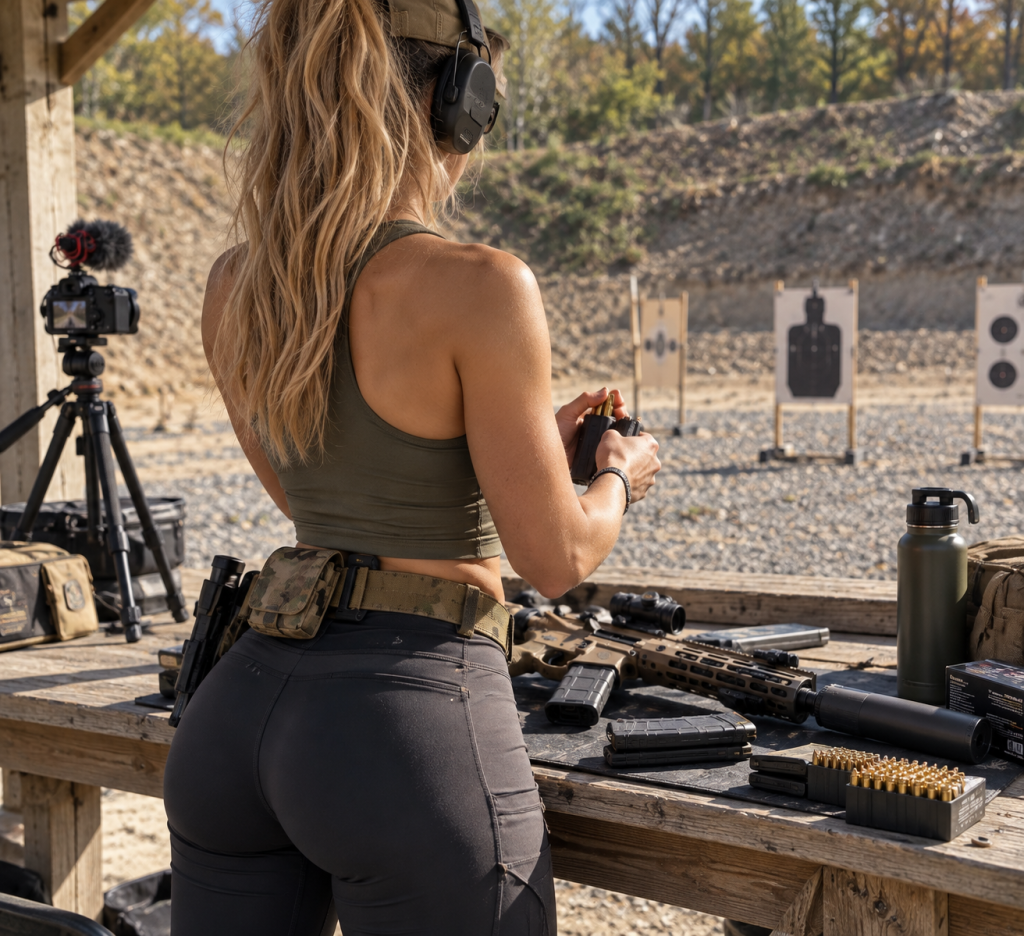
The first thing I noticed about the SIG MCX-LTAW wasn’t the suppressor. It was the woman carrying it.

She had the usual range-influencer arrangement: fitted range clothes, plate carrier, electronic hearing protection, and enough expensive equipment to suggest that somebody was either sponsoring the afternoon or making very poor decisions with a credit card.

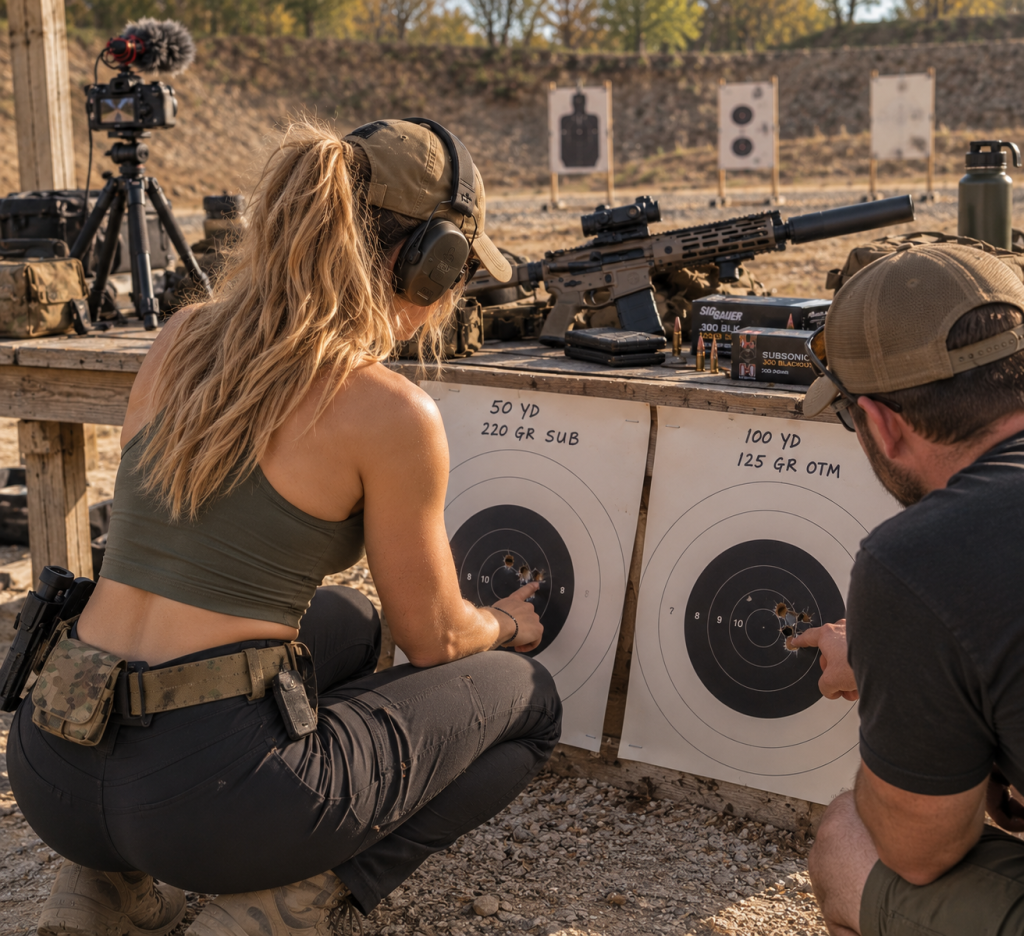
She was setting up a camera behind the firing line when I arrived. On the bench was a compact SIG MCX, several boxes of .300 Blackout, a couple of magazines, and a suppressor that looked nearly as long as the barrel.

I’d come to shoot my regular AR. She’d come to make content. Neither of us had any particular reason to care what the other was doing until I noticed the rifle.

It was an MCX-LTAW.

I’d been curious about one for a while.

The rifle

The MCX-LTAW is SIG’s compact .300 Blackout platform, built around a short-stroke piston system rather than the conventional direct-impingement arrangement found on most AR-15s.

The 6.75-inch barrel is the defining feature. That’s short even by SBR standards, and the folding stock makes the package remarkably compact when stored.

This particular setup had a red-dot optic, a suppressor, and a sling. Nothing especially unusual, although the total price of everything on the bench would have paid for a decent used motorcycle.

I picked it up after asking permission.

It was heavier than expected.

Not excessively heavy, but heavier than its dimensions suggested. The piston assembly, suppressor, and relatively substantial handguard give the rifle a dense feeling. It doesn’t have the hollow, almost insubstantial character of some lightweight AR builds.

The trigger was good. The controls were familiar. The folding stock locked up firmly, and the overall construction felt like what you’d expect from an expensive SIG.

Whether any of that justified the price was another matter.

Starting at 50 yards

The first ammunition was 220-grain subsonic .300 Blackout.

The rifle had already been zeroed, so there wasn’t much to do beyond hanging a fresh target and shooting.

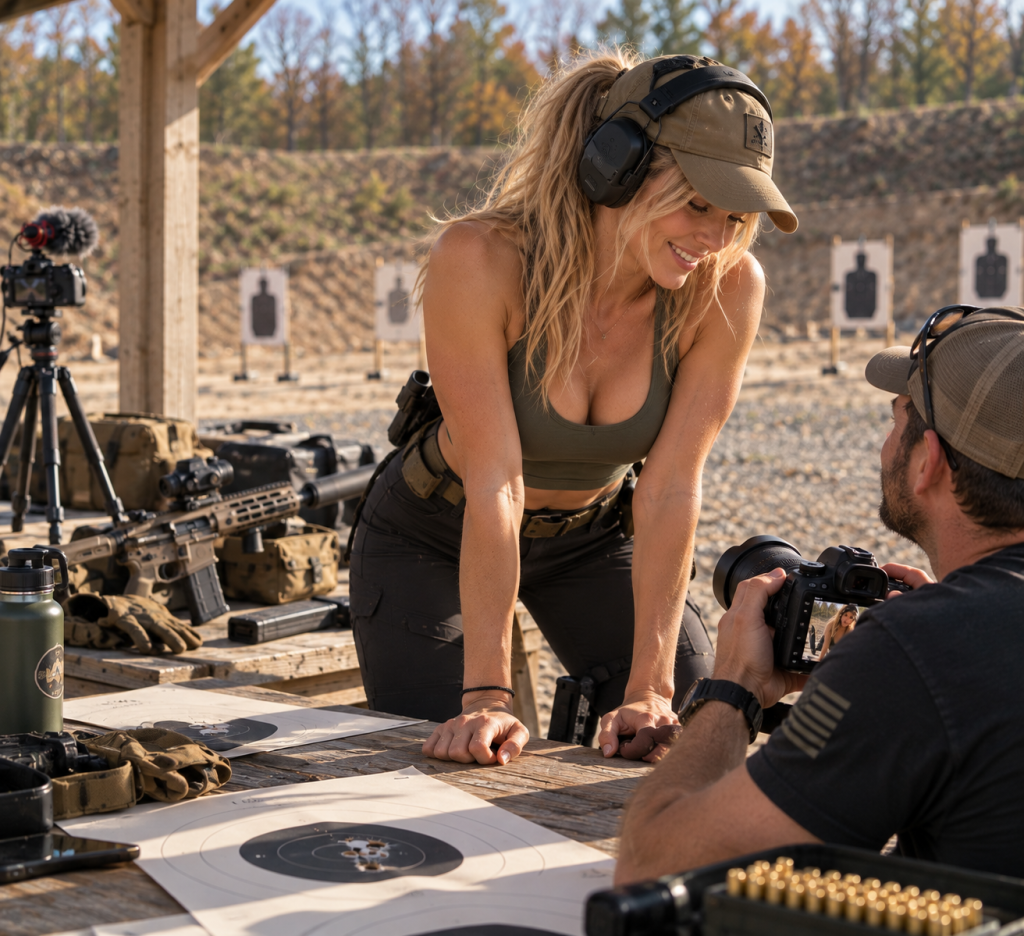
She fired the first five-round group from a supported position. I watched through a spotting scope while she checked the camera between strings.

The first group measured about 1.4 inches.

Not bad.

The second opened slightly, with four shots reasonably close and one wandering out toward the edge of the black.

She blamed herself rather than the ammunition, which was refreshing. I’ve watched grown men spend half an hour explaining how a perfectly good rifle was responsible for a bad shot.

I fired a magazine afterward.

The trigger was predictable, the recoil was mild, and the red dot settled back onto the target without much effort.

The suppressor made the biggest difference to the overall experience. There was still plenty of mechanical noise, and hearing protection stayed on, but the usual sharp muzzle report was substantially reduced.

It was pleasant enough that I understood the appeal immediately.

That didn’t mean I was ready to spend the money.

The 100-yard target

We switched to 125-grain supersonic ammunition for the next portion of the session.

The change in sound was obvious. The supersonic crack returned, although the suppressor continued to moderate the muzzle blast.

The first group at 100 yards measured just under three inches. The next was somewhat tighter.

For a compact rifle wearing a red dot, the results were reasonable. Nobody was going to confuse the target with a high-power match rifle’s slow-fire string, but there was nothing particularly embarrassing about it either.

The groups also exposed the difference between a firearm that is mechanically capable of good accuracy and one that’s easy to shoot precisely.

The MCX’s short barrel isn’t automatically inaccurate. But a relatively coarse aiming reference, a compact shooting position, and ordinary factory ammunition aren’t a recipe for tiny groups.

I would have liked to try it with a magnified optic. That would have told us considerably more about the rifle’s actual accuracy potential.

She wasn’t interested in changing the setup.

Fair enough. It was her rifle.

The targets

The 50-yard target was the better of the two. The subsonic ammunition produced a fairly consistent cluster, and the rifle was easy to keep on target during deliberate shooting.

At 100 yards, the groups were larger but still entirely usable for the kind of shooting this configuration was intended to accommodate.

The results weren’t spectacular, and that was probably the most interesting part of the afternoon.

Expensive rifles don’t automatically produce impressive targets.

They may have better triggers, more sophisticated operating systems, or features that make them easier to handle. None of those things eliminates shooter error or turns ordinary ammunition into match ammunition.

Reliability and handling

Between us, the rifle fired 120 rounds.

There was one failure to feed early in the session with subsonic ammunition. After clearing it, the rifle ran without another stoppage.

That isn’t enough ammunition to draw sweeping conclusions about reliability. It is enough to establish that nothing obviously disastrous happened during the afternoon.

The magazines seated positively, the controls worked as expected, and the bolt locked back consistently during the remainder of the session.

The short configuration was particularly comfortable when shooting standing. The rifle was easy to bring onto target, although the suppressor made it slightly more front-heavy than its appearance suggested.

After several strings, the handguard became warm enough to notice. Nothing unusual there.

I was more interested in the way the rifle balanced.

With the stock extended, it felt compact without being cramped. The grip angle was familiar, and the optic was positioned at a comfortable height.

The folding stock was also genuinely useful, although that’s more of a storage and transportation advantage than something that changes how the rifle shoots.

The influencer problem

At some point she started filming a close-up of the rifle on the bench.

I asked whether she was going to include the malfunction.

She looked at me for a moment.

“Probably.”

That was a better answer than I expected.

There’s a peculiar economy surrounding modern firearms content. A rifle can be perfectly ordinary on the range and somehow become revolutionary once the video has enough slow-motion footage, dramatic music, and attractive people wearing tactical equipment.

The MCX doesn’t need that treatment.

It’s an interesting firearm on its own merits.

The engineering is worth discussing. So are the compromises. It would be considerably more useful to hear about the rifle’s weight, ammunition preferences, maintenance requirements, and reliability over several thousand rounds than to watch somebody fire three magazines into a dirt berm while the camera circles them.

To her credit, she actually kept the targets.

I suspect that puts her ahead of a fair percentage of the internet.

Is the MCX-LTAW worth buying?

That depends entirely on what you want from it.

For somebody who specifically wants a compact, suppressed .300 Blackout rifle, the MCX-LTAW makes a compelling case. The short-stroke piston system, folding stock, compact dimensions, and factory suppressor options offer something meaningfully different from a conventional AR.

For somebody who spends most of their time shooting paper at 100 or 200 yards, it’s considerably harder to justify.

A good AR-15 with a decent barrel and trigger can shoot very well for substantially less money.

And if precision is the priority, there are better ways to spend several thousand dollars.

The MCX’s advantages are primarily in its configuration and handling rather than its ability to put five bullets through the same hole.

That’s not criticism. It’s simply understanding what the rifle is.

Final thoughts

I liked the MCX-LTAW more than I expected.

The suppressed shooting experience was enjoyable, the controls were excellent, and the compact package felt well thought out. Accuracy was adequate, and the single malfunction wasn’t enough to substantially change my opinion.

I still wouldn’t sell a good service rifle to buy one.

Then again, I wouldn’t sell a good service rifle to buy much of anything.

The woman packed up her equipment, checked the footage on her phone, and asked what I thought. Then took me to the porta pot to show me how she can clean a barrel

I told her it was a good rifle, but I wasn’t convinced it was worth what SIG wanted for it.

She shrugged.

“That’s what everybody says until they shoot it.”

I couldn’t entirely disagree.

I went back to my bench and finished shooting the AR I’d brought. Twenty-inch barrel, iron sights, and absolutely nothing new or exciting about it.

The MCX had been more interesting.

My targets were better.

I went home satisfied with that arrangement.

SEO title: SIG MCX-LTAW Suppressor SBR Combo Review | .300 Blackout Range Report

Meta description: SIG MCX-LTAW range review covering the suppressed SBR combo, .300 Blackout accuracy, 220-grain subsonic ammunition, 100-yard groups, handling, and reliability.

Suggested slug: sig-mcx-ltaw-suppressor-sbr-combo-range-review

Tags: SIG MCX-LTAW, MCX-LTAW pistol, MCX suppressor SBR combo, SIG MCX review, 300 Blackout, 300 BLK subsonic, suppressed rifle, SBR, rifle range report, AR-15 comparison.

Posted in XTC

US Palm Storm CAT4 Review | New AR-15 and EOS Suppressors Explained

The US Palm Storm CAT4 review question became considerably more relevant on October 8, 2026, when US Palm announced that the complete Storm CAT4 rifle, 11.5-inch CAT4 pistol and four-model EOS suppressor family were commercially available.

US Palm built its reputation around AK magazines, grips and equipment. Entering the crowded AR-15 rifle and suppressor markets is a major expansion—and the company did not choose the bargain-bin end of either category.

The 16-inch Storm CAT4 rifle and 11.5-inch Storm CAT4 pistol each carry a $1,399.99 MSRP. The EOS-556, EOS-30 and EOS-AK suppressors cost $899.99, while the lightweight EOS-30Ti costs $999.99.

This is not a hands-on firing report. I have not personally tested the CAT4’s reliability, accuracy or suppressor performance, so I will not manufacture a round count or imaginary group size. This review examines the verified specifications, design, price, suppressor compatibility, likely advantages and potential US Palm Storm CAT4 problems.

US Palm Storm CAT4 Specifications

According to the official US Palm Storm CAT4 product page⁠, the rifle is a direct-impingement, 5.56 NATO AR-15 with the following specifications:

  • 16-inch cold-hammer-forged 4150 chrome-moly barrel
  • 1:7-inch rifling twist
  • 7075-T6 aluminum upper and lower receivers
  • Type III hardcoat-anodized finish
  • Seven-sided M-LOK Mono-Loc handguard
  • Full-length Picatinny optics rail
  • Fully ambidextrous controls
  • Ambidextrous 45-degree safety
  • Ambidextrous bolt catch and release
  • Ambidextrous magazine release
  • Ambidextrous charging handle
  • Flared magazine well
  • Hiperfire EDT Designated Marksman trigger
  • US Palm reduced-angle pistol grip
  • Magpul DT Carbine stock
  • Hurricane hybrid flash hider and compensator
  • 30-round magazine capacity
  • Seven-pound unloaded weight
  • 7.8-pound published loaded weight
  • 33.5-inch collapsed length
  • 36.8-inch extended length
  • $1,399.99 MSRP

A seven-pound AR-15 is neither exceptionally light nor unnecessarily heavy. It lands in sensible general-purpose carbine territory before adding an optic, sling, weapon light and suppressor.

The 1:7 twist should accommodate the common range of 5.56 NATO ammunition, including heavier 69-, 75- and 77-grain projectiles. Actual accuracy will depend on ammunition, barrel consistency, optic, environmental conditions and the shooter. Cold-hammer forging sounds impressive in an advertisement, but a target ultimately matters more than a manufacturing buzzword.

What Makes the Storm CAT4 Different?

The modern AR-15 market contains rifles at almost every imaginable price. A basic direct-impingement rifle can cost less than $500, while premium duty carbines easily exceed $2,000.

At $1,399.99, the Storm CAT4 must offer more than a logo and aggressive styling.

Its most distinctive feature is the US Palm Mono-Loc handguard system. The handguard uses a rear-locking interface keyed into the upper receiver. US Palm says this construction reduces rail movement and helps retain the alignment of lasers and other aiming equipment.

That claim is mechanically plausible. Rail rigidity matters when an infrared laser, visible laser, front sight or other aiming device is attached to the handguard. It matters considerably less when the rail holds nothing but a sling attachment and a flashlight.

Independent testing should determine how the CAT4 Mono-Loc handguard compares with established anti-rotation and semi-monolithic AR-15 rail systems after impact, heat and repeated removal.

The fully ambidextrous lower is more immediately useful. A right-side bolt catch and release can simplify reloads and malfunction clearance for a right-handed shooter, while left-handed owners receive proper access to the magazine release, safety and bolt controls.

The Hiperfire EDT Designated Marksman trigger is also a meaningful factory upgrade over a gritty military-style trigger. Guns & Ammo measured the trigger in its sample at three pounds, four ounces, although pull weight can vary between individual rifles.

Storm CAT4 Rifle Versus CAT4 Pistol

The US Palm Storm CAT4 pistol⁠ retains the principal rifle features but substitutes an 11.5-inch barrel and pistol brace.

Its published specifications include:

  • 11.5-inch 5.56 NATO barrel
  • 1:7 twist
  • Six-pound unloaded weight
  • 29-inch collapsed length
  • 32.3-inch extended length
  • Hiperfire EDT trigger
  • Fully ambidextrous controls
  • Mono-Loc M-LOK handguard
  • Hurricane muzzle device
  • $1,399.99 MSRP

The 16-inch CAT4 rifle avoids the federal barrel-length complications associated with a short-barreled rifle and provides greater velocity. It is the straightforward choice for a general-purpose AR-15, training rifle, home-defense carbine or property rifle.

The 11.5-inch CAT4 pistol is shorter and easier to maneuver, especially after attaching a suppressor. Its disadvantages include increased blast, reduced velocity and the necessity of understanding current federal, state and local rules governing pistol braces, short-barreled rifles and firearm configurations.

Government classifications can change faster than the mechanical reality of the firearm. Owners remain responsible for checking the law before replacing braces, stocks, barrels or other regulated components.

US Palm EOS-556 Suppressor

The US Palm EOS-556 suppressor is the obvious companion for either CAT4.

US Palm describes the EOS-556 as a short, low-back-pressure suppressor optimized for gas-operated 5.56 rifles. Its official specifications include:

  • 3D-printed 718 Inconel construction
  • 12.5-ounce weight
  • Low-back-pressure internal design
  • Integrated flash hider
  • HUB-compatible rear interface
  • Included titanium 1/2×28 direct-thread mount
  • Full-auto rating
  • $899.99 MSRP

US Palm also says the EOS-556 passed a SOCOM durability stress test. That is a manufacturer performance claim, not evidence that the suppressor received a military contract or formal adoption.

The low-back-pressure design is particularly relevant on a direct-impingement AR-15. Conventional restrictive suppressors can increase bolt velocity, cyclic speed, fouling and gas directed toward the shooter. A properly designed reduced-back-pressure suppressor can mitigate those effects.

It cannot repeal physics. Attaching any suppressor adds weight, length and heat while changing the firearm’s gas behavior. Buyers should still evaluate ejection pattern, reliability, ammunition, buffer weight and gas exposure.

The EOS-556’s HUB compatibility is valuable because it provides access to a broad mounting ecosystem instead of permanently locking the owner into one proprietary muzzle device. The included direct-thread mount is the lightest and simplest configuration, while compatible quick-detach systems may provide faster movement between hosts at the cost of additional weight and length.

US Palm EOS Suppressor Comparison

US Palm’s four EOS suppressors serve different firearms rather than merely offering four cosmetic variations.

EOS-556

The EOS-556 is the dedicated 5.56 option. It weighs 12.5 ounces, uses 718 Inconel and includes a 1/2×28 HUB direct-thread mount. It is the logical choice for a Storm CAT4, conventional AR-15 or 5.56 short-barreled rifle.

EOS-30

The EOS-30 suppressor is a general-purpose .30-caliber model intended for 7.62 gas guns. It weighs 14.7 ounces, uses 3D-printed 718 Inconel and includes a titanium 5/8×24 direct-thread mount. Its $899.99 MSRP matches the EOS-556.

The EOS-30 provides greater caliber flexibility for .308 Winchester, 7.62 NATO and compatible smaller cartridges, although a dedicated 5.56 suppressor may offer better size, weight, flash and sound characteristics on a 5.56 rifle.

EOS-30Ti

The EOS-30Ti suppressor is optimized for .300 Blackout semiautomatic rifles and hunting firearms. Its 3D-printed titanium construction reduces weight to 10.8 ounces. It is HUB compatible, includes a 5/8×24 titanium direct-thread mount and costs $999.99.

That weight is attractive on a hunting rifle or .300 Blackout carbine. Titanium generally deserves more conservative heat management than a hard-use Inconel suppressor, so the EOS-30Ti should not automatically be treated as the lightweight substitute for every high-volume application.

EOS-AK

The US Palm EOS-AK suppressor is purpose-built for AKM rifles with standard 14×1 left-hand muzzle threads. It weighs 15.4 ounces and uses a collet mounting system intended to secure the suppressor on the AK platform.

That dedicated mount could solve a real problem. AK muzzle threads and front-sight assemblies do not always provide the alignment consistency expected from a modern AR-15 barrel shoulder. Owners should still check bore alignment before firing any suppressed AK. An expensive Inconel tube does not make a crooked rifle concentric.

Potential US Palm Storm CAT4 Problems

No widespread CAT4 reliability problem has been established. The rifle is too new for that conclusion in either direction.

Questions worth watching include:

  • Long-term durability of the proprietary Mono-Loc interface
  • Availability and price of replacement proprietary components
  • Handguard heat during extended suppressed shooting
  • Gas exposure with the EOS-556 and competing suppressors
  • Accuracy across common 55-, 62-, 69- and 77-grain ammunition
  • Bolt and barrel life at higher round counts
  • Trigger consistency between production rifles
  • Suppressor alignment and mount retention
  • Parts and warranty support through US Palm and Century Arms

A January 2026 Guns & Ammo review reported favorable function and measured the sample’s specifications, but one published rifle cannot establish the reliability of an entire production line.

Optics and Accessories for the CAT4

The CAT4 ships optic-ready without iron sights. A red dot, holographic sight or low-power variable optic would suit the rifle’s general-purpose configuration.

The new EOTECH EXPS3 HD⁠ offers a holographic reticle, lower-one-third height and magnifier compatibility, although its $999 MSRP would push the complete CAT4 package well beyond $2,000.

Buyers should budget for:

  • A dependable optic
  • Sling
  • Weapon-mounted light
  • Backup sights if desired
  • Magazines
  • Appropriate ammunition
  • Hearing protection
  • Suppressor mount or muzzle device
  • Tax and transfer costs where applicable

Anyone new to suppressed firearms should also understand that a suppressor reduces sound and concussion; it does not produce Hollywood silence. My threaded Desert Eagle suppressor article⁠ explains why ammunition velocity, action noise, mounting and bore clearance still matter.

Is the US Palm Storm CAT4 Worth It?

The US Palm Storm CAT4 appears competitively equipped at $1,399.99.

Its cold-hammer-forged barrel, ambidextrous lower, Hiperfire trigger, rigid handguard, upgraded furniture and hybrid muzzle device address components that owners commonly replace on cheaper rifles. Buying an inexpensive AR-15 and upgrading every control, trigger and rail can erase the original savings surprisingly quickly.

The unresolved issue is proof.

Established premium AR-15 manufacturers possess years of documented service, training and high-round-count experience. The CAT4 specifications are promising, but specifications do not substitute for long-term reliability data.

The EOS suppressors may be the more distinctive part of the release. Low-back-pressure construction, 3D-printed Inconel, HUB compatibility and platform-specific models place the lineup squarely within the modern suppressor market rather than several years behind it.

For someone searching for a fully ambidextrous AR-15 under $1,500, a suppressor-ready 11.5-inch AR pistol or a matched CAT4 and EOS-556 package, the new US Palm system deserves serious consideration.

The Storm CAT4 does not need to defeat every AR-15 ever produced. It needs to prove that its proprietary features deliver measurable value, its replacement parts remain available and its reliability survives beyond the launch photographs.

On paper, the storm looks promising. Now it needs weather.

GarandThumb.com was established on May 4, 2012, to document my experiences trying to become a better marksman.
Posted in XTC