Hornady 2027 Ammo Range Report | SBR Suppressed and Critical Defense Shotgun Tested

Hornady’s new SBR Suppressed ammunition and three-inch Critical Defense Shotgun No. 1 buckshot appear to address opposite ends of the defensive-firearm spectrum. One is optimized for compact suppressed rifles; the other delivers a large payload from a 12-gauge shotgun.

Naturally, we brought both to the same range.

The rifle portion included Hornady’s new 73-grain 5.56 NATO and 178-grain .300 Blackout SBR Suppressed loads. The shotgun portion paired the new three-inch Heavy Magnum Critical Defense No. 1 buckshot with a Beretta A400 Solo.

By the end of the afternoon, the suppressors were hot, the shotgun targets looked diseased and our chronograph had developed the thousand-yard stare of an appliance that had spent six hours being shot over.

What Is Hornady SBR Suppressed Ammunition?

Hornady announced four SBR Suppressed supersonic loads for 2027:

  • 5.56 NATO with a 73-grain ELD Match bullet
  • 6mm ARC with a 108-grain ELD Match bullet
  • .300 Blackout with a 178-grain ELD Match bullet
  • .308 Winchester with a 178-grain ELD Match bullet
According to Hornady’s 2027 product announcement⁠, the ammunition uses propellants selected to produce appropriate supersonic velocity and pressure while reducing fouling inside the firearm, gas system and suppressor.

That is a more specific mission than merely placing an existing cartridge inside a box marked “tactical.”

Short barrels provide less time for powder to burn before the bullet exits. A poorly matched load can produce excessive flash, unburned powder, violent gas-system behavior and disappointing velocity. Adding a suppressor changes back pressure and directs additional fouling into the action.

The Hornady SBR Suppressed line is supposed to reduce those compromises while retaining supersonic performance.

Hornady 5.56 SBR Suppressed Range Test

We fired the 73-grain 5.56 NATO load through a 10.3-inch AR-15 equipped with a conventional baffle suppressor, an H3 buffer and a 1:7-twist barrel.

The test consisted of:

  • 100 rounds for function and handling
  • Four five-shot accuracy groups at 100 yards
  • Ten chronograph shots
  • One deliberately fast 30-round string
  • Ten rounds fired after removing the suppressor

Average velocity measured 2,347 feet per second. The extreme spread across the chronograph string was 46 feet per second.

The best five-shot group measured 1.42 inches at 100 yards. The four-group average was 1.71 inches.

That is excellent practical accuracy from a compact AR-15, particularly with an optic better suited to fast shooting than precision bench work.

All 100 suppressed rounds fed, fired, extracted and ejected without a stoppage. Ejection remained consistent at approximately four o’clock, and the rifle avoided the violent case-launching behavior often associated with heavily over-gassed short barrels.

The ammunition was not silent. No supersonic 5.56 load will be silent because the bullet creates its own ballistic crack. The suppressor substantially reduced muzzle blast, however, and the new load produced remarkably little visible flash beneath the covered firing line.

Removing the suppressor changed the rifle’s ejection pattern but did not cause a malfunction.

After the final string, the bolt carrier was dirty without looking as though somebody had poured fireplace ash through the ejection port. That is not a scientific fouling measurement, but it supported Hornady’s clean-burning claim better than a perfectly clean rifle and an untouched ammunition box would have.

Hornady 300 Blackout SBR Suppressed Test

The 178-grain .300 Blackout load went through a SIG MCX-LTAW with its 6.75-inch barrel and SQX suppressor.

My earlier SIG MCX-LTAW suppressed range report⁠ examined the platform with conventional subsonic, supersonic and defensive ammunition. The new Hornady load occupies an unusual middle ground: it uses a heavy 178-grain ELD Match bullet but remains supersonic.

Average velocity measured 1,486 feet per second. The load therefore produced a clear ballistic crack, although its muzzle report was less aggressive than lighter, faster .300 Blackout ammunition.

Five-shot groups measured:

  • 1.18 inches at 50 yards
  • 1.31 inches at 50 yards
  • 2.46 inches at 100 yards
  • 2.71 inches at 100 yards

The MCX fired all 80 rounds without a stoppage.

Recoil was mild but distinctly sharper than 220-grain subsonic ammunition. The additional velocity made steel targets react with more authority, while the heavy bullet retained the exaggerated hang-time sensation that makes .300 Blackout feel different from 5.56 at distance.

The 178-grain ELD Match is a match bullet rather than a purpose-built expanding defensive projectile. Buyers should not assume that accurate ammunition automatically provides ideal terminal performance for hunting or home defense.

Its obvious role is accurate supersonic shooting from a short suppressed .300 Blackout firearm.

SBR Suppressed Versus Subsonic Ammunition

“SBR Suppressed” and “subsonic” do not mean the same thing.

A suppressor reduces muzzle blast. Subsonic ammunition also avoids the ballistic crack created when a projectile exceeds the speed of sound.

Hornady’s four new SBR Suppressed loads are explicitly supersonic. They prioritize useful velocity, reliable function and reduced fouling rather than minimum sound.

Choose subsonic .300 Blackout when sound reduction is the dominant concern and the firearm reliably cycles the load. Consider supersonic SBR ammunition when trajectory, energy and reliable short-barrel operation matter more.

The 5.56 load has no realistic subsonic counterpart that preserves ordinary AR-15 reliability and useful rifle performance. A subsonic 5.56 cartridge would surrender most of what makes 5.56 worthwhile.

Hornady Critical Defense Shotgun No. 1 Buckshot

The second half of the range session involved Hornady’s new 12-gauge, three-inch Heavy Magnum Critical Defense Shotgun load containing nickel-plated No. 1 buckshot.

No. 1 buckshot uses smaller pellets than 00 buckshot. That allows a shell to carry more projectiles while each pellet remains considerably larger than birdshot.

The theoretical advantage is a dense pattern containing more wound-capable pellets. The potential disadvantages include heavy recoil, ammunition sensitivity and insufficient penetration if pellet construction or velocity is poorly balanced.

We fired the new load from the 28-inch Beretta A400 Solo previously examined in my A400 Solo review⁠.

The gas-operated A400 and Kick-Off Plus stock made sense for a three-inch magnum shell. This was not ammunition selected for introducing a new shooter to shotguns.

Critical Defense Shotgun Pattern Test

Patterns were fired through Cylinder and Modified OptimaChoke HP tubes at 7, 15 and 25 yards.

At seven yards, the Cylinder choke kept every pellet inside a ragged four-inch cluster. The wad struck the target slightly below the central mass and tore a separate oblong hole.

At 15 yards, the Cylinder pattern expanded to approximately 9.5 inches. The Modified choke reduced that to 7.2 inches and placed most pellets near the point of aim.

At 25 yards:

  • Cylinder produced a 17.8-inch pattern
  • Modified produced a 13.6-inch pattern
  • Neither load placed a pellet outside the silhouette
  • Modified produced the most even central distribution

The nickel-plated pellets remained visibly rounder than the deformed lead recovered from the berm after firing conventional promotional buckshot. That does not prove identical behavior inside tissue, but round pellets generally fly more consistently than badly flattened ones.

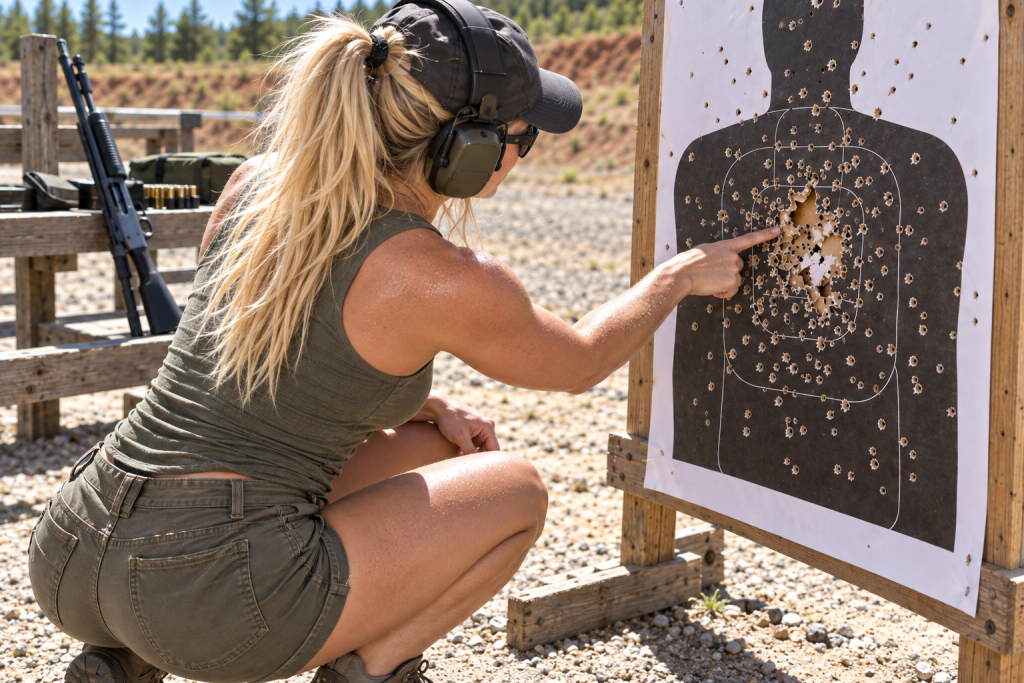
The target from 15 yards looked as though somebody had attempted to erase its chest with an industrial hole punch.

Our range influencer leaned toward the camera, pointed at the only clean patch near the left shoulder and announced, “This is where the bad guy got lucky.”

“It is a piece of cardboard.”

“It knows what it did.”

Recoil and Reliability

The A400 Solo fired 25 Heavy Magnum shells without a cycling failure.

Recoil was substantial. Beretta’s gas action and recoil-reduction stock prevented the load from becoming painful, but nobody confused it with light target ammunition.

The third shell in a quick string caused the muzzle to climb enough that disciplined technique became more important than enthusiasm. A heavy three-inch defensive shell provides no benefit when recoil prevents fast, accountable follow-up shots.

Shooters using lighter pumps or fixed-breech shotguns should expect harsher recoil than we experienced with the 7.7-pound gas-operated Beretta.

A person selecting this load for home defense should pattern it through the actual shotgun and choke being used. Shotgun patterns are not universal, and a printed distance on somebody else’s target cannot substitute for testing your firearm.

Final Verdict

Hornady’s SBR Suppressed line addresses a real problem. Short suppressed rifles benefit from ammunition designed around their limited barrel length, altered pressure behavior and tendency to accumulate fouling.

The 73-grain 5.56 load produced the best overall balance of accuracy, reliable function and practical short-barrel performance. The 178-grain .300 Blackout load was accurate and unusually pleasant, although buyers must remember that supersonic SBR ammunition is not intended to provide subsonic quiet.

Hornady Critical Defense Shotgun No. 1 buckshot delivered dense, even patterns and complete reliability through the Beretta A400 Solo. It also produced enough recoil to make the shooter respect every pull of the trigger.

For a compact suppressed AR-15, the new 73-grain 5.56 load deserves attention. For a suppressed .300 Blackout SBR, the 178-grain load offers an intriguing heavy-supersonic option.

For home defense, the three-inch No. 1 buckshot load provides impressive pattern density—but only for shooters and shotguns capable of controlling it.

The rifle ammunition behaved like a careful engineering project.

The shotgun ammunition behaved like a fistful of angry ball bearings that had recently received professional management.

Both worked.

GarandThumb.com was established on May 4, 2012, to document my experiences trying to become a better marksman.

Posted in XTC

Springfield Echelon COG Review | Is the $295 Standalone Chassis Worth Building Around?

The Springfield Echelon COG is now available as a standalone serialized chassis for $295. That means buyers can start with the Echelon’s Central Operating Group rather than purchasing a complete pistol and replacing half of it afterward.

Springfield announced the standalone COG on October 20, 2026. It contains the Echelon’s trigger and primary operating components and can be transferred among compatible grip modules and slide assemblies.

This is not a hands-on firing review. It is an examination of the verified specifications, compatibility, price and practical cost of building a custom Echelon pistol around the factory COG.

What Is the Springfield Echelon COG?

COG stands for Central Operating Group. It is the Echelon’s removable stainless-steel operating chassis and the component legally treated as the firearm.

According to Springfield Armory’s official COG announcement⁠, the chassis incorporates the trigger and other critical operating parts. Springfield also specifies a secondary sear intended to reduce the risk of an unintentional discharge if the pistol is dropped.

Because the COG carries the serial number, purchasing one requires transfer through a federal firearms licensee. The surrounding polymer grip module is not the serialized firearm under current federal classification.

That arrangement allows one COG to become the foundation for several Echelon configurations without forcing the owner to buy another regulated chassis each time.

Springfield Echelon COG Specifications

The official Springfield Echelon COG product page⁠ lists these specifications:

  • Caliber: 9mm
  • Weight: 3 ounces
  • Length: 4.3 inches
  • Height: 1.9 inches
  • Color: black
  • Frame compatibility: Echelon-compatible
  • Magazine pattern: Echelon
  • SKU: EC9900-RET
  • UPC: 706397012373
  • MSRP: $295

The standalone component includes a flat-faced trigger with an integrated trigger safety. Springfield describes the chassis as compatible with factory and qualifying aftermarket Echelon components.

The $295 price buys the operating core, not a complete pistol. Buyers still need a compatible grip module, slide, barrel, recoil assembly, sights and magazine.

Which Echelon Configurations Can the COG Build?

Springfield identifies three principal factory configurations.

Echelon 4.0C Compact

The Echelon 4.0C combines:

  • Compact grip module
  • Four-inch slide assembly
  • Compact magazine configuration

This is the most natural concealed-carry build. Its shorter grip should print less beneath clothing than the full-size frame, while the four-inch upper avoids turning the pistol into an excessively small micro-compact.

Echelon 4.0FC

The Echelon 4.0FC combines:

  • Full-size grip module with a compact dust cover
  • Four-inch slide assembly
  • Full-size control and capacity

This hybrid arrangement uses the compact upper with a longer grip. It sacrifices some concealability in exchange for more gripping surface and ammunition capacity.

Owners should select the correct compact-dust-cover module. Springfield warns that placing a compact slide on its ordinary full-size grip module can leave the dust cover extending beyond the barrel.

Echelon 4.5F Full Size

The Echelon 4.5F combines:

  • Full-size grip module
  • 4.5-inch slide assembly
  • Full-size magazine configuration

This is the conventional duty-size Echelon. It offers the longest factory slide and the greatest gripping area of the three standard configurations.

Springfield also offers standard, threaded and integrally compensated upper assemblies. That creates considerably more variety than merely selecting between compact and full-size pistols.

How Much Does an Echelon COG Build Cost?

The standalone COG costs $295. Factory grip modules are approximately $64.99, while Springfield currently lists its four-inch and 4.5-inch slide assemblies from $299.99 to $439.99 depending upon configuration and included components.

A basic factory-parts calculation therefore begins around:

  • $295 for the COG
  • $64.99 for the grip module
  • $439.99 for a slide kit containing the standard barrel and recoil assembly

That produces an estimated subtotal of approximately $800 before a magazine, shipping, transfer fee, sales tax or optional optic.

Exact pricing depends upon the upper selected and whether Springfield changes its accessory prices. A stripped slide advertised at the lower end of the range still requires the missing barrel and recoil components before it becomes a functional upper assembly.

This calculation exposes the central weakness in the standalone Echelon COG proposition: building a complete pistol entirely from separately purchased factory components may cost more than buying a complete Echelon.

Springfield lists standard complete Echelon pistols with suggested retail prices generally beginning above $700, while the Echelon Alpha family starts substantially lower. Dealer prices can fall below MSRP.

Anyone who simply wants an ordinary 4.0C or 4.5F should compare the complete-pistol price before ordering parts individually.

The standalone chassis makes more financial sense for someone who wants a specialized configuration and would otherwise replace the original grip, slide or barrel immediately.

Echelon COG Versus the SIG FCU

The obvious comparison is the serialized SIG fire-control unit used throughout the P320 ecosystem.

Both systems place regulated operating components inside a removable chassis that can be transferred among compatible grip modules and upper assemblies. Both let an owner alter pistol size, texture, color and purpose without treating every polymer shell as a separate firearm.

SIG has the enormous advantage of market maturity. P320 owners can choose from years of accumulated factory and aftermarket slides, grip modules, barrels and accessories.

Springfield’s Echelon ecosystem is younger, but its standalone COG gives manufacturers a clearer incentive to develop components for it. A buyer can now build around the system without first stripping a complete donor pistol.

The Echelon also uses its own magazine pattern and component dimensions. It does not become compatible with SIG P320 parts merely because both pistols employ removable serialized chassis.

My SIG P385 review⁠ examines another modern modular handgun built around a removable fire-control unit. The P385 reportedly accepts P320-pattern magazines, but its own FCU is not interchangeable with the P320’s unit.

“Modular” does not mean universal. Each manufacturer still controls a distinct mechanical ecosystem.

Are Echelon Magazines Compatible?

The standalone COG uses Echelon-pattern magazines.

Magazine fit depends upon the selected grip module. A compact magazine can fit flush in the compact configuration, while larger full-size magazines may extend below a shorter grip.

Prospective builders should match the magazine to the grip rather than assuming every Echelon magazine will sit flush in every configuration. Magazine sleeves may fill the exposed gap when using longer magazines in compact frames.

The COG does not provide Glock, SIG or Springfield XD magazine compatibility.

What Optics Fit an Echelon COG Build?

Optics compatibility comes from the selected Echelon slide, not the COG itself.

Factory Echelon slides use Springfield’s Variable Interface System. Its pin-based arrangement supports direct mounting of numerous popular pistol optics without stacking a conventional adapter plate beneath the sight.

The exact pin combination and screw set depend upon the optic. Builders should consult Springfield’s current compatibility instructions before installation rather than selecting screws by appearance.

An incorrectly fitted optic can damage threads, interfere with internal components or loosen during firing. Modularity is useful, but it does not eliminate the need to follow the manufacturer’s mounting specifications.

Is the Standalone Echelon COG Worth $295?

The Echelon COG is worth considering if you:

  • Want to build a particular Echelon configuration from the beginning
  • Already possess compatible spare components
  • Intend to use an aftermarket grip or specialized upper
  • Want one serialized chassis supporting multiple pistol sizes
  • Prefer an FFL-transferred factory core rather than buying a complete donor pistol

It is a poor value if you:

  • Merely want a standard factory Echelon
  • Expect the $295 chassis to become a cheap complete handgun
  • Have not priced every required component
  • Assume components from unrelated modular pistols will fit
  • Need several complete configurations available simultaneously

One COG can move among several assemblies, but it can only make one complete pistol at a time. Anyone wanting a compact carry pistol and a full-size home-defense pistol simultaneously still needs two operating groups—or two complete pistols.

Final Verdict

Releasing the standalone Springfield Echelon COG is a meaningful expansion of the platform.

The $295 chassis gives lawful owners a factory starting point for custom Echelon builds and makes the system’s modularity more than a feature demonstrated during disassembly. It supports compact, hybrid and full-size configurations using standard, threaded or compensated upper assemblies.

It is not automatically the cheapest route to an Echelon.

A complete factory-parts build can approach or exceed $800 before transfer fees, taxes, magazines and optics. Buyers seeking a conventional configuration should price a complete pistol first.

The COG makes the strongest case when the final pistol would differ substantially from a standard factory model. In that situation, buying only the regulated operating core can prevent an owner from paying for a grip, slide and barrel that will immediately enter a spare-parts box.

More manufacturers treating the serialized component as a durable operating chassis—and the surrounding grip as an easily replaceable ergonomic choice—is good for private gun owners. It encourages repairability, configuration freedom and competition among component makers.

The Springfield Echelon COG is therefore a promising foundation, but the parts list decides whether it becomes a sensible custom pistol or an expensive lesson in buying one gun several pieces at a time.

GarandThumb.com was established on May 4, 2012, to document my experiences trying to become a better marksman.

Posted in XTC

Smith & Wesson Buys Savage Arms for $160 Million | What Happens to Savage Rifles and Stevens Shotguns?

Smith & Wesson bought Savage Arms on October 21, 2026, completing a $160 million acquisition that joins two of America’s oldest firearm manufacturers under one corporate roof.

The short answer for gun owners is reassuring: Savage Arms has not disappeared, current rifles and shotguns have not suddenly become obsolete, and the company has announced no cancellation of existing warranties. The acquisition gives Smith & Wesson a much larger position in hunting rifles, rimfires and shotguns while Savage gains the resources and distribution of a significantly larger firearm manufacturer.

The more interesting question is what happens next to the Savage Model 110, Axis, Stevens shotguns, REVEL rimfires and Smith & Wesson long guns.

Did Smith & Wesson Buy Savage Arms?

Yes. This is a completed acquisition, not a rumor, proposed merger or anonymous internet claim.

According to the official Smith & Wesson announcement⁠, the company acquired Savage from an indirect subsidiary of JDH Capital. The transaction closed on October 21, 2026. 

Smith & Wesson paid with approximately nine million shares of its common stock plus cash. The final SEC filing reports a cash component of $42.4 million, subject to post-closing adjustments.

JDH emerged from the transaction owning approximately 16.7 percent of Smith & Wesson’s outstanding stock and received representation on the company’s board. That structure matters because Savage’s former owner did not simply collect cash and vanish. JDH now has a substantial financial interest in the combined company’s success.

Why Did Smith & Wesson Buy Savage?

Smith & Wesson is strongest in handguns, particularly its M&P semiautomatic pistols and traditional revolvers. It has expanded into modern sporting rifles, pistol-caliber carbines and suppressors, but hunting rifles have never been the center of its current catalog.

Savage fills that hole immediately.

Savage has a substantial position in:

  • Bolt-action hunting rifles
  • Precision and competition rifles
  • Affordable Axis rifles
  • Rimfire rifles
  • Lever-action rimfires
  • Stevens shotguns
  • Youth and entry-level firearms
  • Specialty hunting cartridges and configurations

Smith & Wesson described the two catalogs as complementary. That is corporate language, but it is also accurate. Smith & Wesson did not need another polymer duty pistol line. It needed a serious hunting and bolt-action division.

Savage generated approximately $160 million in sales and shipped about 500,000 firearms during the twelve months ending September 2026. Smith & Wesson’s investor presentation estimates the combined operation at roughly $711 million in revenue, 1.6 million firearms shipped annually, five manufacturing locations and 2,227 employees. 

That is not Smith & Wesson buying a nostalgic name and a box of old blueprints. Savage remains a functioning, high-volume firearm manufacturer.

What Happens to Savage Model 110 and Axis Rifles?

Nothing immediate has been announced for the Savage Model 110, Axis or the company’s rimfire lines.

The Model 110 is too important to discard. It gives the combined company an established bolt-action system covering inexpensive hunting rifles, left-handed models, heavy-barreled precision rifles and specialized chamberings.

The Axis occupies an equally useful position at the affordable end of the market. Smith & Wesson gains access to buyers who want a practical deer rifle without paying custom-rifle money.

Savage also supports newer cartridges aggressively. As discussed in my comparison of the 350 Legend, 400 Legend and 450 Bushmaster⁠, Savage already offers numerous Axis and Model 110 configurations chambered for 400 Legend. That type of broad chambering support is valuable to a larger manufacturer trying to compete nationally.

The sensible prediction is continued Model 110 and Axis production with gradual changes to manufacturing, sourcing and distribution. Wholesale cancellation of successful product families would defeat the stated purpose of the acquisition.

That remains an informed prediction, not an announced product plan.

What Happens to Stevens Shotguns?

The Stevens name gives Smith & Wesson an immediate presence in affordable sporting shotguns.

That may be more strategically useful than it initially appears. Smith & Wesson has handguns, AR-pattern rifles, folding carbines and Gemtech suppressors, but it lacks a broad shotgun catalog. Savage and Stevens provide access to hunting, clay-target and defensive-shotgun buyers without requiring Smith & Wesson to develop an entire product family from scratch.

Do not expect every current Stevens model to survive forever. Large manufacturers routinely examine overlapping products, slow sellers and complicated supply chains after an acquisition.

That does not mean an immediate Stevens shutdown is coming. Smith & Wesson specifically purchased Savage to broaden its long-gun and hunting presence. Eliminating the shotgun line immediately would work against that goal.

The acquisition also arrives while hunters continue shopping across categories. A customer comparing a Stevens shotgun with the Beretta A400 Solo⁠ is obviously considering very different price points, but both purchases place the manufacturer in the same hunting market Smith & Wesson wants to enter more deeply.

Does Smith & Wesson Now Own Federal Ammunition?

No. Federal Ammunition was not included in this acquisition.

That confusion is understandable because Savage and Federal once shared a corporate connection through Vista Outdoor. Those businesses have since traveled down separate ownership paths.

Federal is currently part of The Kinetic Group, alongside ammunition brands including CCI, Speer and Remington Ammunition. The Kinetic Group is owned by CSG. Federal’s own company information confirms that relationship. 

Smith & Wesson bought the Savage Arms firearm business from JDH Capital. It did not buy Federal, CCI, Speer or Remington Ammunition.

That distinction matters because otherwise we will spend the next decade hearing somebody at a gun counter confidently explain that Smith & Wesson manufactures Federal primers.

Are Savage Warranties Still Valid?

Savage has announced no general cancellation of warranties or repair service.

Its current repair and warranty page⁠ continues to direct customers to Savage Arms service in Westfield, Massachusetts. It states that Savage services current firearms manufactured after November 1, 1995, subject to parts availability for discontinued or revised models. Warranty claims require proof of purchase. 

Owners should retain receipts, serial-number records and copies of warranty correspondence. That is good practice regardless of corporate ownership.

The acquisition release does not promise that every service policy will remain unchanged indefinitely. It also provides no evidence that ordinary Savage owners must register again, contact Smith & Wesson or replace existing paperwork.

Could Smith & Wesson and Savage Share Designs?

This is where the acquisition becomes genuinely interesting.

Smith & Wesson now controls established handgun, carbine, modern sporting rifle, suppressor, bolt-action, rimfire and shotgun product families. Shared engineering and distribution could produce several logical combinations:

  • Savage rifles packaged with Gemtech suppressor compatibility
  • Greater Smith & Wesson distribution for Savage hunting rifles
  • New bolt-action rifles using Smith & Wesson manufacturing capacity
  • Expanded suppressor-ready rimfire and centerfire models
  • Shared materials, barrels, forgings or machining resources
  • Coordinated hunting packages and ammunition-independent promotions
  • Smith & Wesson-branded products borrowing Savage bolt-action engineering

None of those products has been announced. They are reasonable possibilities based on the companies’ existing strengths, not secret information disguised as certainty.

Gun owners should be skeptical whenever a manufacturer promises “synergy.” Sometimes synergy means better availability and new products. Sometimes it means fewer catalog numbers, relocated production and a replacement part that remains backordered until the next presidential administration.

The SEC filing itself warns that integration could disrupt relationships with customers, vendors or employees and that projected savings may not materialize. That is ordinary securities disclosure, but it is also refreshingly less enthusiastic than an acquisition-day press release. 

Is the Smith & Wesson Savage Deal Good for Gun Owners?

Potentially, yes.

Savage brings serious bolt-action knowledge, strong hunting-market recognition and a catalog that reaches from inexpensive rimfires to competition rifles. Smith & Wesson brings capital, manufacturing resources, broad distribution and one of the most recognizable names in American firearms.

The danger is consolidation. Fewer independent manufacturers can mean fewer genuinely different designs, less pricing pressure and more products built around corporate purchasing decisions instead of shooters’ needs.

The opportunity is a stronger American manufacturer capable of competing across nearly every major firearm category.

For now, existing Savage owners do not need to panic. Keep shooting the rifle, retain the purchase records and watch what the combined company actually does rather than what online speculation claims it might do.

The first meaningful evidence will be found in warranty service, parts availability, employee retention, new-product announcements and whether Savage continues offering the odd chamberings and left-handed configurations that helped distinguish it.

A corporate presentation can promise a stronger company. Gun owners will decide whether that promise was kept one rifle, one repair and one target at a time.

GarandThumb.com was established on May 4, 2012, to document my experiences trying to become a better marksman.

Posted in XTC

How to Avoid Garand Thumb | M1 Loading, Injury and First Aid

Garand thumb is a crushing injury caused when an M1 Garand’s bolt closes while the shooter’s thumb remains inside the receiver. It is also called M1 thumb, Garand finger and, by people whose phones refuse to cooperate, Grand Thumb, M1 Grand Thumb, Garant Thumb, Garand Thimb, Garand Tumb or Garand Thump.

Whatever spelling brought you here, the rifle works the same way.

The good news is that Garand thumb is preventable. Positively lock the bolt open, maintain control of the operating-rod handle while loading and keep your hand positioned so the bolt cannot trap your thumb.

For the short history and original explanation behind the name of this website, visit What Is Garand Thumb?⁠.

What Causes Garand Thumb?

The M1 Garand loads from the top using an eight-round en-bloc clip. When the clip is pressed fully into the magazine, the clip latch and operating mechanism allow the bolt to move forward.

A properly functioning Garand does not normally attack the shooter without warning. The dangerous situation usually begins when the bolt is not positively locked behind the operating-rod catch.

A bolt can appear open while merely resting against the follower. If the shooter presses down on the follower or inserts a clip, the bolt may immediately move forward under spring pressure.

The rifle is not confused. It is doing exactly what its operating system permits.

The shooter is the replaceable part.

How to Tell Whether the M1 Garand Bolt Is Locked Back

Before placing a thumb anywhere near the receiver, pull the operating-rod handle completely to the rear and confirm that the bolt is positively held open.

Do not assume the bolt is locked merely because it has stopped moving.

A bolt resting against the follower can resemble a locked bolt, especially to a new shooter handling an unfamiliar military-surplus rifle. Pressing the follower removes the only thing preventing that bolt from moving forward.

If you are uncertain, keep the muzzle pointed in a safe direction, control the operating-rod handle and start again.

The Civilian Marksmanship Program’s M1 publications⁠ cover the rifle’s operation, loading, unloading and safe handling in detail. A new M1 owner should read the manual before attempting to diagnose the mechanism through experimentation with his thumb. 

How to Load an M1 Garand Without Getting Garand Thumb

Begin with the rifle pointed safely downrange and the bolt positively locked open.

Place the edge of your loading hand against the operating-rod handle while pressing the loaded clip down into the magazine with your thumb. This hand position gives you control if the bolt releases earlier than expected.

Once the clip is seated:

  1. Keep the operating-rod handle controlled with the edge of your hand.
  2. Withdraw your thumb completely from the receiver.
  3. Allow the bolt to move forward only after your thumb is clear.
  4. If the bolt stops before fully chambering the cartridge, keep the rifle pointed safely and use the heel of your hand against the operating-rod handle.

Do not place fingers in front of the bolt to “help” a cartridge chamber.

Do not hold the rifle sideways while looking into the action.

Do not test whether the bolt is truly locked by pressing the follower with an unprotected thumb.

That last procedure is commonly known as the Grand Thumb Verification Method. It verifies the bolt’s spring pressure and your ability to invent new language.

Does the M1 Garand Always Close Automatically?

No. Some rifles close immediately after the clip seats. Others require a tap on the operating-rod handle before the bolt moves completely forward.

Differences can result from clip fit, lubrication, spring condition, internal friction and the relationship among the clip latch, bullet guide, follower and operating-rod catch.

A bolt that needs a light tap after loading is not giving permission to leave your thumb inside the receiver. Continue controlling the handle until your hand is clear.

Likewise, a rifle that has never produced M1 thumb can still do it tomorrow. Familiarity with one particular Garand does not repeal spring tension.

Can You Get Garand Thumb While Unloading?

Yes.

The most famous injury occurs during loading, but any situation involving an open bolt and a hand inside the receiver demands control of the operating rod.

Removing a partially loaded clip, clearing a malfunction, cleaning the rifle or demonstrating the action can all place fingers in the bolt’s path. Verify that the rifle is unloaded, keep the muzzle safe and physically control the operating-rod handle whenever your hand enters the action.

The word “unloaded” describes the ammunition condition. It does not mean the operating spring has stopped storing energy.

Does an M1 Garand SLED Prevent Garand Thumb?

An M1 Garand SLED helps a shooter load individual cartridges during slow-fire competition. It does not eliminate the bolt or operating spring.

My M1 Garand SLED guide⁠ explains how the device fits into the rifle and supports single loading.

A SLED can simplify competition loading, but it is not an M1 Garand thumb saver in the literal sense. The shooter must still control the operating rod and remove his thumb before releasing the bolt.

Equipment can support good handling. It cannot replace it.

How Bad Does Garand Thumb Hurt?

The severity depends upon where the bolt catches the thumb and how much tissue is compressed.

Possible symptoms include:

  • Immediate pain
  • Swelling and bruising
  • A cut or torn skin
  • Blood beneath the thumbnail
  • Nail-bed damage
  • Difficulty moving the thumb
  • Numbness
  • A fracture

Some incidents produce little more than soreness, embarrassment and a purple thumbnail. Others require medical treatment.

Being able to finish a range session does not prove the thumb is undamaged. Adrenaline and the urgent need to pretend nobody noticed can both interfere with an honest assessment.

Garand Thumb Treatment and First Aid

Move away from the firing line, unload and secure the rifle, then examine the injury.

For an apparently minor crushed finger, MedlinePlus recommends applying an ice pack wrapped in clean cloth to reduce swelling. Appropriate over-the-counter pain medication may help when used according to its label and the person’s medical restrictions.

Do not place ice directly against the skin. Do not attempt to drain blood from beneath the nail unless a medical professional instructs you to do so. 

Seek prompt medical attention if:

  • The thumb is bent or deformed
  • You cannot move or feel its tip
  • Bone is visible
  • The skin is deeply cut
  • The nail is displaced from its normal position
  • Pain is severe or worsening
  • Considerable blood has accumulated under the nail
  • Bleeding will not stop
  • Swelling or discoloration appears to compromise circulation

A crushed thumb can involve the bone, joint, tendon or nail bed even when the external wound looks unimpressive.

Internet bravado is not diagnostic imaging.

Grand Thumb, Garant Thumb and Garand Thimb

The correct term is Garand thumb, named for the M1 Garand rifle designed by John C. Garand.

Grand Thumb sounds like a senior member of a thumb-based royal family. Garant Thumb sounds imported. Grande Thumb sounds like it costs an extra dollar and comes with whipped cream.

Garand Thimb, Garand Tumb, Garand Thump, Garand Thumn and M1 Grand Thumb are ordinary typing errors, but they all describe the same unpleasant mechanical lesson.

Call it Garand finger if you want. Just do not demonstrate it.

The Bottom Line

Garand thumb happens when the M1 Garand bolt closes on a thumb left inside the receiver.

Prevent it by positively locking the bolt open, controlling the operating-rod handle, keeping the muzzle pointed safely and withdrawing the thumb before allowing the bolt to move forward.

The M1 Garand is not unusually difficult to load. It simply comes from an era when machinery expected the operator to pay attention and delivered immediate performance feedback when he did not.

Learn the mechanism before handling live ammunition. Practice under the supervision of someone familiar with the rifle. Read the CMP material. Control the operating rod every time.

Most importantly, do not trust a spring-loaded piece of American military history merely because it behaved itself during the previous eight clips.

GarandThumb.com was established on May 4, 2012, to document my experiences trying to become a better marksman.

Posted in XTC

Supreme Court AR-15 Case Update | Cook County and Connecticut Briefs Explained

The Supreme Court AR-15 case moved forward on October 21, 2026, when Cook County and Connecticut submitted their merits briefs in Viramontes v. Cook County and Grant v. Higgins.

These consolidated cases ask whether the Second and Fourteenth Amendments protect the right to possess AR-15-platform and similar semiautomatic rifles. Oral argument is scheduled for December 2, 2026.

The government briefs reveal the strategy that defenders of “assault weapon” bans will place before the Supreme Court: portray the AR-15 as an unusually dangerous offensive weapon, dismiss ownership numbers as constitutionally insufficient and compare modern rifle bans with historical restrictions on everything from medieval weapons to Bowie knives and machine guns.

That is a strained argument for banning America’s most popular semiautomatic rifle, but it is now the argument the justices must confront.

What Was Filed in the Supreme Court AR-15 Case?

The official Supreme Court docket⁠ shows two submissions dated October 21:

Connecticut defends its prohibition covering named rifle models and semiautomatic firearms possessing specified features. Cook County defends its local “assault weapon” ordinance.

Both briefs ask the Supreme Court to uphold the bans.

Both also depend upon essentially the same proposition: government may prohibit a firearm it characterizes as unusually dangerous even when large numbers of peaceful Americans lawfully own that firearm.

Connecticut Says AR-15s Are Unusually Dangerous

Connecticut’s brief argues that AR-15 rifles combine characteristics enabling rapid, accurate and sustained semiautomatic fire. It connects those capabilities with several mass shootings and argues that the platform presents dangers comparable to its military counterpart.

The brief then claims a historical tradition of restricting weapons considered unusually dangerous relative to other available arms. Its examples reach back well before the American founding and include:

  • Medieval restrictions involving the launcegay
  • English crossbow regulations
  • Restrictions on going armed to the terror of the public
  • Nineteenth-century Bowie-knife laws
  • Twentieth-century machine-gun restrictions

Connecticut argues that the regulated weapon may change while the underlying principle remains the same.

The obvious problem is that many of these historical laws did not impose a complete ban on peaceful possession inside the home. Regulations concerning threatening public carry, concealed knives, poaching or medieval social classes are not automatic historical twins for a modern prohibition on possessing a common semiautomatic rifle.

The Supreme Court has said that governments need not identify a perfect historical twin. That does not mean any old weapons law becomes a constitutional blank check.

Cook County Calls the AR-15 an Offensive Weapon of War

Cook County’s brief is even more direct. It describes AR-15-platform firearms as “offensive weapons of war” designed for maximum lethality and argues that they are not customarily used for self-defense.

It also makes the extraordinary claim that the AR-15 has effectively placed the destructive power of an armed battalion into one person’s hands.

That description is political theater masquerading as mechanical analysis.

A civilian AR-15 fires one cartridge for each pull of the trigger. It does not provide the automatic fire, crew-served weapons, explosives, indirect fire, logistics or combined capabilities possessed by an infantry formation.

The rifle’s common features—including a detachable magazine, pistol grip, adjustable stock, barrel shroud and threaded muzzle—can improve handling and adaptability. They do not transform one citizen into a battalion.

The actual American AR-15 is a defensive rifle, hunting rifle, ranch rifle, recreational firearm and competition platform. My first NRA High Power match⁠ involved a White Oak AR-15A2 configured as a service rifle. My Crosman MAR177 review⁠ shows how the same AR lower, trigger and geometry can support indoor marksmanship practice.

That is the real rifle culture these government briefs attempt to erase.

Is Common Use Enough to Protect AR-15 Rifles?

Common use may become the decisive issue.

The challengers argue that AR-15 rifles are protected because Americans possess tens of millions of them for lawful purposes. The United States also filed an amicus brief supporting the gun owners and identifying the AR-15 as the country’s most popular rifle.

Cook County and Connecticut respond that ownership numbers cannot immunize a weapon from regulation.

Cook County argues that a firearm’s popularity is not constitutionally determinative, particularly when the government claims the firearm is not customarily used in actual self-defense. Connecticut similarly rejects what it calls a “common-use-only” test.

That theory would drain common use of its practical meaning.

A citizen should not have to shoot an attacker with his rifle before the rifle counts as being used for self-defense. Keeping a firearm available to defend a home is itself a lawful defensive use, even if the owner is fortunate enough never to fire it at another person.

Otherwise, government could dismiss every firearm that successfully deters violence without a shot as unused.

The briefs also create a dangerous circular argument. A jurisdiction prohibits a rifle, thereby reducing lawful possession and reported defensive use within that jurisdiction, and then cites the resulting scarcity as evidence that the firearm is not customarily used for defense.

Constitutional protection cannot depend upon how thoroughly a government has already suppressed the protected activity.

The Historical-Analogue Problem

Neither brief identifies a founding-era American tradition of banning an entire class of commonly possessed rifles inside citizens’ homes.

Instead, the respondents assemble a long chain of regulations addressing different weapons, conduct, locations and historical circumstances. They argue that these laws collectively establish a broader government power to prohibit unusually dangerous weapons.

The comparison becomes especially weak when laws regulating threatening conduct are treated as equivalents to bans on simple possession.

There is an enormous difference between punishing someone for carrying a weapon in a manner intended to terrorize the public and declaring that millions of peaceful citizens may not possess a particular rifle at all.

The Second Amendment does not protect only whichever arms legislators consider sufficiently modest. It removes the basic right to keep and bear arms from ordinary political balancing.

If a legislature can prohibit a common rifle after declaring it especially dangerous, common use offers no meaningful protection. Any effective defensive firearm can be described as dangerous. That is part of what makes it useful against a violent attacker.

What Happens Next in Viramontes and Grant?

The gun owners will have an opportunity to answer these arguments before oral argument.

On December 2, the justices are likely to press both sides on several central questions:

  • Does common lawful ownership establish constitutional protection?
  • Must a firearm be frequently discharged in self-defense, or is possession for defensive readiness sufficient?
  • Can an arm be common and nevertheless “unusual”?
  • Are historical public-carry restrictions valid analogues for possession bans?
  • How similar is a semiautomatic AR-15 to a machine gun?
  • Can governments prohibit a protected arm merely because other firearms remain available?
  • Would a ruling apply to comparable semiautomatic rifles beyond specifically named AR-15 models?

The last question is particularly important. Connecticut and Cook County regulate more than one manufacturer’s rifle. A narrow opinion addressing only particular statutory definitions could invite states to rewrite their feature lists and begin another decade of litigation.

A clear holding that common semiautomatic rifles are protected arms would reach the actual constitutional problem.

Could the Supreme Court End Assault-Weapon Bans?

A decisive ruling for the challengers could place state and local bans in immediate jeopardy nationwide.

The effect will depend upon the language of the eventual opinion. Courts would still need to apply that decision to individual statutes, but hostile jurisdictions would have difficulty preserving categorical bans if the Supreme Court holds that AR-15-platform rifles are protected arms in common lawful use.

The Court should say exactly that.

Cook County and Connecticut have now presented their strongest defense. It rests upon inflammatory descriptions, remote historical comparisons and a theory under which widespread lawful ownership does not necessarily prevent prohibition.

The Second Amendment means more than the right to own whatever firearm the government considers least objectionable. An AR-15 does not lose constitutional protection because politicians dislike its appearance, fear its effectiveness or prefer that citizens select a different rifle.

The government does not get to choose the people’s arms.

GarandThumb.com was established on May 4, 2012, to document my experiences trying to become a better marksman.

Posted in XTC