ATF Just Made Suppressor Repairs and Caliber Changes Easier | Here’s What Gun Owners Can Actually Do

The ATF has quietly reversed years of restrictive suppressor guidance.

Under a new federal open letter published September 8, 2026, a registered silencer may be repaired or converted to another caliber without being treated as a newly manufactured NFA firearm—provided the work preserves the serialized frame or receiver and does not create an additional suppressor.

That is a real improvement for suppressor owners.

It means a damaged baffle stack may no longer condemn an expensive silencer to life as a serialized metal paperweight. It also gives qualified repair shops considerably more freedom to rebuild, recore or change the caliber of an existing registered suppressor.

However, it does not authorize gun owners to order loose baffles, manufacture spare suppressor cores or replace the serialized tube at home.

This is the ATF. Even when it loosens a restriction, somebody still has to read three regulations and an open letter to determine whether replacing a damaged piece of metal is a federal felony.

What Did the ATF Change About Suppressor Repairs?

The ATF’s August 28 Open Letter to All Federal Firearms Licensees on Silencers⁠ states that a complete registered suppressor may be repaired or changed to another caliber without creating a new NFA firearm when the work does not:

  • Destroy the serialized frame or receiver
  • Remove, alter or obliterate required markings
  • Replace the registered frame or receiver
  • Produce an additional suppressor
  • Add unregistered spare suppressor parts to the owner’s possession

That is substantially more flexible than the ATF’s older position.

Guidance published in 2008 treated changing a suppressor’s caliber as the manufacture of a new silencer. It also treated replacement of the outer tube as a new “making” because the tube was considered the principal structural component.

Even increasing the tube’s length could trigger new manufacturing, marking, registration and tax requirements.

Under the new guidance, changing the caliber is not automatically considered manufacturing a new suppressor.

The registered silencer remains the same registered firearm as long as its serialized frame or receiver survives.

Can a Suppressor Be Re-Cored Under the New ATF Rule?

Potentially, yes.

A qualified manufacturer or dealer may repair an existing registered suppressor using replacement components received through the procedures allowed by federal regulation.

The ATF specifically explains that qualified manufacturers may obtain unregistered and unmarked replacement components from other qualified manufacturers and use them to repair a registered complete silencer.

Once installed, the replacement component becomes part of the already registered suppressor. The repaired silencer may then be returned to its registered owner.

That could permit substantial repairs involving:

  • Damaged baffles
  • Eroded internal components
  • End-cap strikes
  • Baffle strikes
  • Damaged mounting components
  • Replacement of internal sound-reduction parts
  • Modification of existing baffles for a larger caliber
  • Limited tube shortening necessary for rethreading

The exact repair still matters.

The ATF says a minimal reduction in outer-tube length caused by rethreading may be acceptable. Destroying or replacing the serialized frame or receiver remains a very different matter.

A repair shop cannot preserve a suppressor’s legal identity by moving its serial number onto an entirely new tube as though it were transferring a VIN plate between pickup trucks.

Can You Change a .22 Suppressor to 9mm?

The ATF’s own letter uses the example of drilling the existing end cap and baffles of a .22-caliber suppressor so it can accommodate a 9mm projectile.

According to the agency, modifying those existing components does not manufacture new silencer parts because they remain parts of the previously registered complete suppressor.

That is a major departure from the older interpretation.

Previously, ATF guidance stated that drilling baffles to increase caliber created new parts, each independently falling within the federal definition of a silencer. That tortured logic made a practical caliber conversion legally dangerous even when the owner still possessed only one functional suppressor.

The new position recognizes the obvious: enlarging the bore of an existing registered silencer does not magically create a second silencer.

Whether converting a particular .22 suppressor to 9mm is mechanically intelligent is another question. Pressure ratings, tube diameter, wall thickness, baffle design, mounting systems and projectile clearance still matter.

Federal permission does not make bad engineering work.

Do not attack an aluminum rimfire suppressor with a cordless drill merely because the ATF included a caliber-conversion example. Have the design evaluated by its manufacturer or a qualified suppressor repair specialist.

Does This Mean Owners Can Buy Replacement Baffles?

No.

This is the most important limitation in the new ATF suppressor guidance.

Federal law still defines a component intended only for use in assembling or manufacturing a silencer as a silencer. The ATF therefore continues to treat loose baffles and similar suppressor-only components as regulated firearms when transferred separately.

The relevant federal marking and transfer regulation⁠ allows qualified manufacturers to transfer unmarked replacement silencer parts to qualified manufacturers or dealers for use in repairing an existing registered device.

It does not create a general retail market in spare baffles for unlicensed consumers.

A suppressor owner should not assume the letter permits him to order:

  • Spare baffle stacks
  • Replacement monocores
  • Extra suppressor tubes
  • Unregistered modular sections
  • Homemade replacement baffles
  • Suppressor repair kits containing regulated parts

The government’s position remains absurdly broad. A component that would be an ordinary piece of machined metal in almost any other product may become a federally regulated “firearm” because it was designed for a suppressor.

The new letter makes professional repairs easier.

It does not end the federal obsession with individual silencer parts.

Can the Serialized Suppressor Tube Be Replaced?

Generally, no.

The 2022 federal frame-or-receiver rule⁠ formally identified the suppressor’s outer tube or principal housing as its frame or receiver.

For a conventional suppressor, that will ordinarily be the marked tube surrounding the baffles. In a modular design, the receiver is generally the principal housing attached to the firearm.

A removable end cap is specifically excluded from the regulatory definition of a suppressor frame or receiver.

That distinction is what now permits broader internal repair and caliber conversion. The ATF can treat the marked housing as the suppressor’s continuing legal identity while allowing other components to be repaired, replaced or modified.

But once the serialized receiver is destroyed, the original registered firearm is effectively gone.

Manufacturing a replacement receiver would ordinarily create another silencer requiring its own lawful manufacture, markings and registration. The owner cannot simply engrave the old serial number onto a new tube.

Protecting the serialized component is therefore central to any repair.

Does a Suppressor Caliber Change Require a New Tax Stamp?

Under the new ATF guidance, changing the caliber of a registered suppressor does not require a new making application or registration when the change preserves the existing serialized frame or receiver and does not otherwise create a new firearm.

The agency compares this treatment with its longstanding approach to registered short-barreled rifles. Owners have generally been permitted to change an SBR’s caliber without obtaining another registration, although ATF recommends updating the firearm’s information in the National Firearms Registration and Transfer Record.

An owner planning a permanent suppressor caliber conversion should have the qualified manufacturer document the work and ask whether the NFRTR description should be updated.

Keep the invoice, repair description and correspondence with the manufacturer.

The government created a regulatory system in which a metal tube can have a permanent federal biography. Keeping paperwork about major changes is cheap insurance.

Is This Related to the 2026 NFA Court Decision?

It is related to the same larger fight, but it is not the same legal development.

As explained in my article, The NFA Just Lost in Federal Court—and the ATF Has Nobody to Blame but Itself⁠, a federal court restricted enforcement of major NFA requirements against protected plaintiffs and customers after Congress reduced the applicable making and transfer taxes to zero.

That decision raised far larger questions about whether the federal government can preserve an NFA registration system that it spent decades defending as tax administration after the tax disappeared.

The new repair letter operates inside the existing NFA framework. It assumes the suppressor is registered in the NFRTR and explains what may be done to that registered firearm without manufacturing another one.

In other words, the court decision attacks the foundation of the system.

The open letter makes one corner of that system slightly less ridiculous.

Gun owners should welcome both developments without confusing them.

What Should You Do With a Damaged Suppressor?

If your suppressor suffers an end-cap strike, baffle strike or other serious damage:

  1. Unload the firearm and stop using the suppressor.
  2. Photograph the damage before disassembling anything.
  3. Contact the original manufacturer.
  4. Ask whether the serialized frame or receiver remains repairable.
  5. Confirm that the person performing the work is legally qualified to receive and install suppressor components.
  6. Obtain shipping instructions directly from the manufacturer or repair facility.
  7. Retain the repair invoice and description of any caliber or dimensional change.
  8. Do not separately order or manufacture replacement baffles based solely on an internet interpretation of the letter.

A damaged suppressor is not automatically ruined, and the new guidance gives manufacturers more room to save one.

That does not turn every garage workbench into a licensed suppressor factory.

Suppressors Should Never Have Been NFA Firearms

The new ATF position is better than the old one, but the entire argument demonstrates how irrational federal suppressor law remains.

Suppressors protect hearing, reduce disruptive noise and make recreational shooting more tolerable for shooters, neighbors and property owners. They do not make gunfire silent. They do not turn lawful citizens into movie assassins.

They are useful safety equipment attached to constitutionally protected firearms.

An American should not need federal permission to buy one. A manufacturer should not need a legal memorandum to replace a damaged baffle. A registered owner should not risk a serious criminal charge because an agency changed its interpretation of which part of a metal cylinder possesses a legal identity.

Still, the September 2026 ATF suppressor letter is a meaningful improvement.

Registered silencers may now receive more extensive repairs. Existing internal components may be modified for a caliber conversion. Qualified repair facilities may obtain replacement components without forcing the owner to register an entirely new suppressor.

The serialized frame or receiver must remain intact, and consumers still cannot freely possess loose suppressor parts.

That is not full freedom.

It is one bureaucratic boot lifted slightly off the neck of lawful gun owners.

For anyone searching the Garand Thumb Blog for suppressor repair rules, ATF silencer guidance, caliber conversions, replacement baffles or current NFA news, the short answer is simple:

Your registered suppressor may now be repairable or convertible without becoming a new NFA firearm.

Just do not mistake “less stupid than before” for constitutional.
Posted in XTC

ATF May Let Gun Stores Ship Firearms to Your Home|Something the CMP Already Does

The federal government may finally allow ordinary Americans to purchase firearms remotely and have them shipped directly to their homes.

This is not some imaginary “gun-show loophole.” It is not mail-order anarchy. It would not allow prohibited persons to click a button and receive an unregistered machine gun from Amazon before dinner.

The proposed ATF rule would permit a Federal Firearms Licensee to sell and deliver a firearm remotely to a lawful buyer residing in the same state. The buyer would still complete a Form 4473, verify his identity, pass the required NICS background check and wait while the dealer notifies local law enforcement.

The Civilian Marksmanship Program has already shipped eligible rifles directly to American homes for decades.

Civilization survived.

I know because I have bought CMP rifles myself. My guide, How to Buy an M1 Garand From the CMP, explains the paperwork, eligibility requirements and ordering process.

The CMP does not throw an M1 Garand onto an unattended porch because somebody sent it a coupon clipped from the back of a magazine. Buyers establish their identity, citizenship, age, club affiliation, marksmanship activity and legal eligibility before a rifle is shipped.

The proposed ATF home-delivery rule would create a different process for ordinary licensed dealers, but the central idea is already proven: a firearm can be delivered to a verified lawful buyer without forcing him to stand inside a gun store.

It is about time the rest of the firearms market entered the 21st century.

What Is the Proposed ATF Gun Home-Delivery Rule?

The proposal is officially titled “Revising Non-Over-the-Counter Firearms Transaction Requirements.”

ATF calls these transactions “non-over-the-counter,” or NOTC, firearm sales.

Federal law has recognized certain non-over-the-counter transfers since the Gun Control Act of 1968. Existing ATF regulations, however, generally limit the process to transactions exempt from the normal NICS requirement.

The proposed rule would remove that regulatory restriction and allow an FFL to conduct a remote sale requiring a NICS background check when the buyer lives in the same state as the dealer.

Under the proposal, the process would include:

  • A sale conducted by a licensed firearms dealer
  • A buyer who resides in the same state as that dealer
  • A completed ATF Form 4473
  • A true copy of the buyer’s photographic identification
  • Live remote comparison of the buyer and identification
  • Identity verification through an approved credential service
  • A NICS background check
  • Notification to the buyer’s chief local law-enforcement officer
  • A federally required waiting period before delivery
  • Compliance with applicable state and local laws

That is more verification than many ordinary online transactions involving bank accounts, prescription medication or access to sensitive government records.

ATF says the proposed remote-verification standards could be more reliable than an ordinary gun-counter employee glancing at a driver’s license under fluorescent lighting. (federalregister.gov, federalregister.gov)

The proposal does not eliminate the background check.

It changes where the buyer stands while completing it.

The CMP Already Ships M1 Garand Rifles to American Homes

The hysterical claim will be that shipping a firearm to someone’s home is a radical and untested idea.

It is neither.

Eligible CMP customers have long been able to order qualifying rifles and receive them at home, subject to federal law and restrictions imposed by individual states. The CMP verifies the purchaser’s documentation and legal eligibility before releasing the rifle.

My CMP M1 Garand buying guide covers the basic process.

A CMP customer generally has to provide proof of citizenship and age, demonstrate membership in a CMP-affiliated organization, satisfy the applicable marksmanship or firearms-activity requirement and complete the CMP’s order paperwork. The CMP conducts the required background-check process before shipping an eligible rifle.

That system is not identical to the new ATF proposal. The CMP operates under its own federal statutory authority, and different rules apply to different firearms and jurisdictions.

For example, CMP M1911 pistols are transferred through an FFL rather than shipped directly to the purchaser’s front door. Some states also require CMP rifles to pass through a dealer.

The important point remains:

The government already permits properly vetted Americans to receive certain firearms at home.

Anyone claiming home delivery automatically eliminates safeguards must explain why CMP M1 Garands have not caused the national catastrophe we are always promised.

They have had decades to produce evidence.

Instead, we have thousands of ordinary collectors legally receiving rifles after completing a documented eligibility process.

Can You Really Buy a Gun Online and Have It Shipped to Your House?

Not yet under this proposed rule.

The ATF proposal is not currently a universal authorization to order any firearm from any dealer in America and have it shipped directly to your door.

As proposed, the dealer and buyer must be residents of the same state. More precisely, the buyer must reside in the state where the FFL’s licensed business premises are located.

That limitation matters.

If you live in Pennsylvania, you could not use this rule to order directly from a Texas gun store and bypass a Pennsylvania transfer dealer. You would need to purchase remotely from a participating FFL located in Pennsylvania.

The dealer would also have to choose to offer remote transfers. Nothing in the proposal forces an FFL to build an online ordering system, hire an identity-verification provider or ship guns to customers.

State and local laws would continue to apply. States hostile to gun ownership could prohibit or restrict the process, require dealer transfers or pile additional paperwork onto it.

The proposed federal rule creates an option.

It does not guarantee that every dealer, carrier or state will cooperate.

How Would an Online Gun Purchase Work?

The proposed process is more involved than the phrase “guns shipped to your home” suggests.

First, the buyer would select a firearm from a participating in-state FFL.

The buyer would send the dealer a completed Form 4473 and a true copy of the required photographic identification. The dealer would compare the form with the identification and determine whether the transaction appears lawful under federal, state and local law.

The dealer would then conduct a remote videoconference to examine the identification and compare the photograph with the buyer.

Next comes remote identity proofing through a credential service provider meeting the National Institute of Standards and Technology’s IAL2 requirements. Authentication would have to meet the AAL2 standard when applicable.

In plain English, the system would verify that:

  • The identity exists
  • The identification document is genuine
  • The information is valid and current
  • The person presenting the identification is actually connected to it
  • The person completing the transaction controls the verified account

The process could involve document scanning, live photographic comparison, confirmation codes, multifactor authentication or biometric comparison. The proposal does not mandate one exclusive technological method.

After verifying the buyer’s identity, the FFL would initiate the NICS background check.

The dealer would also provide the required information to the chief law-enforcement officer in the buyer’s locality.

Only after satisfying the legal requirements and waiting period could the firearm be shipped.

This is not anonymous.

This is not a private seller mailing a pistol to a stranger after receiving cryptocurrency.

This is a federally licensed dealer transferring a documented firearm to an identified, background-checked resident of the same state.

The Seven-Day Waiting Period Is the Rotten Part

The proposal is a major improvement, but it still carries an unnecessary seven-day delay tied to the federal statute governing these transactions.

Under 18 U.S.C. § 922(c), the dealer must send the buyer’s sworn statement and a description of the firearm to the buyer’s chief local law-enforcement officer. The dealer must then wait at least seven days after receiving confirmation that the officer accepted or refused delivery of that notice.

That delay is not a substitute for the background check.

The buyer has already undergone NICS.

The seven-day period merely forces a person whom the government has approved to wait longer before taking possession of his firearm.

A constitutional right should not be suspended for a week because the transaction used a camera and computer instead of a gun-store counter.

If the government can verify a taxpayer’s identity online, issue licenses electronically and provide access to sensitive records through secure systems, it can process a lawful firearm transaction without treating time itself as a public-safety measure.

The ATF cannot erase the statutory waiting period through a regulation. Congress should remove it.

Gun owners should support the proposed expansion while remaining clear that the seven-day delay is excessive.

A rule can be a step forward without being the final destination.

Online Gun Sales Already Require an FFL Transfer

People already buy firearms online every day.

Under the ordinary process, an out-of-state online retailer ships the firearm to an FFL near the buyer. The purchaser visits that dealer, completes the required paperwork, passes the background check and receives the firearm.

The internet is used to select and purchase the gun. The local dealer performs the transfer.

The proposed rule would not suddenly invent online gun sales. It would allow an in-state FFL to complete the required identification and background-check process remotely and then deliver the firearm directly to the approved buyer.

The gun-control crowd has spent years describing online firearm sales as though guns currently appear from an anonymous warehouse without paperwork.

That claim is garbage.

A conventional online firearm purchase already ends at a licensed dealer. The proposed process would still involve a licensed dealer, a Form 4473, identification and a background check.

It removes a trip.

It does not remove the law.

Why Gun Owners Should Support Direct Firearm Delivery

The Second Amendment does not say the right to keep and bear arms shall not be infringed unless the citizen lives too far from a gun shop.

Americans in rural areas may travel considerable distances to reach an FFL. Disabled buyers, elderly collectors, people without reliable transportation and customers working unusual schedules can face additional burdens.

A Pennsylvania collector might find the exact rifle he wants at an FFL several hours away but still inside Pennsylvania. Under the current system, buying it could require a full day of driving.

The proposed system could allow that dealer to verify the buyer remotely, complete the background check and ship the rifle to the approved address.

That creates a statewide market for small dealers. A shop would no longer be limited primarily to customers willing to drive through its door.

It also gives buyers more choices.

Competition means better pricing, access to unusual inventory and less dependence on whichever store happens to be closest.

ATF estimates that remote firearm transactions could eventually benefit approximately 3.28 million purchasers annually. The agency calculates that buyers could save almost four million hours of travel and processing time each year, worth approximately $103.7 million annually. (federalregister.gov, federalregister.gov, federalregister.gov)

Those are the government’s estimates, not guarantees. Actual participation will depend on dealers, technology costs, state laws, insurance requirements and carrier policies.

Even if the final numbers are lower, giving lawful buyers another option is worthwhile.

Freedom does not require universal participation.

It requires the government to stop prohibiting voluntary transactions without a legitimate reason.

What About Small Gun Stores?

Some small FFLs worry that direct home delivery will benefit large online retailers and eliminate the transfer fees local dealers earn from internet purchases.

That concern is understandable.

It is not a valid reason to force gun owners to make an unnecessary trip.

A business model dependent upon the government requiring customers to stand inside a particular building is not entitled to permanent regulatory protection.

Small dealers can also use the rule.

An independent Pennsylvania gun shop could advertise throughout the state, conduct remote transfers and ship firearms to customers who otherwise would never visit. Dealers specializing in collectible military rifles, competition guns, hunting firearms or unusual used inventory could reach more buyers.

Local gun stores provide real value when they offer knowledgeable service, gunsmithing, ammunition, accessories, training and a place for new buyers to handle different firearms.

Good dealers will remain useful.

The shops most threatened by remote delivery will be those surviving mainly by collecting transfer fees while acting as what ATF itself described as little more than a paperwork conduit.

Government should not preserve inconvenience to protect a fee.

The “Straw Purchase” Argument Is Weak

Opponents claim a remote dealer cannot observe suspicious behavior and identify a potential straw purchaser.

Sometimes an experienced employee does recognize suspicious conduct inside a store. That is valuable.

It is not magic.

A person willing to lie on a Form 4473 can also lie while standing beneath a security camera at a gun counter. Physical presence does not allow a dealer to read minds.

The proposed system creates a digital record of the buyer’s documents, identity verification, background check and remote interaction. ATF argues that the required identity-proofing standards could verify a person more reliably than ordinary visual examination of an identification card.

Straw purchasing would remain illegal.

Lying on Form 4473 would remain illegal.

Transferring a firearm to a prohibited person would remain illegal.

Trafficking firearms would remain illegal.

The proposal does not legalize any of those acts.

The argument against home delivery amounts to claiming that every lawful buyer should be burdened because a criminal might commit another crime after successfully deceiving the dealer and passing the background-check process.

That logic has no limiting principle.

Criminals misuse cars, phones, medication, bank accounts and delivery services. We punish the criminal conduct. We do not require every lawful citizen to obtain ordinary products through the least convenient method available.

Gun Delivery Is Not the Same as Leaving a Rifle Unsecured

A separate question involves what happens after the carrier reaches the delivery address.

The final rule should establish clear delivery standards that prevent a carrier from abandoning a conspicuously marked firearm on a sidewalk.

That can be addressed without killing the entire proposal.

Carriers already transport firearms, ammunition, expensive electronics, prescription drugs, alcohol and other regulated or theft-sensitive products. Adult-signature requirements, identity confirmation and secure pickup alternatives already exist.

The answer to a manageable delivery problem is a responsible delivery procedure.

It is not forcing every gun buyer in America to keep performing a pointless ceremonial visit to a counter.

The CMP has already demonstrated that rifles can be shipped to lawful customers under a structured process.

Use what works.

Improve what needs improvement.

Stop pretending the cardboard box becomes possessed because it contains an M1 Garand.

Will Pennsylvania Gun Buyers Be Able to Use It?

If the proposal becomes final, a Pennsylvania resident could potentially purchase remotely from a participating Pennsylvania FFL and receive the firearm at home, provided the transaction complies with all applicable federal and Pennsylvania requirements.

The rule would not override Pennsylvania law.

It would also not authorize direct interstate sales to unlicensed buyers. A Pennsylvania resident could not simply order from any dealer in the country under this procedure.

Handgun transfers may raise additional state-law considerations that do not apply identically to long guns. Buyers and dealers would need to examine the final rule and Pennsylvania requirements for the particular firearm.

Nobody should rely upon a YouTube gun-news headline as legal instructions.

The useful answer is:

  • Same-state remote transactions could become possible
  • The buyer would still undergo identity verification and a background check
  • The dealer would have to participate
  • Federal waiting and notification provisions would apply
  • Pennsylvania law would still control where it imposes additional requirements
  • The final rule could differ from the proposal

Until the rule is finalized and effective, use the existing lawful transfer process.

Is the ATF Rule Final?

No.

The public-comment period for docket ATF 1140-AB05 closed on August 6, 2026. The agency must now review the comments and decide whether to finalize, revise or withdraw the proposal. (federalregister.gov)

That means headlines claiming Americans can now order guns directly to their homes are premature.

The proposal could change before publication as a final rule. It could also face lawsuits, implementation delays and resistance from hostile states.

Gun owners should be optimistic without becoming gullible.

An ATF proposal is not law merely because somebody made a dramatic video about it.

The correct headline is not “Guns Can Now Be Shipped Anywhere.”

The correct headline is that ATF has proposed allowing licensed dealers to conduct certain same-state firearm transfers remotely while preserving identification, Form 4473, NICS and law-enforcement-notification requirements.

That wording is less exciting.

It is also true.

The Government Should Expand the Rule Further

The same-state limitation reflects the existing federal statutory structure, but it also shows how outdated that structure has become.

A federally licensed dealer is still federally licensed after crossing a state line.

NICS is still NICS.

A prohibited person does not become more prohibited because the seller is located in Ohio instead of Pennsylvania.

Congress should eventually create a straightforward national system allowing lawful adults to purchase ordinary firearms from any FFL, provided the transaction complies with the laws applicable to the buyer and firearm.

That system should not include a seven-day waiting period after a successful background check.

It should not require buyers to ask local police for informal permission.

It should not turn a technical error into a trap for an otherwise lawful citizen.

It should verify identity, confirm eligibility, create the legally required dealer record and deliver the firearm securely.

Then the government should get out of the way.

The CMP Proved Home Delivery Can Work

The most important argument for firearm home delivery is not theoretical.

The CMP already does it.

Americans have ordered M1 Garand rifles, completed the eligibility process, passed the required checks and received rifles at home. Collectors did not become criminals because the final step involved a delivery driver instead of a gun-store clerk.

The CMP process is not perfect, and it is not legally identical to the ATF proposal. It nevertheless destroys the claim that direct firearm delivery is inherently reckless or impossible.

My How to Buy an M1 Garand From the CMP guide shows what lawful mail-order gun buying already looks like in practice.

The new ATF proposal would bring a version of that convenience to participating licensed dealers and eligible buyers within the same state.

Gun owners should support it.

We should also demand something better than the seven-day delay, same-state restriction and predictable pile of government-mandated technical requirements.

The right to keep and bear arms belongs to the citizen.

It does not belong to the gun store.

It does not belong to the delivery company.

It does not belong to ATF.

If a lawful adult can prove his identity, complete the required paperwork and pass the background check, forcing him to drive across the state and stand at a counter accomplishes nothing except wasting his time.

The CMP figured that out years ago.

The rest of the federal government is finally beginning to notice.

If you found this while searching the Garand Thumb website for information about buying guns online, firearm home delivery, the new ATF gun rule, Form 4473, NICS background checks or ordering an M1 Garand from the CMP, this is the Garand Thumb Blog’s independent pro-gun analysis of the proposal.

YouTube gun channels will eventually discover the story and act as though home delivery was invented yesterday.

CMP rifle buyers know better.

Posted in XTC

Army M17 and M18 Pistol Safety Report: What It Means for the SIG P320

The U.S. Army says its SIG Sauer M17 and M18 pistols are safe, reliable and have not experienced a mechanically induced accidental discharge during any investigated incident.

That is important evidence in the ongoing SIG P320 safety debate.

It does not prove that every civilian P320 is identical to a military M17 or M18. It also does not erase the 2017 P320 voluntary upgrade or answer every allegation involving civilian pistols, holsters and handling.

The Army’s findings are significant because more than 400,000 military Modular Handgun System pistols have entered service. The government has conducted extensive testing, inspected large numbers of pistols and investigated reported discharges under controlled conditions.

The result is not as dramatic as an internet gun video, but it is considerably more useful: every investigated incident involved trigger movement.

What Did the Army Find About the M17 and M18?

The Army’s official Modular Handgun System report covers the full-size M17 and compact M18 pistols.

The military says:

  • More than 400,000 M17 and M18 pistols have entered service
  • More than 200 test pistols fired over 1.5 million rounds during production-verification testing
  • Testing included reliability, durability, accuracy, drop safety and extreme environmental conditions
  • Every production lot passed government acceptance testing
  • Reported firearms mishaps represented less than 0.006 percent of issued pistols
  • Nearly 114,000 Air Force M18 pistols were inspected after a fatal incident
  • Inspectors found no condition capable of causing an uncommanded discharge
  • Investigators could not make an examined pistol fire without trigger movement

That is a substantial amount of testing.

No mechanical device deserves a claim of absolute perfection. Pistols can be damaged, improperly assembled, modified or mishandled. The Army’s report does not establish that mechanical failures are impossible.

It does establish that the military has not verified a mechanically caused discharge involving an investigated M17 or M18.

That distinction matters.

How Is the Military M17 Different From a Civilian P320?

The M17 and M18 belong to the SIG Sauer P320 family, but the military pistols are not automatically identical to every civilian P320.

The military configuration includes an external ambidextrous manual safety and a specific group of internal safety features. Military pistols are also manufactured under government contracts, inspected through an institutional acceptance process and maintained by trained armorers.

The M17 and M18 use multiple safety mechanisms, including:

  • A primary sear notch
  • A secondary sear notch
  • A striker safety lock
  • A disconnector
  • An ambidextrous manual safety

Many civilian P320 pistols do not include the external manual safety found on the M17 and M18.

That does not automatically make a civilian P320 unsafe. It does mean that the phrase “the P320” covers a broad range of pistols made in different configurations, production periods and conditions.

A military M18, a civilian P320 Compact, an older P320 with an incomplete upgrade and a modified competition pistol should not be treated as mechanically interchangeable.

What Happened With the 2017 P320 Drop-Safety Issue?

The Army’s new findings do not erase the original P320 drop-safety controversy.

In 2017, SIG Sauer announced a voluntary upgrade after additional testing determined that an original P320 could potentially discharge if dropped under particular conditions and angles.

The upgrade reduced the mass of the trigger, sear and striker and added a mechanical disconnector. SIG Sauer states that pistols manufactured after August 8, 2017, already incorporated the updated design.

Owners of older P320 pistols should still verify whether their firearm received the voluntary upgrade. A used pistol should not be assumed to have been updated simply because it appears clean or has been owned by a responsible person.

Product revisions are normal in the firearms industry. A manufacturer identifying a potential failure mode and changing the design is not proof that every later pistol is defective.

It is also not honest to pretend the original issue never existed.

Both facts can be true:

The earlier P320 design had a documented drop-safety concern, and the updated military M17 and M18 pistols have passed extensive testing without a verified mechanically induced discharge.

How Did the Army Investigate Alleged Accidental Discharges?

According to the Army, pistols involved in reported incidents were preserved in their existing condition and sent for examination under government control.

Investigators then:

  1. Examined the pistol as received.
  2. Inspected internal and external safety mechanisms.
  3. Conducted live-fire function testing.
  4. Tested striker operation.
  5. Disassembled and inspected the pistol.
  6. Evaluated whether the pistol could fire without trigger movement.

The Army reports that every completed investigation traced the discharge to trigger movement rather than a pistol firing independently.

That finding does not necessarily answer what caused the trigger to move.

A trigger can be moved by:

  • A finger
  • Clothing
  • A drawstring
  • A damaged or incompatible holster
  • A foreign object entering the trigger guard
  • Improper reholstering
  • A modified or improperly assembled firearm

Intent and mechanical cause are separate questions.

A person may honestly say, “I did not intentionally pull the trigger,” while an examination determines that the trigger moved far enough to fire the pistol.

Calling every event an uncommanded discharge before examining the pistol is irresponsible. Declaring every incident simple negligence without investigating the firearm and holster is equally irresponsible.

The evidence should determine the conclusion.

Does the Army Report Prove Every Civilian SIG P320 Is Safe?

No.

The Army report is strong evidence about military M17 and M18 pistols in the configuration tested by the government. It is not a laboratory report covering every civilian P320 ever manufactured.

Civilian pistols may differ by:

  • Date of manufacture
  • Voluntary-upgrade status
  • Manual-safety configuration
  • Fire-control assembly
  • Trigger
  • Grip module
  • Slide assembly
  • Maintenance history
  • Aftermarket modifications
  • Holster design
  • Damage
  • Improper reassembly

That is why a person evaluating a defensive handgun should examine the specific model instead of relying on brand loyalty or internet panic.

My Glock 19 versus Glock 26 comparison⁠ looks at the practical differences between two common defensive pistols. My coverage of the Glock 40 10mm long-slide pistol⁠ examines a completely different type of handgun intended for hunting and woods use.

The right defensive pistol is the one that fits the shooter, functions reliably, can be carried safely and can be used competently under stress.

What Should SIG P320 Owners Do?

Owners of older P320 pistols should first verify the firearm’s upgrade status through SIG Sauer.

Do not guess based on the pistol’s appearance. Do not assume a previous owner completed the work. Check the serial number and retain the documentation.

Owners should also use a properly fitted holster that fully protects the trigger guard. A loaded pistol inside a loose bag, damaged holster or collapsing soft case is not safely secured merely because the owner did not intend to touch the trigger.

Inspect the pistol and holster regularly. Stop carrying equipment that is damaged, altered or behaving abnormally until it has been examined by SIG Sauer or a qualified gunsmith.

Reholster deliberately. Look for clothing, drawstrings, straps and other objects around the trigger guard. There is no practical benefit to rushing a loaded pistol into a holster.

Finally, do not perform homemade drop testing with a loaded firearm. SIG Sauer specifically warns against that, and basic firearm safety should make the reason obvious.

The P320 Debate Has Become Mostly Tribal

The SIG P320 safety argument has become one of the least productive debates in the firearms community.

One side treats every reported incident as proof that the pistol fires by itself. The other side treats every criticism as an attack on SIG Sauer.

Neither approach helps gun owners.

The Army’s findings are meaningful because they are based on testing, inspections and investigations involving a very large number of military pistols. The findings show that properly configured M17 and M18 pistols have not demonstrated a mechanically induced discharge during an investigated incident.

At the same time, the report should not be stretched beyond its actual scope.

It does not erase the 2017 drop-safety issue. It does not prove every civilian P320 has the same configuration. It does not eliminate the importance of holster design, upgrade status, maintenance or safe handling.

A defensive pistol should be evaluated using evidence rather than online tribalism.

How Does the P320 Compare With Other Defensive Pistols?

The P320 has several advantages, including its modular design, interchangeable grip modules and availability in multiple sizes and configurations.

Its competitors have their own strengths.

The Glock 19 remains popular because it is simple, widely supported and easy to maintain. The Glock 26 offers a smaller package for concealed carry. The M&P series provides another common striker-fired alternative.

For a pistol with a weapon-mounted light, my SureFire X300 Ultra and MR07 1911 rail article⁠ covers an older but useful weapon-light setup.

The question should not be which logo wins an internet argument. The question should be whether the particular pistol, holster and ammunition combination works reliably for the person carrying it.

What Does the Army M17 and M18 Report Actually Prove?

The Army’s report supports several clear conclusions.

The military M17 and M18 pistols have undergone extensive testing. The military configuration includes multiple safety mechanisms and a manual safety. Production lots have passed government acceptance testing. Nearly 114,000 Air Force M18 pistols were inspected without identifying a mechanical condition capable of causing an uncommanded discharge.

The Army also reports that every investigated incident involved trigger movement.

That is strong evidence that the issued M17 and M18 Modular Handgun System pistols are safe and reliable in their approved configuration.

It is not proof that every P320 in civilian hands is mechanically identical. It is not proof that negligent handling is impossible. It is not permission to ignore a pistol’s upgrade status or carry a loaded handgun in poor equipment.

The honest conclusion is more limited and more useful:

The military M17 and M18 have earned substantial confidence through testing, inspection and service use. Civilian P320 owners should evaluate their individual pistols, verify applicable upgrades and use proper holsters and handling procedures.

That is how firearms should be judged.

Not by marketing.

Not by panic.

By evidence.

If you found this while searching for the Garand Thumb website, a Garand Thumb gun review or a Garand Thumb YouTube topic, this is the Garand Thumb Blog’s analysis of the military M17 and M18 findings, based on the available report and the documented history of the P320 design.

Posted in XTC

Pennsylvania Game Wardens Need a Warrant Now Posted Land Is No Longer Government Property

The Pennsylvania Supreme Court has ruled that game wardens generally cannot enter clearly marked private land without a warrant, consent or a recognized exception to the warrant requirement.

The July 21, 2026 decision in Punxsutawney Hunting Club v. Pennsylvania Game Commission is a major victory for Pennsylvania hunters, gun owners and landowners.

For years, the Pennsylvania Game Commission relied on state statutes allowing its officers to enter private property—“posted or otherwise”—while enforcing the Game and Wildlife Code. A locked gate, fence, No Trespassing sign or line of purple paint did not necessarily keep a government officer from walking onto the property and conducting surveillance without a warrant.

That was an outrageous amount of power.

The state Supreme Court finally said so.

Private property does not become public property because deer live there. A hunting license is not a blanket waiver of constitutional rights. A game warden’s job may be important, but importance does not create an exemption from the Pennsylvania Constitution.

What Did the Pennsylvania Supreme Court Rule?

In a unanimous decision, the Pennsylvania Supreme Court overturned its own 2007 precedent and rejected the federal “open fields doctrine” under Article I, Section 8 of the Pennsylvania Constitution.

The court’s complete opinion in Punxsutawney Hunting Club v. Pennsylvania Game Commission⁠ holds that private land can receive constitutional protection even when it is located beyond the home and its immediate surroundings.

The court concluded that government officials must generally obtain a warrant based on probable cause before entering private land when the owner has taken sufficient steps to exclude intruders.

Those steps can include:

  • Posting No Trespassing signs
  • Installing fences
  • Closing or locking gates
  • Using legally compliant purple paint markings
  • Otherwise clearly indicating that the property is private

The court struck down portions of Sections 303(c) and 901(a)(2) of the Pennsylvania Game and Wildlife Code because those provisions purported to authorize entry onto posted private property without a warrant.

That authority was too broad and violated Pennsylvania’s constitutional protection against unreasonable searches.

Why Did the Hunting Clubs Sue the Game Commission?

This case was not based on a game warden accidentally stepping across an uncertain property line.

According to the court’s opinion, Pennsylvania Game Commission officers entered land belonging to the Punxsutawney Hunting Club and Pitch Pine Hunting Club without consent, a warrant or probable cause at least 15 to 22 times beginning in 2013.

A warden also installed a trail camera on Punxsutawney Hunting Club property while attempting to develop probable cause for alleged illegal elk feeding.

The camera remained there for 78 days.

Read that again.

A government agent entered posted private land without a warrant, installed surveillance equipment and left it there for more than two months while attempting to find evidence that might justify charges.

The state’s theory effectively placed the investigation before the probable cause. It treated private land as a convenient government observation platform until officers could discover something useful.

That is precisely why warrants exist.

The government is supposed to establish probable cause and then ask a neutral judge for permission to search. It is not supposed to wander around private property until it finds enough evidence to justify the wandering.

What Was the Open Fields Doctrine?

The federal open fields doctrine generally holds that the Fourth Amendment does not protect land beyond the “curtilage,” meaning the area immediately associated with a home.

Under that rule, fields, woods and other undeveloped private acreage can receive far less protection from government searches than a house, vehicle or other protected space. The property can be fenced and posted against trespassing yet remain vulnerable to warrantless government entry under federal constitutional law.

Pennsylvania previously followed that reasoning.

The state Supreme Court’s 2007 decision in Commonwealth v. Russo held that Article I, Section 8 of the Pennsylvania Constitution did not provide additional protection for open fields.

The court has now admitted that Russo was wrongly decided.

The crucial difference is that Pennsylvania’s Constitution protects people in their “persons, houses, papers and possessions.” The court examined the historical meaning of “possessions” and determined that the term includes land.

That is not a creative loophole. It is the actual language of Pennsylvania’s Constitution being applied instead of treated like decorative text surrounding government authority.

Does a Game Warden Always Need a Warrant Now?

No.

The ruling is important, but it is not an automatic force field around every acre of privately owned land.

The court specifically explained that game wardens may still:

  • Enter private land that is not posted, fenced or otherwise marked to exclude intruders
  • Observe violations or evidence visible from a lawful location
  • Obtain a search warrant based on probable cause
  • Search under a recognized exception to the warrant requirement
  • Enter with the owner’s consent

The ruling protects landowners who have taken meaningful steps to establish that their property is private.

It does not prevent the Game Commission from investigating poaching, illegal baiting or other violations. It requires the agency to investigate within constitutional limits.

The Pennsylvania Game Commission’s official response⁠ acknowledged that its officers must now enforce wildlife laws under the new constitutional standards.

Obtaining a warrant is not an impossible burden. Courts issue warrants every day. If an officer has probable cause to believe somebody is violating a wildlife law on posted property, he can present that evidence to a judge.

The Constitution does not disappear because completing that process is less convenient than climbing over a gate.

Pennsylvania Landowners Should Clearly Post Their Property

The practical lesson is simple: if you want the strongest protection recognized by this ruling, make it unmistakably clear that the public is excluded.

Pennsylvania permits landowners to use signs, fencing and purple paint. Under the state’s official Purple Paint Law guidance⁠, a compliant mark must be:

  • A vertical purple line
  • At least eight inches long
  • At least one inch wide
  • Positioned with its bottom between three and five feet above the ground
  • Readily visible to someone approaching
  • No more than 100 feet from the next mark

Purple paint is not woodland decoration. It means No Trespassing.

Landowners should inspect boundaries regularly. Replace missing signs, repaint faded markings, repair damaged fences and photograph how the property was posted. Gates should remain closed when access is not permitted.

The court did not announce that every privately owned blade of grass automatically receives identical protection. It focused on land where owners demonstrated an intention to exclude intruders.

Make that intention obvious.

Hunters Still Need Permission to Enter Private Land

This decision restricts government searches. It does not give hunters permission to ignore private-property boundaries.

A hunter who crosses a fence, walks past a No Trespassing sign or ignores purple paint without authorization may still face trespassing charges and hunting-license consequences.

Pennsylvania’s expansion of Sunday hunting does not change that. As I explained in Pennsylvania Sunday Hunting Is Finally Here—Government Only Took 153 Years⁠, additional hunting opportunities do not convert farms, hunting camps and private woods into public land.

Ask permission.

Know the boundaries.

Do not assume that access granted five years ago remains valid today. Do not follow a wounded deer across posted land without considering the applicable law and contacting the property owner. Do not become the slob hunter whose behavior is used to justify another round of restrictions on everybody else.

Private gun ownership and private property rights belong together.

This Ruling Does Not Legalize Poaching

The predictable argument is that requiring warrants will somehow cripple wildlife enforcement and turn Pennsylvania into a poaching carnival.

That is nonsense.

Poaching was illegal before this decision and remains illegal afterward. So are unlawful baiting, hunting without the required license, taking game out of season and other violations of the Game and Wildlife Code.

The decision changes how government agents may gather evidence on clearly marked private land. It does not repeal Pennsylvania’s hunting laws.

Law enforcement agencies regularly investigate serious crimes while complying with warrant requirements. The Game Commission is not entitled to weaker constitutional standards because its officers wear green uniforms and investigate deer instead of stolen cars.

Responsible hunters have every reason to support enforcement against poachers. Someone illegally taking wildlife is stealing from every lawful hunter who buys licenses, follows seasons and accepts bag limits.

Supporting wildlife enforcement does not require supporting warrantless surveillance.

Both ideas can fit inside the same adult brain.

What About Trail Cameras and Other Surveillance?

The 78-day government trail camera in this case should concern every landowner.

A trail camera can document who enters a property, when they arrive, what they carry and how frequently they return. Modern cameras may transmit photographs remotely, operate for months and monitor locations that a landowner reasonably considers private.

Government installation of surveillance equipment on posted land is not comparable to an officer seeing something from a public road.

It is a deliberate physical intrusion performed to collect evidence over time.

People searching YouTube for “Pennsylvania game warden warrant,” “open fields doctrine overturned” or “can game wardens enter private property” will encounter plenty of absolute claims. Some videos will say wardens can never enter private property again. Others will pretend the ruling changed nothing.

Both claims are wrong.

The real rule depends upon whether the land was clearly marked, whether the officer had consent, whether a warrant existed and whether a recognized exception applied.

A dramatic Garand Thumb video title cannot replace reading the decision.

Pennsylvania’s Constitution Provided the Stronger Protection

The Second Amendment is indispensable, but it is not the only constitutional protection that matters to gun owners.

The right to keep and bear arms becomes considerably less secure if government agents can enter posted hunting property at will, install cameras and search for violations without first demonstrating probable cause.

Pennsylvania’s Constitution is particularly direct about armed self-defense. Article I, Section 21 states that the right of citizens to bear arms in defense of themselves and the state “shall not be questioned.”

The Punxsutawney Hunting Club decision was ultimately decided under Pennsylvania’s search-and-seizure provision, not its right-to-bear-arms clause. Still, the broader principle matters: constitutional protections are supposed to limit government even when those limits make enforcement less convenient.

Hunting clubs are not government property.

Gun owners are not presumptive criminals.

Buying a hunting license is not consent to unlimited surveillance.

Posted land means something.

The Game Commission Can Enforce the Law Without Ignoring It

Pennsylvania game wardens still have substantial legal authority. They can patrol public land, investigate reported violations, interview witnesses, observe conduct from lawful locations and seek warrants when the evidence supports one.

What they can no longer do is rely on a statute claiming private property was open to government entry merely because it sat beyond the immediate area surrounding a house.

Good.

The Pennsylvania Supreme Court did not create a special privilege for hunters. It restored a basic protection for every landowner who makes clear that his property is private.

The government may dislike needing permission to search.

That is generally a sign the Constitution is working.

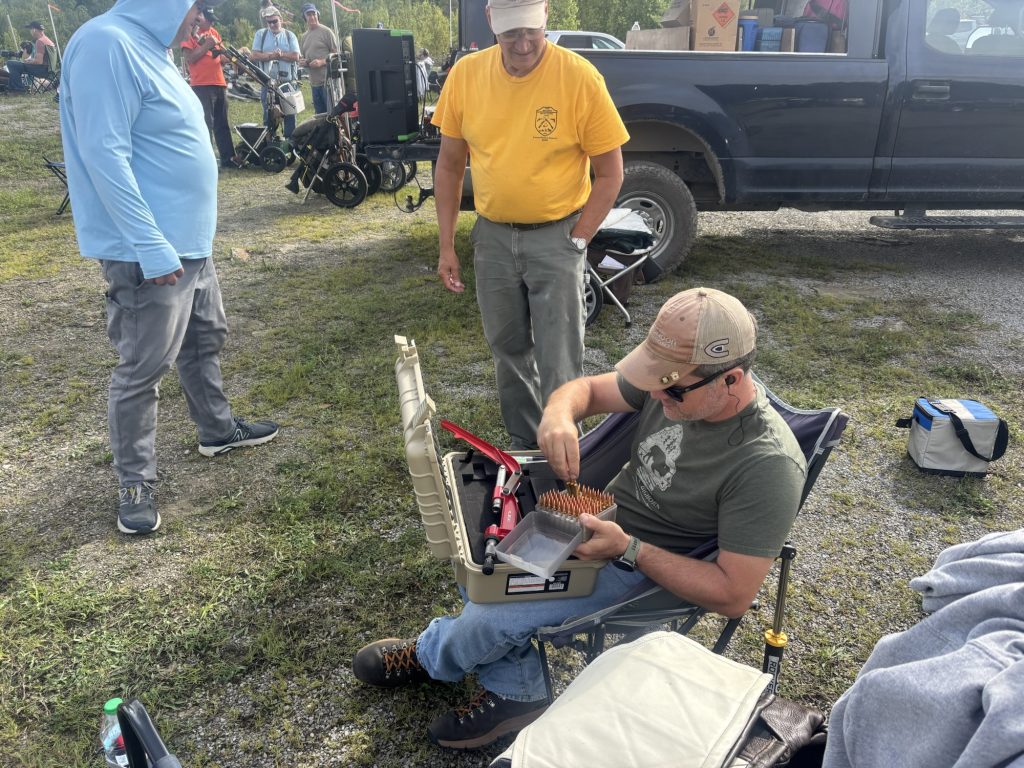
When a 3×600 Match Turns Into an Ammunition Repair Job

During the Pennsylvania Mid-Range Championship at Reade Range, part of the Riflemen’s Weekend competition, the shooter was working through the first string of a 3×600 match.

Three rounds turned out to be too long to chamber properly. Rather than force the issue and turn a minor ammunition problem into a major rifle problem, the rounds had to be beaten back out of the rifle.

That is when the scorer—and what looked like an entire reloading department—went into action.

The shooter dealt with the rifle while the scorer worked on the ammunition and helped get everything sorted out. High-power rifle competition is usually associated with precision, discipline, and carefully prepared equipment. It is also occasionally associated with tools scattered everywhere while somebody asks, “Who has a press?”

At 600 yards, every shot matters. A 3×600 match requires 60 record shots from the prone position, along with wind calls, sight adjustments, position management, rifle function, and ammunition that actually agrees with the chamber. There is not much room for a cartridge that decides it would rather remain outside the rifle.

A round that is slightly too long may not sound like a serious problem, but it can bring a match rifle to a complete stop. The shooter has to recognize the issue, keep the rifle safe, remove the ammunition, and decide whether the rounds can be corrected or need to be retired from competition. Losing time during a string can hurt almost as much as losing points on the target.

Fortunately, the firing line apparently had access to enough reloading equipment to handle the emergency. That is one of the benefits of shooting with experienced competitors: somebody usually has the exact tool needed, even if it is buried beneath three ammunition boxes, a spotting scope, and enough miscellaneous gear to open a small machine shop.

The score will record the points and center shots, but it will not record the interruption, the ammunition problem, or the scorer’s efforts to get everything back on track.

A 3×600 match may be built around precision, but it still includes the occasional reminder that even carefully prepared ammunition can develop an attitude—usually at the worst possible time, during the final string, with the clock running.

Posted in XTC