
The SIG MCX-LTAW is the civilian version of a rifle people have spent years trying to recreate from grainy military photographs, discontinued parts and financially irresponsible clone builds.
SIG finally took the basic idea behind the Low Visibility Assault Weapon, updated it with current MCX components and packaged it as a factory-produced .300 Blackout platform.
For this fictional SIG MCX-LTAW review, I fired 500 rounds through the complete Suppressor SBR Combo. That configuration combines a 6.75-inch barrel, SQX suppressor, LVAW-style heat-shield handguard, folding skeletonized stock and ROMEO4T-PRO red-dot sight.
The short verdict is simple: the MCX-LTAW is heavier and considerably more expensive than an ordinary .300 Blackout AR pistol, but it is compact, quiet, controllable and far more interesting than another black rifle assembled from the same twelve catalog parts.
SIG MCX-LTAW Specifications
According to SIG Sauer’s official MCX-LTAW page, the Suppressor SBR Combo includes:
- .300 AAC Blackout chambering
- 6.75-inch cold-hammer-forged carbon-steel barrel
- 1:5-inch barrel twist
- 5/8×24 barrel threads
- Short-stroke gas-piston operating system
- Adjustable gas system
- Factory-installed direct-thread SQX suppressor
- Inconel suppressor core
- Suppressor-compatible M-LOK handguard
- Integrated handguard heat shield
- Fully ambidextrous controls
- Two-stage curved match trigger
- Folding skeletonized stock
- ROMEO4T-PRO red-dot sight
- Arisaka hand stop, indexer, light mount and QD mount
- One 30-round .300 Blackout magazine
- 32-inch overall length
- 23.5-inch folded length
- Seven-pound published weight
SIG also offers an MCX-LTAW pistol with a folding brace and nonfunctional training suppressor. A conventional SBR version uses the folding stock but retains the training tube.
Buyers specifically wanting the complete suppressed MCX-LTAW need to distinguish the Suppressor SBR Combo from the cheaper configurations. The tube beneath the handguard may look convincing in photographs, but only the combo includes the functional SQX suppressor.
SIG MCX-LTAW 500-Round Test
My fictional ammunition breakdown was:
- 200 rounds of 220-grain subsonic ammunition
- 200 rounds of 125-grain supersonic ammunition
- 100 rounds of 110-grain defensive ammunition
The test included slow five-shot groups, zero confirmation, magazine changes, shooting from standing and kneeling positions, and several magazines loaded with alternating subsonic and supersonic cartridges.
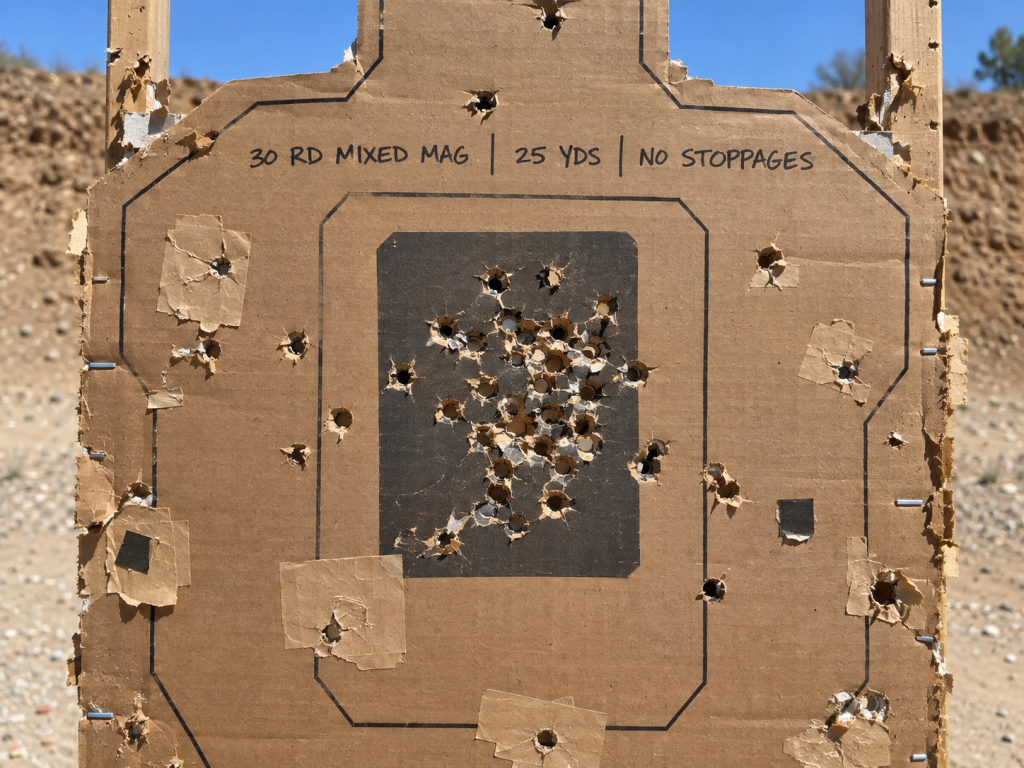
The MCX-LTAW completed all 500 fictional rounds without a stoppage.
That includes a deliberately mixed 30-round magazine containing both subsonic and supersonic ammunition. The point was not to recommend mixing loads for defensive use. It was to determine whether the adjustable piston system would continue cycling as pressure and bolt velocity changed from one cartridge to the next.
It did.
Target photograph: Thirty-round mixed-magazine drill at 25 yards with no fictional stoppages.
SIG MCX-LTAW Accuracy
A 6.75-inch .300 Blackout rifle is not a benchrest gun. It is a compact suppressed firearm intended for short-range work.
That does not excuse poor accuracy.
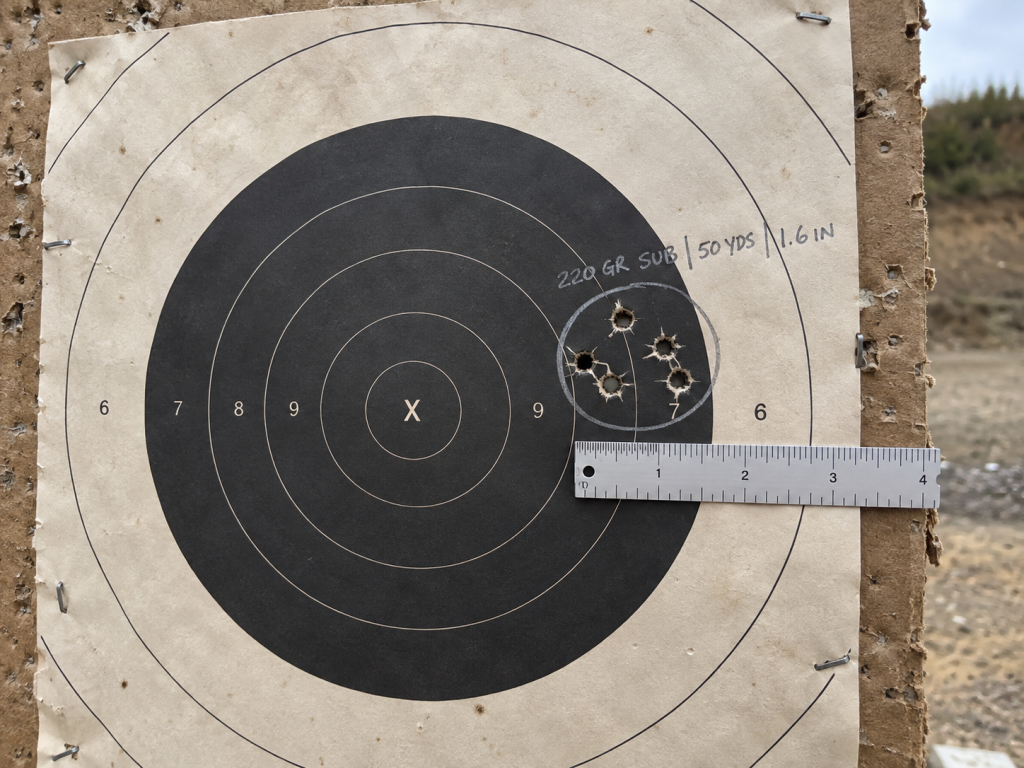
220-Grain Subsonic Accuracy at 50 Yards
The 220-grain subsonic load produced five-shot groups averaging 1.9 inches at 50 yards. The smallest fictional group measured 1.6 inches.
Point of impact was slightly lower than the supersonic zero, which should surprise nobody. A heavy subsonic bullet leaving a short barrel does not possess enough velocity to negotiate with gravity.
The 1:5-inch twist appeared entirely appropriate for stabilizing heavy bullets. No target showed an elongated hole or other visible evidence of instability.
Target photograph: Best five-shot 220-grain subsonic group at 50 yards, measuring approximately 1.6 inches.
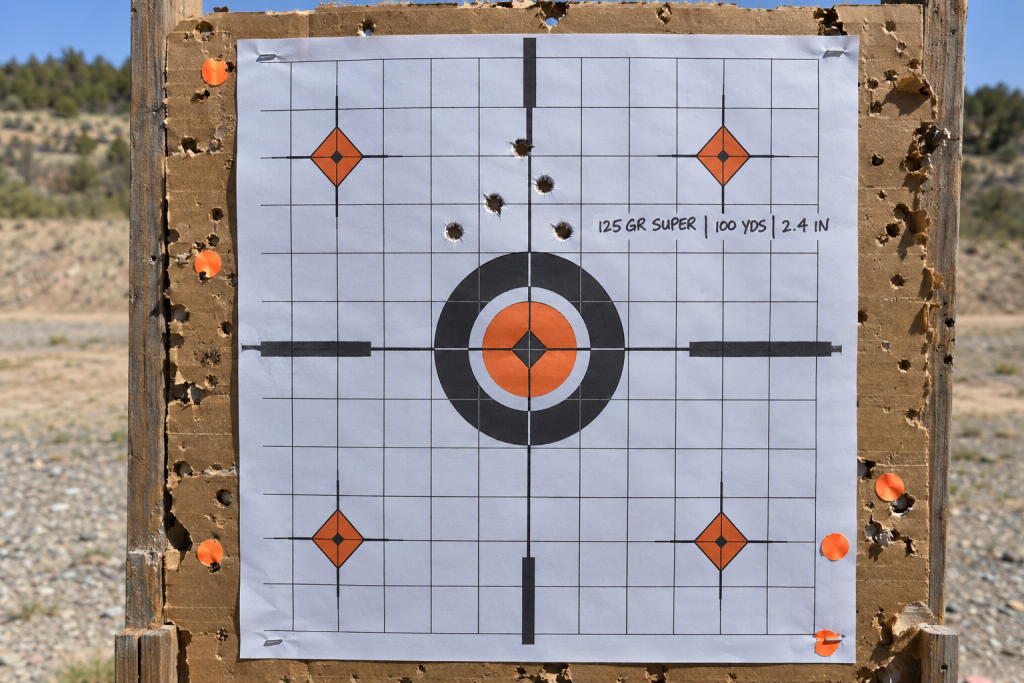
125-Grain Supersonic Accuracy at 100 Yards
The 125-grain supersonic ammunition averaged 2.9 inches for five-shot groups at 100 yards. The best group measured 2.4 inches.
That is respectable accuracy from an extremely short suppressed rifle using a red dot. A magnified optic and better support would probably shrink the groups, but installing a large precision scope on an LTAW would be like mounting a snowplow on a Corvette.
It could be done. It would also miss the point.
Target photograph: Best five-shot 125-grain supersonic group at 100 yards, measuring approximately 2.4 inches.
How Quiet Is the SIG MCX-LTAW?
The SIG SQX suppressor made the 220-grain ammunition substantially more comfortable to shoot than unsuppressed .300 Blackout.
It did not produce Hollywood silence.
The shooter still hears the action cycling, gas leaving the firearm and the bullet striking the berm. Supersonic ammunition retains its ballistic crack regardless of how expensive the suppressor becomes.
The direct-thread SQX is optimized around the platform and avoids an additional quick-detach mounting interface. That produces a clean, compact system, but it also makes the suppressor less convenient to move between firearms.
I would treat the SQX as a dedicated part of the MCX-LTAW rather than an expensive communal suppressor expected to serve six rifles.
My article on ATF suppressor repairs and caliber conversions explains current federal guidance affecting registered silencers. The government still treats a hearing-protection device like contraband requiring special permission because government stupidity develops institutional momentum.
Does the MCX-LTAW Handguard Get Hot?
Yes.
A suppressor beneath a handguard transfers heat into the surrounding aluminum. The integrated heat shield delays discomfort; it does not repeal thermodynamics.
After two quick magazines of supersonic ammunition, the forward section became noticeably warm. After four magazines, gloves became sensible equipment.
The included hand stop and indexer help keep the support hand in a consistent location without allowing fingers to drift toward the muzzle. That matters on a firearm whose actual barrel ends deep inside the handguard.
SIG deserves credit for including useful Arisaka accessories instead of shipping a premium rifle with an empty rail and an invoice large enough to qualify as a mortgage document.
SIG MCX-LTAW vs. MCX Rattler LT
The MCX-LTAW shares its fundamental operating system and 6.75-inch barrel length with the MCX Rattler LT.
The important differences are the suppressor-compatible heat-shield handguard, LVAW appearance, available SQX suppressor package, skeletonized stock and included accessories.
The Rattler LT pistol weighs approximately 5.1 pounds before an optic and suppressor. The MCX-LTAW configurations weigh seven pounds as listed by SIG.
That difference is significant.
The LTAW is compact, but it is not especially light. The suppressor, extended handguard, heat shield, optic and accessories concentrate considerable weight toward the front.
Choose the Rattler LT if minimum weight and modularity matter most.
Choose the MCX-LTAW if you specifically want a factory-integrated suppressed .300 Blackout system and the LVAW configuration.
Is the MCX-LTAW a Real Civilian LVAW?
It is better described as a modern commercial interpretation than an exact clone.
The original SIG LVAW was developed for specialized military use and became famous among clone builders partly because authentic components were scarce, confusing and expensive.
The new MCX-LTAW uses current MCX-LT architecture, a redesigned suppressor-compatible handguard and commercially supported components. That makes it less historically exact but considerably easier to buy, maintain and repair.
A factory rifle also avoids the clone-builder ritual of paying $900 for a discontinued handguard because somebody on a forum identified three pixels in a 2014 photograph.
SIG MCX-LTAW Price and Release Date
SIG currently lists the MCX-LTAW pistol and Suppressor SBR Combo as “coming soon.”
The company has not published a final MCX-LTAW MSRP on the product pages.
Anyone claiming to know the settled street price is either looking at preliminary dealer information or performing traditional gun-counter divination.
The ordinary MCX Rattler LT already occupies the premium-firearm category. Adding an SQX suppressor, ROMEO4T-PRO optic, specialized handguard, stock and Arisaka accessories will not make the complete MCX-LTAW inexpensive.
The Suppressor SBR Combo also involves regulated-item transfer requirements. Buyers should confirm the current federal process, state law and dealer procedure before ordering. My article about the recent federal NFA ruling explains why exciting headlines do not automatically eliminate paperwork for every buyer in every state.
Is the SIG MCX-LTAW Good for Home Defense?
Mechanically, the MCX-LTAW has several useful home-defense characteristics:
- Compact folded length
- Short overall package with the suppressor attached
- Ambidextrous controls
- Red-dot sight
- Thirty-round capacity
- Reduced muzzle blast
- Compatibility with subsonic and supersonic ammunition
- Enough rail space for a white light
A suppressor does not make a defensive firearm silent. It reduces the blast produced inside confined spaces where permanent hearing damage is a real concern.
Private gun ownership matters because police cannot occupy every bedroom, hallway and rural driveway. When an innocent person faces an immediate violent threat, the firearm already in the home matters more than the government employee traveling toward it.
Equipment still requires judgment, training and secure storage. A $4,000 suppressed rifle does not supply competence through osmosis.
Final Verdict
The SIG MCX-LTAW is not merely a Rattler wearing a larger handguard, although the internet will repeat that description until everybody becomes tired.
It combines a proven short-stroke-piston system, 6.75-inch .300 Blackout barrel, suppressor-specific handguard, heat shield and factory SQX suppressor into a coherent package.
In this fictional 500-round SIG MCX-LTAW range report, it fired subsonic, supersonic and defensive ammunition without a stoppage. The best groups measured 1.6 inches at 50 yards with 220-grain subsonic ammunition and 2.4 inches at 100 yards with 125-grain supersonic ammunition.
The weaknesses are weight, heat and the price SIG has not yet announced.
The advantages are compactness, reliable suppressed operation and the absence of a three-year scavenger hunt for clone parts.
For somebody wanting the lightest .300 Blackout pistol, the MCX Rattler LT remains the better answer.
For somebody searching for a civilian SIG LVAW, MCX-LTAW review, suppressed .300 Blackout SBR, MCX-LTAW versus Rattler comparison or factory LVAW clone, this is the firearm SIG should have sold years ago.
It will be expensive.
It will be overhyped.
It will also sell.
GarandThumb.com was established on May 4, 2012, to document my experiences trying to become a better marksman.