Fulton Armory M1A/M14 HUB Mount Review | Suppressor Fitment, Installation and Problems

The new Fulton Armory M1A/M14 HUB Mount finally gives owners a direct route from the rifle’s unusual muzzle threads to the suppressor industry’s increasingly common 1.375×24 HUB interface. Fulton currently lists the adapter in stock for $89.95, making it one of the simplest answers yet for anyone searching for an M1A suppressor adapter, M14 HUB mount or a practical way to suppress a Springfield Armory M1A.

This is a specifications-based review, not a claim of personal range testing. The important questions are whether the adapter fits your particular rifle, whether your suppressor is compatible and what other changes an M14-pattern rifle may require before it can be fired safely with a suppressor.

Fulton Armory M1A/M14 HUB Mount Specifications

According to the official Fulton Armory product page⁠, the adapter has the following specifications:

Specification

Fulton Armory M1A/M14 HUB Mount

Product number

FA-M-186

Rifle-side thread

.595×32 right-hand

Suppressor-side thread

1.375×24 HUB

Material

Hardened 4140 steel

Finish

Nitride

Supported barrel lengths

18.5 and 22 inches

18-inch compatibility

Fits, but must be removed for gas-piston cleaning

Listed price

$89.95

Optional wrench

$12.95

The adapter converts the standard .595×32 M1A/M14 muzzle thread to the 1.375×24 pattern commonly called HUB, Bravo or “universal” suppressor threading. “Universal” is marketing shorthand rather than a promise that every silencer fits every rifle. Buyers still need to confirm the suppressor’s rear-interface threads, caliber rating and minimum permitted barrel length.

What Does the M1A HUB Mount Actually Solve?

Suppressing an AR-10 is usually straightforward because the commercial market standardized around familiar muzzle threads and mounting systems. The M14 family never received that benefit.

An M1A generally uses the old M14-style .595×32 muzzle thread arrangement. That considerably limits direct-thread suppressor options and often forces an owner into proprietary muzzle devices, multiple adapters or more extensive front-end changes.

Fulton’s mount removes one layer of nonsense. It threads onto the rifle and presents a standard 1.375×24 HUB interface at the suppressor end. A compatible suppressor can then attach directly to the mount without stacking another removable HUB adapter between the rifle and silencer.

Fewer threaded connections can mean fewer opportunities for something to loosen or become misaligned. That does not guarantee concentricity, but it is a cleaner design than balancing several adapters simply because a rifle designed in the 1950s predates today’s suppressor market.

Which M1A and M14 Rifles Does It Fit?

Fulton states that the adapter fits M1A and M14-pattern rifles with 18.5-inch and 22-inch barrels. It also fits 18-inch models, but the company warns that the adapter must be removed to access and clean the gas piston.

That maintenance limitation matters. An adapter that has to be removed repeatedly should be reinstalled correctly every time, and bore alignment should be rechecked whenever the muzzle assembly has been disturbed.

Owners should also identify exactly what they possess before ordering. “M14,” “M1A” and “M14-style rifle” are often used casually, but rifles from Springfield Armory, Fulton Armory, LRB, Bula Defense and other manufacturers may have different barrels, front-sight arrangements or aftermarket muzzle components.

Do not order by nickname. Verify the actual muzzle thread, barrel length, gas-system configuration and suppressor specifications.

The Front-Sight Problem

The traditional M14 flash suppressor assembly also carries the front sight. Removing that assembly to install a compact suppressor mount can therefore leave a rifle without its original front-sight mounting point.

That may not matter to an owner using an optic exclusively, but anyone who wants functional iron sights needs a replacement arrangement. One established solution is a gas-lock front-sight base that relocates the sight closer to the gas cylinder.

This additional part is not included with Fulton’s adapter. Buyers comparing the advertised $89.95 price against a complete M1A suppressor conversion should therefore account for any required sight base, gas plug, gunsmithing and suppressor-specific components.

Fulton’s optional installation wrench costs another $12.95. That is a reasonable purchase for an owner who expects to remove the mount for maintenance, especially on an 18-inch rifle.

M1A Suppressor Gas-System Considerations

The HUB mount solves the physical thread problem. It does not automatically solve the M1A’s gas-system problems.

A conventional suppressor can increase backpressure. On an M14-pattern action, excess gas may increase bolt velocity, make extraction more violent and impose additional stress on the operating system. Symptoms can include unusually forceful ejection, case damage, excessive fouling or an action that feels much harsher than it did unsuppressed.

Unlike many modern rifles, the standard M1A does not provide a simple external gas adjustment. Owners commonly investigate purpose-built adjustable gas plugs or lower-backpressure suppressors when configuring one of these rifles.

Any gas-system change should be approached conservatively. The goal is dependable operation without battering the rifle, not proving that maximum gas and maximum bolt speed can throw brass into the next county.

The operating rod is one of the defining components of the platform and one of the reasons careless suppressor installation is a bad bargain. A $90 adapter does not make replacement M14 parts cheap.

Check Bore Alignment Before Firing

Suppressor alignment is critical on every firearm, but the M1A’s barrel threads, muzzle shoulder and front-end assembly deserve particular attention.

After installation, the suppressor bore should be checked with the correct alignment rod. The rod should remain centered through the suppressor without approaching or contacting an endcap or baffle. If the alignment looks questionable, stop and determine why.

Possible causes include:

  • Damaged or nonconcentric muzzle threads
  • An incorrectly seated adapter
  • Carbon or debris between mating surfaces
  • An unsuitable washer or shim arrangement
  • A suppressor mount that is not fully installed
  • A previously modified barrel or muzzle assembly

“Close enough” is an expensive attitude when a .308 projectile is passing through a stack of baffles. A baffle strike can damage the suppressor and create a genuine safety problem. When the alignment is doubtful, a qualified M14 gunsmith is cheaper than replacing a silencer.

Will the Adapter Affect M1A Accuracy?

Any change to an M14-pattern rifle’s muzzle assembly has the potential to change point of impact or group size. The weight of the suppressor, the installation tension and contact among the gas cylinder, front band and stock can all affect how the rifle behaves.

That does not mean the Fulton mount inherently harms accuracy. There is not enough independent shooting data yet to make that claim. It means owners should establish a sensible unsuppressed baseline, install the complete suppressor system correctly and then compare groups using the same ammunition and shooting conditions.

If accuracy changes dramatically, inspect the installation before blaming the barrel or ammunition. Confirm that nothing has loosened, that bore alignment remains correct and that the gas system is not operating excessively hard.

Does This Mount Work With CMP M14 Rifles?

The adapter is directly relevant to commercial semiautomatic M14-pattern rifles. The legal status of authentic military M14 receivers is a separate subject.

The planned CMP M14 program does not make every original M14 receiver an ordinary transferable semiautomatic rifle. Machine-gun classification and the CMP’s special statutory authority require careful treatment. My article explaining the CMP M14 sale and federal machine-gun classification⁠ covers that distinction.

Likewise, the federal government’s recent suppressor policy did not erase every firearm law. The current legal position is explained in ATF Ends NFA Registration Enforcement Nationwide⁠ and Buying a Suppressor Without a Tax Stamp⁠.

Government should never have treated ordinary hearing-protection equipment like contraband. Nevertheless, state restrictions and the remaining federal rules still matter.

Fulton Armory M1A/M14 HUB Mount Problems to Consider

The known limitations are straightforward:

  • Installing it may remove the original front-sight mounting point.
  • An 18-inch model requires adapter removal for gas-piston cleaning.
  • The M1A may need gas-system changes for suppressed shooting.
  • HUB threading alone does not guarantee that a suppressor is caliber- or barrel-length-rated.
  • Every completed installation still requires an alignment check.
  • Independent long-term reliability and accuracy reports remain limited because the product is new.

Those are not reasons to dismiss the mount. They are reasons to understand that suppressing an M1A remains a system project rather than a one-part conversion.

Is the Fulton Armory M1A HUB Mount Worth Buying?

At $89.95, the Fulton Armory M1A/M14 HUB Mount appears to be a practical and fairly priced solution to the platform’s obsolete muzzle-thread problem. Hardened 4140 steel, a nitride finish and direct compatibility with 1.375×24 HUB suppressors are sensible design choices.

The mount is most attractive for an owner who already has a compatible HUB suppressor, understands the M1A gas system and has a plan for the front sight. It is less compelling for someone expecting to screw on a silencer with no additional inspection or tuning.

Fulton has solved an annoying mechanical problem that should have been addressed years ago. Just remember what the product is: a well-designed thread adapter, not a magic cure for every complication involved in suppressing an M14-pattern rifle.

GarandThumb.com was established on May 4, 2012, to document my experiences trying to become a better marksman.
Posted in XTC

Savage REVEL Tactical Review | .22 LR vs .22 WMR vs .17 HMR

The Savage REVEL Tactical is a takedown rimfire lever-action rifle offered in .22 LR, .22 WMR and .17 HMR. It combines an 18-inch threaded barrel, factory Picatinny rail, M-LOK fore-end and MDT-designed synthetic stock with the familiar REVEL action.

This Savage REVEL Tactical review is based on verified manufacturer specifications and published documentation, not a personal range test. I have not fired this rifle, so I will not manufacture an accuracy group, reliability claim or round count to make the article sound more exciting.

Savage announced the rifle on October 8, 2026. It enters a market dominated by traditionally styled rimfire lever guns, but its real competition includes the Henry X Model, suppressor-ready bolt actions and semiautomatic .22 rifles equipped with modern accessories.

Savage REVEL Tactical Specifications

According to Savage’s published information and the NRA’s detailed product report, the REVEL Tactical uses the established REVEL takedown action beneath new MDT-designed furniture. 

Specification

Savage REVEL Tactical

Action

Lever-action rimfire

Chamberings

.22 LR, .22 WMR and .17 HMR

Barrel

18-inch medium-profile barrel

Muzzle threads

1/2×28 with thread protector

Capacity

12 rounds in .22 LR; 9 rounds in .22 WMR or .17 HMR

Magazine

Under-barrel tubular magazine

Receiver

Steel receiver beneath an aluminum cover

Optics mounting

Factory-installed 0-MOA Picatinny rail

Sights

Elevation-adjustable rear U-notch and hooded front post

Stock

Black MDT-designed synthetic stock with clip-on cheek riser

Fore-end

Textured synthetic fore-end with M-LOK slots

Safety

External hammer and crossbolt safety

Weight

Approximately 6 pounds

MSRP

$629 in .22 LR; $659 in .22 WMR or .17 HMR

The rifle is also a takedown model. Two captive receiver pins allow its major assemblies to separate without turning the gun into a loose collection of springs and tiny parts.

That capability matters for storage and transportation. It can also make routine access easier, although “takedown” should not automatically be interpreted as “every internal component is effortless to remove and scrub.”

Savage REVEL Tactical .22 LR Review

The .22 LR version is the logical choice for most buyers.

It has the largest magazine capacity at 12 rounds, the least expensive ammunition of the three chamberings and the widest selection of standard-velocity, high-velocity and subsonic loads. The combination of a manually operated action and 1/2×28 muzzle threads also gives it obvious potential as a suppressor host.

Unlike a blowback semiautomatic, a lever action keeps its breech closed until the shooter manually cycles it. That avoids the action noise and ejection-port gas associated with many suppressed semiautomatic rimfires.

The .22 LR model is the best fit for:

  • Economical recreational shooting
  • Suppressed target practice
  • Small-game hunting where lawful
  • New-shooter instruction
  • Buyers who want the full 12-round capacity
  • Anyone comparing the Savage REVEL Tactical vs Henry X rimfire models

A suppressor does not eliminate the need for hearing protection, safe handling or an adequate backstop. Buyers must also comply with whatever federal, state and local restrictions remain applicable. Those laws frequently punish ordinary ownership while accomplishing little beyond creating paperwork for people who were never the problem.

Savage REVEL Tactical .22 WMR Review

The .22 WMR version sacrifices three rounds of magazine capacity and carries a $30-higher suggested price, but it delivers substantially more useful velocity and energy than .22 LR.

That makes it the more practical field cartridge for hunters who want greater reach and authority on varmints or small predators. Ammunition costs more, produces more muzzle blast and is rarely the best option for casual high-volume shooting.

The 1/2×28 threads remain useful, but owners must confirm that any suppressor is specifically rated for .22 WMR. A rimfire suppressor rated only for .22 LR should not be treated as automatically compatible with a magnum cartridge.

Choose the .22 WMR REVEL Tactical if hunting performance matters more than ammunition cost or maximum tubular-magazine capacity.

Savage REVEL Tactical .17 HMR Review

The .17 HMR model is the specialist of the three.

It offers a relatively flat trajectory and is well suited to small targets at distances where ordinary .22 LR begins requiring more elevation correction and wind judgment. Its velocity also makes it attractive for varmint control in appropriate locations.

The tradeoffs are higher ammunition cost, greater noise and reduced versatility with suppressors. As with .22 WMR, buyers must verify the suppressor manufacturer’s caliber rating before attaching anything.

The factory Picatinny rail and raised cheekpiece make particular sense on the .17 HMR model because most owners will want magnified glass rather than treating the rifle primarily as an iron-sight plinker.

For precision-minded rimfire shooters, the unanswered question is accuracy. Savage has provided the hardware needed to mount a capable optic, but I have not found a manufacturer accuracy guarantee for this model. Until repeatable independent testing exists, claims about half-inch groups or ammunition preferences would be speculation.

Is the REVEL Tactical a Good Suppressor Host?

On paper, yes.

The Savage REVEL Tactical suppressor-host package includes three important features:

  1. An 18-inch barrel threaded 1/2×28
  2. A manually operated action that remains closed during firing
  3. A factory optics rail that avoids searching for a compatible base

The .22 LR chambering is the obvious choice for quiet shooting with suitable subsonic ammunition. The longer barrel may keep some loads below the speed of sound while pushing others above it, depending on the cartridge and atmospheric conditions. Ammunition marked “subsonic” is the more dependable starting point than assuming every standard-velocity load will behave identically.

Always confirm bore alignment, thread condition, suppressor caliber rating and the manufacturer’s mounting instructions.

Savage REVEL Tactical Takedown and Cleaning

The REVEL Tactical separates into two principal sections after its two captive push pins are released. The barrel, receiver and fore-end remain together, while the lever, trigger group and stock form the other section.

That is useful for fitting the rifle into a compact case and reaching areas that are awkward on conventional lever actions. Savage’s own takedown guide presents the REVEL system as suitable for storage, travel, small-game hunting and recreational shooting.

The design does not mean owners should attack the rifle with a screwdriver after every range visit. Rimfire ammunition is dirty, but careless over-disassembly causes its own problems. Follow the current owner’s manual, keep oil out of the ammunition and firing-pin channel, and avoid damaging the muzzle crown with a cleaning rod.

Savage REVEL Tactical vs Henry X

The Savage REVEL Tactical vs Henry X question largely comes down to priorities rather than one rifle making the other obsolete.

Henry has an established reputation in lever guns and appeals to buyers who want a proven product family. The Savage counters with its two-pin takedown system, included Picatinny rail, MDT furniture and three rimfire chamberings.

Savage’s advantages include:

  • Rapid takedown into two major sections
  • Factory-installed optics rail
  • M-LOK accessory mounting
  • Included raised cheekpiece
  • Choice of .22 LR, .22 WMR or .17 HMR

The REVEL Tactical’s styling will divide shooters. Some will appreciate a lever action designed around optics, suppressors and practical accessories. Others will see black polymer and the word “Tactical” as marketing applied to a rimfire rifle.

I care less about whether it resembles a cowboy rifle and more about whether the pins remain secure, the action cycles cleanly, the zero survives repeated takedown and assembly, and Savage supports replacement parts. Those are the questions that matter after the launch-day photography is forgotten.

Savage REVEL Tactical Problems to Watch

No broad Savage REVEL Tactical reliability problem has been established. The rifle is too new for responsible claims about long-term durability.

Prospective buyers should nevertheless examine:

  • Consistency of lockup after repeated takedown cycles
  • Whether an optic maintains zero after disassembly
  • Feeding with different bullet profiles
  • Extraction with dirty rimfire chambers
  • Magazine-tube operation with a suppressor installed
  • Stock and cheek-riser fit
  • Lever clearance when wearing gloves
  • Availability of replacement pins and small parts

The recent Smith & Wesson acquisition of Savage Arms⁠ adds another legitimate ownership question: long-term parts, warranty and product-line support. Nothing presently indicates that the REVEL family is being canceled, but corporate promises are cheaper than replacement parts. Owners should retain receipts and warranty documentation.

Savage REVEL Tactical Price and Verdict

At $629 for .22 LR and $659 for .22 WMR or .17 HMR, the REVEL Tactical is not an inexpensive plinking rifle. Buyers are paying for the takedown system, threaded barrel, MDT furniture, M-LOK mounting and included optics rail.

The .22 LR version offers the broadest appeal and the strongest suppressor-host potential. The .22 WMR is the better hunting choice when additional power matters. The .17 HMR makes the most sense for shooters prioritizing trajectory and varmint accuracy.

My preliminary verdict is favorable but conditional. The specifications are intelligently chosen, and Savage did more than bolt a plastic stock onto an existing rifle. The REVEL Tactical has a coherent purpose: it is a compact, optics-ready and suppressor-ready lever-action rimfire.

Whether it deserves its price will depend on real accuracy, consistent zero after takedown, long-term parts support and reliability across commonly available ammunition. Those answers require honest shooting and time, not a press release dressed up as a range report.

GarandThumb.com was established on May 4, 2012, to document my experiences trying to become a better marksman.

Posted in XTC

BCA Bear Pump Explained | Pump-Action AR-15 Compatibility, Calibers and Hunting Uses

The BCA Bear Pump is a manually operated pump-action AR-15 offered as either a complete rifle or an upper assembly for a standard AR-15 lower. Bear Creek Arsenal launched it on November 5, 2026, initially chambered in .400 Legend and .450 Bushmaster with 16-, 18- and 20-inch barrels.

Instead of using combustion gas to cycle the action, the Bear Pump requires the shooter to pull its sliding forend rearward to extract and eject the fired case, then push it forward to chamber the next cartridge. It combines familiar AR-15 controls, magazines and lower receivers with an action that behaves more like a pump shotgun.

This is an examination of BCA’s published design and specifications, not a hands-on Bear Pump review or range test. BCA has not yet published enough independent shooting data to justify invented accuracy groups, reliability claims or breathless declarations that it has somehow reinvented the rifle.

What Is the BCA Bear Pump?

The official Bear Creek Arsenal announcement⁠ describes the Bear Pump as the company’s first pump-action AR-15. BCA says it retains compatibility with standard AR-15 magazines, pistol grips and many mil-spec internal components. Complete Bear Pump uppers are designed for compatible standard AR-15 lower receivers. 

Its basic operating sequence is straightforward:

  1. Fire the chambered cartridge.
  2. Pull the forend rearward.
  3. The action extracts and ejects the fired case.
  4. Push the forend forward.
  5. The bolt strips another cartridge from the magazine and chambers it.

There is no automatic cycling between shots. That makes the Bear Pump fundamentally different from an ordinary direct-impingement or piston-operated semiautomatic AR-15.

It also means the shooter controls the entire cycling stroke. A short or hesitant pump could potentially cause a feeding problem, just as it can with any manually operated repeating firearm. That is an operational consideration, not evidence that the Bear Pump itself is unreliable.

BCA Bear Pump Specifications

BCA’s initial announcement confirms the following:

Feature

Confirmed information

Action

Manually operated pump action

Initial chamberings

.400 Legend and .450 Bushmaster

Barrel lengths

16, 18 and 20 inches

Configurations

Complete rifle or complete upper assembly

Lower compatibility

Compatible standard AR-15 lower receivers

Magazine compatibility

Standard AR-15-pattern magazines appropriate to the chambering

Grip compatibility

Standard AR-15 pistol grips

Optics mounting

Full-length Picatinny top rail

Launch date

November 5, 2026

Additional chamberings

Planned but not yet identified

BCA had not included complete weights, twist rates, muzzle-thread specifications or retail prices in its launch announcement when this article was prepared. Those details should be checked against the exact product listing before ordering because barrel length and chambering may change them.

Will a Bear Pump Upper Fit a Standard AR-15 Lower?

BCA says the complete Bear Pump upper is designed to attach to a compatible standard AR-15 lower. That is probably the feature that will generate the most interest.

An owner who already has a suitable lower may be able to replace the semiautomatic upper with a Bear Pump upper without buying another complete rifle. The lower retains familiar AR controls, including the trigger, safety, magazine release and bolt catch.

However, “standard AR-15 compatible” should not be read as a promise that every collection of aftermarket parts will work perfectly.

Before purchasing a BCA Bear Pump upper, confirm:

  • The lower is dimensionally compatible.
  • The magazine matches the selected cartridge.
  • The hammer and fire-control components are conventional and properly installed.
  • The stock, grip and accessories do not interfere with pump operation.
  • The selected optic provides adequate eye relief and clearance.
  • BCA’s instructions do not require a specific buffer or internal configuration.

The initial Bear Pump uses large straight-wall cartridges, so feeding depends heavily on using appropriate magazines. A magazine that physically fits an AR-15 lower is not automatically reliable with .400 Legend or .450 Bushmaster ammunition.

Bear Pump .400 Legend vs .450 Bushmaster

The first Bear Pump caliber choice comes down to recoil, ammunition support and the kind of hunting the rifle will actually see.

Bear Pump in .400 Legend

The .400 Legend occupies the middle ground between .350 Legend and .450 Bushmaster. It offers a larger and heavier projectile than .350 Legend without demanding the recoil associated with many .450 Bushmaster loads.

Potential advantages include:

  • More moderate recoil than .450 Bushmaster
  • Useful energy for whitetail deer and similar game
  • A practical balance of bullet weight and trajectory
  • Straight-wall cartridge eligibility in jurisdictions that permit it

Its main weakness is ammunition selection. The .400 Legend is newer, and local availability may be inconsistent. A rifle is not especially useful during hunting season if the owner cannot obtain the load it prefers.

Bear Pump in .450 Bushmaster

The .450 Bushmaster is the established heavy hitter. It has broader rifle and ammunition support and delivers substantial power at ordinary woods-hunting distances.

Potential advantages include:

  • Established factory-ammunition support
  • Heavy bullets and strong short-to-medium-range performance
  • Existing AR-15 magazine and component knowledge
  • A well-understood role as a straight-wall deer and hog cartridge

The costs are heavier recoil, more muzzle blast and a more arcing trajectory than smaller cartridges. A pump-action rifle also requires the shooter to disturb the firing position after every shot, making recoil management and rapid reacquisition especially relevant.

My existing 350 Legend vs .400 Legend vs .450 Bushmaster comparison⁠ covers the cartridge differences in greater detail.

Is the Bear Pump Legal in Restricted States?

A pump-action rifle is not semiautomatic, but that does not automatically make every Bear Pump configuration legal in every state or municipality.

Firearm restrictions can regulate more than the operating system. Laws may address detachable magazines, particular features, overall length, barrel length, named models or combinations of parts. Hunting regulations are a separate problem: a rifle that is legal to possess may still be prohibited for a particular season, species or county.

The government has spent decades producing a senseless maze in which functionally similar rifles receive different treatment because one cycles itself and another requires movement of a wooden or aluminum handle. That does not excuse an owner from checking the actual law.

Do not rely on a retailer’s generic “ban-state legal” label. Verify the exact configuration through current state statutes, wildlife-agency regulations and, when necessary, a qualified local attorney. Also confirm whether the chosen straight-wall cartridge is permitted where you hunt; “straight wall” is not a nationwide hunting exemption.

Bear Pump Hunting Advantages

The Bear Pump makes the most sense as a specialized hunting rifle.

Its potential advantages include:

  • Straight-wall hunting cartridges
  • Familiar AR-15 ergonomics
  • Quick removal of the upper for cleaning or transport
  • Compatibility with existing lowers and accessories
  • Manual operation for hunters who prefer a simple repeating action
  • A Picatinny rail that accepts conventional hunting optics

The 18- and 20-inch versions may appeal to hunters who want additional barrel length, while the 16-inch rifle should be more convenient in blinds and thick cover. Actual velocity differences cannot be assumed until BCA or independent testers publish chronograph results from each configuration.

A pump rifle can also keep the firing hand near the pistol grip while the support hand cycles the action. Whether BCA’s forend is genuinely smooth and comfortable remains a range-testing question.

Bear Pump Questions That Still Need Answers

The announcement establishes the concept, but several important Bear Pump review questions remain unresolved:

  • What do the complete rifles and uppers weigh?
  • What are the barrel twist rates?
  • Which magazines ship with each chambering?
  • Does the action feed blunt hunting bullets reliably?
  • How much force does the pump require?
  • Can the rifle be cycled easily from supported field positions?
  • Does the forend develop play after extended use?
  • What accuracy can buyers expect from each barrel length?
  • How difficult is disassembly and cleaning?
  • What are the complete-rifle and upper prices?
  • Which additional calibers will follow?

Those are not minor details. A pump-action AR must offer more than novelty. It needs reliable extraction, positive feeding and enough practical accuracy to justify carrying it into deer season.

Is the BCA Bear Pump Worth Buying?

The Bear Pump is one of the more interesting AR-pattern releases of 2026 because it is aimed at a real use rather than another cosmetic rearrangement of the same 5.56 rifle.

The ability to place a manually operated .400 Legend or .450 Bushmaster upper on a compatible AR-15 lower could appeal to straight-wall hunters, owners living under hostile firearm laws and shooters who simply want an unusual American-made repeating rifle.

Still, the correct verdict is “promising, but unproven.” BCA has confirmed the action, chamberings, barrel lengths and basic compatibility, but price, weight and independent reliability evidence will determine whether the Bear Pump becomes a useful hunting rifle or merely an interesting answer to a question few people asked.

For now, the .400 Legend version looks like the better-balanced deer rifle. The .450 Bushmaster is the safer choice for buyers who value established ammunition support and maximum close-range authority. Either one deserves a real range test before anybody pretends the pump-action AR-15 argument has been settled.

GarandThumb.com was established on May 4, 2012, to document my experiences trying to become a better marksman.

Posted in XTC

SIG XRAY5 Review | Digital Zeroing, Footprints and Does It Need a Phone?

The SIG XRAY5 is an enclosed-emitter pistol red dot that replaces conventional mechanical windage and elevation adjustments with digital zeroing. It can be adjusted using its onboard buttons; a phone is not required for basic sight adjustment. The app adds configuration tools and multiple zero profiles.

That distinction matters. A sight that offers an optional app is one thing. A defensive optic that becomes useless because a phone is dead would be something else entirely.

This SIG XRAY5 review examines the documented design, mounting options, prices and early owner reports. I have not personally tested the optic, so there are no invented recoil impressions, drop tests or round counts here.

What Makes the SIG XRAY5 Different?

Most pistol red dots adjust the relationship between their optical components mechanically. The XRAY5 instead uses a fixed 225-element LED matrix to change the dot’s position electronically. SIG markets this as solid-state construction without moving adjustment components.

The enclosed housing protects the emitter, while SIG’s Zero Distortion Optical System changes the optical arrangement to provide a view through a flat front window. SIG identifies the XRAY5 as a reflex sight—not a holographic sight. Its claims of superior clarity and durability remain manufacturer claims, not independent conclusions. 

The idea deserves attention. Eliminating a mechanical adjustment assembly could remove one potential source of movement. It does not eliminate loose mounting screws, damaged electronics, battery trouble or software problems.

“No moving parts” is an engineering description, not a promise that nothing can fail.

SIG XRAY5 Specifications

SIG lists these specifications for the XRAY5 Enclosed PRO:

Feature

Factory specification

Reticle

Red 3.5-MOA dot

Clear aperture

24mm, measured diagonally

Battery

One CR2032, accessed from the side

Battery life

Up to 10,000 hours

Brightness

13 daylight and two night-vision settings

Adjustment

Onboard buttons or XRAY5 app

Windage/elevation travel

80 MOA each

Housing

7075 aluminum with titanium lens shield

Optical system

Fully enclosed and argon-purged

These are published specifications, not results from my own testing. Battery life is an “up to” figure, not a replacement schedule that owners should blindly adopt. 

My preference for a defensive optic is straightforward: replace batteries predictably, check function regularly and confirm zero. A marketing number does not excuse neglect.

Does the XRAY5 Need a Phone?

No. SIG explicitly says the sight’s critical functions and adjustments are accessible through its two control buttons.

The app provides access to features including multiple zero profiles, digital-zero configuration, motion-activation settings, auto-off settings, a battery indicator and the round counter. It also supports the LightFight system. SIG’s XRAY5 support page⁠ links the current manual and FAQ. 

That makes the app a configuration interface rather than a requirement to aim the pistol.

Still, buyers should learn the button controls before trusting the sight. “I can probably figure it out when necessary” is a poor maintenance plan, particularly when the product operates differently from familiar optics.

A phone can make setup convenient. It should not become the only place an owner knows how to operate his equipment.

XRAY5 Footprints: PRO, Compact and SIG-LOC

There are four mounting versions. The names are similar enough to invite expensive mistakes.

XRAY5 version

Mounting interface

Enclosed PRO

DeltaPoint Pro footprint

Enclosed Compact

Shield RMSc footprint

SIG-LOC PRO

SIG-LOC PRO

SIG-LOC Compact

SIG-LOC Compact

SIG’s manual identifies these as four distinct footprints and says the interface name is engraved underneath the optic. It also supplies a mounting-screw application table with different hardware and torque requirements. 

“Enclosed” does not mean ACRO footprint. “PRO” does not mean RMR. And a Compact model is not interchangeable with SIG-LOC Compact merely because both names contain the same word.

Before buying, verify the exact slide cut, optic model, required plate and fasteners. Follow the current instructions for the complete combination rather than borrowing a torque number from an unrelated installation.

For related pistol context, the P365-AXG Equinox article⁠ discusses that model’s compact-optic interfaces. The pistol and optic still need to be checked as a specific pairing.

SIG XRAY5 Price and Availability

As checked on November 4, 2026, SIG’s website listed:

  • Enclosed Compact: $499.99
  • Enclosed PRO: $549.99
  • SIG-LOC Compact: $549.99
  • SIG-LOC PRO: $599.99

These are SIG website prices, not guaranteed dealer prices. The Compact and SIG-LOC PRO pages showed out-of-stock notices when checked, so a launch announcement should not be confused with universal availability. 

At roughly $500–$600, the XRAY5 needs to offer more than novelty. Digital adjustment must be intuitive, the mounting arrangement must be sound and the sight must retain its settings consistently.

Buy the correct interface first. Saving twenty dollars on the wrong version is not a bargain.

Digital Zeroing and Multiple Profiles

The practical attraction of digital zeroing is eliminating tiny adjustment screws and saving different settings.

Multiple profiles could be useful when ammunition produces a repeatable point-of-impact difference. They could also create confusion if the owner forgets which profile is active.

My approach would be conservative: establish one primary zero, verify it with the intended ammunition and understand profile selection before adding alternatives. More settings are not automatically more capability.

The same caution applies to app-guided setup. A calculated correction still needs live-fire confirmation. The application cannot tell whether the group was distorted by poor shooting, a loose mount or inconsistent ammunition.

For a defensive pistol, boring consistency beats a collection of clever presets.

XRAY5 Problems and Early Owner Reports

One early owner posted an October 20 report describing pairing trouble and difficulty moving the dot. The subsequent update said a complete reset resolved the problem. That is a useful firsthand report, but it does not establish a defect rate or prove that all XRAY5 optics share the issue. 

If an XRAY5 will not pair, adjust or retain settings, consult SIG’s current instructions and support rather than improvising from scattered comments.

For intermittent illumination, the manual specifically warns that an improperly secured battery cap can cause unreliable LED operation or permit moisture entry. 

Keep the categories separate: mounting trouble, battery contact, app pairing and failed electronics are different problems. Calling all of them “the optic lost zero” makes diagnosis harder.

XRAY5 vs ROMEO-X: Should You Switch?

An established optic that fits properly and performs consistently does not become obsolete because another model adds digital profiles.

The XRAY5’s appeal is its different adjustment architecture and connected features. Whether those features justify replacing a satisfactory ROMEO-X depends on the owner’s needs—not the excitement surrounding a launch.

I would not replace dependable equipment solely to acquire an app. I would consider the XRAY5 if its controls, optical presentation and mounting options solved a problem my existing sight did not.

That is the standard manufacturers should meet.

The Verdict

The SIG XRAY5 is interesting because it changes how a pistol optic is adjusted, not merely its housing shape.

The documented advantages are clear: enclosed construction, tool-free electronic adjustment, several mounting interfaces and optional app-based configuration. Long-term reliability and practical superiority require independent evidence.

Private gun owners deserve that evidence just as much as agencies buying equipment with somebody else’s money. A badge on the customer does not make a manufacturer’s claims more convincing.

The XRAY5 deserves examination. It has not earned an automatic recommendation simply by being new.

GarandThumb.com was established on May 4, 2012, to document my experiences trying to become a better marksman.

Posted in XTC

Smith & Wesson Model 22 Range Report | .45 ACP vs .45 Colt From the Four-Inch N-Frame

The revived Smith & Wesson Model 22 Classic is a four-inch, fixed-sight N-frame revolver capable of firing both .45 ACP and .45 Colt. The .45 ACP cartridges require moon clips, while rimmed .45 Colt ammunition loads directly into the cylinder.

That dual-caliber arrangement makes the new Model 22 considerably more interesting than another expensive historical reproduction. It can digest ordinary .45 ACP at the range, fire traditional .45 Colt loads without clips and still look like a proper blued Smith & Wesson revolver.

We brought the four-inch Model 22 Classic, 120 rounds of ammunition and the five supplied full-moon clips to the range to determine whether the practical model deserves its $1,299 suggested price.

Smith & Wesson Model 22 Classic Specifications

Smith & Wesson announced the Model 22 Classic alongside the longer Model 22 of 1917 Classic on October 27, 2026.

The four-inch revolver has the following factory specifications:

  • Chambering: .45 ACP and .45 Colt
  • Capacity: six rounds
  • Action: double-action and single-action
  • Frame: blued carbon-steel N-frame
  • Barrel: four inches
  • Twist rate: 1:16-inch right hand
  • Front sight: black serrated ramp
  • Rear sight: fixed frame trench
  • Overall length: 9.38 inches
  • Height: 5.38 inches
  • Width: 1.71 inches
  • Weight: 34.6 ounces
  • Grips: smooth walnut
  • Included moon clips: five
  • Internal lock: none
  • MSRP: $1,299

The cylinder is cut for moon clips and configured to accept both .45 ACP and .45 Colt. Smith & Wesson’s announcement confirms that the shorter Model 22 loads .45 ACP with clips while .45 Colt can be inserted normally. 

The absence of an internal lock is especially welcome. A blued N-frame with walnut stocks and a lanyard loop does not need a lock hole drilled into its side like a government-mandated beauty mark.

Model 22 Range-Test Ammunition

The range bag contained:

  • 72 rounds of 230-grain .45 ACP full-metal-jacket ammunition
  • 48 rounds of standard-pressure 250-grain .45 Colt lead round-nose flat-point ammunition
  • Five factory-supplied full-moon clips
  • A basic moon-clip unloading tool
  • Paper bullseye targets
  • A sandbag rest

We fired the revolver both double-action and single-action from seven, 15 and 25 yards. The measured accuracy groups were fired single-action from a supported position.

The Model 22 received only a quick inspection and light lubrication before shooting. No polishing, spring changes or sight work was performed.

Loading .45 ACP With Moon Clips

The supplied moon clips held six .45 ACP cartridges apiece. Once loaded, each clip dropped into the cylinder as a single unit. That makes a full reload dramatically faster than inserting six individual cartridges.

Extraction was equally positive. Pressing the ejector rod removed all six fired cases and the clip together without leaving one stubborn case behind.

Loading the clips by hand was manageable. Removing fired cases without the unloading tool was less entertaining. After sacrificing enough thumbnail to prove the point, we used the tool for the remainder of the session.

None of the five clips produced cylinder drag, light primer strikes or failures to seat. Nevertheless, moon clips are thin pieces of spring steel. Tossing them loose into a range bag beneath ammunition cans is an excellent way to turn dependable equipment into a bent nuisance.

Smith & Wesson Model 22 .45 ACP Accuracy

The Model 22 immediately showed why large-frame Smith & Wesson revolvers remain pleasant range guns.

Recoil from standard 230-grain .45 ACP was a broad rearward push rather than a sharp snap. The revolver’s 34.6-ounce weight and full-size grip absorbed enough movement that the sights returned naturally after each shot.

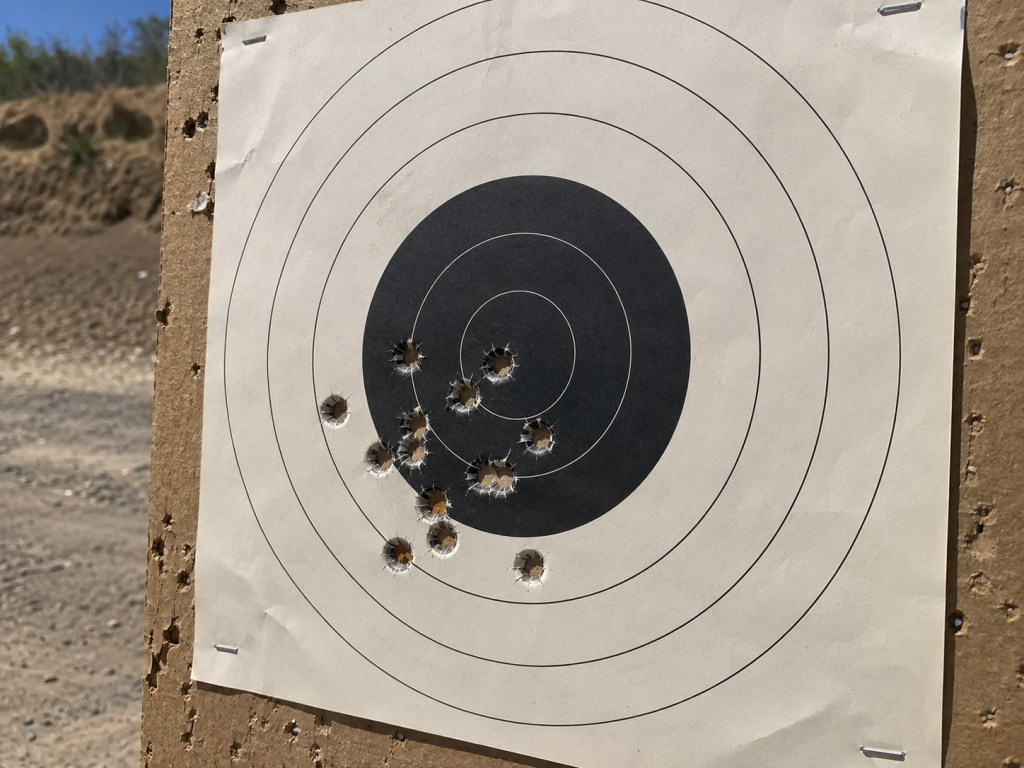
At 15 yards, three supported six-shot groups averaged 2.9 inches. The best measured 2.4 inches, with five shots clustered tightly and one opening the group along the lower edge.

Target photo: Three cylinders of 230-grain .45 ACP fired single-action at 15 yards.

The fixed sights placed the .45 ACP load slightly below the center of the bullseye when using a conventional center hold. That is preferable to a large unexplained horizontal correction and easy to accommodate once confirmed.

Double-action shooting at seven yards produced a fist-sized center group when the trigger was pressed continuously. Staging the trigger made the sights wobble more, not less. The Model 22 rewarded a smooth pull and punished attempts to negotiate with it halfway through the stroke.

Shooting .45 Colt From the Same Cylinder

Switching to .45 Colt required no moon clips and no mechanical changes. Open the cylinder, load six rimmed cartridges and close it.

The longer cartridges made the Model 22 feel like a different revolver. Recoil remained comfortable with the standard-pressure load, but the gun rolled farther upward than it did with .45 ACP. The sensation was slower and heavier without becoming abusive.

The .45 Colt cases extracted cleanly. Because their rims provide the ejector something to push against, the star lifted all six cases normally without clips.

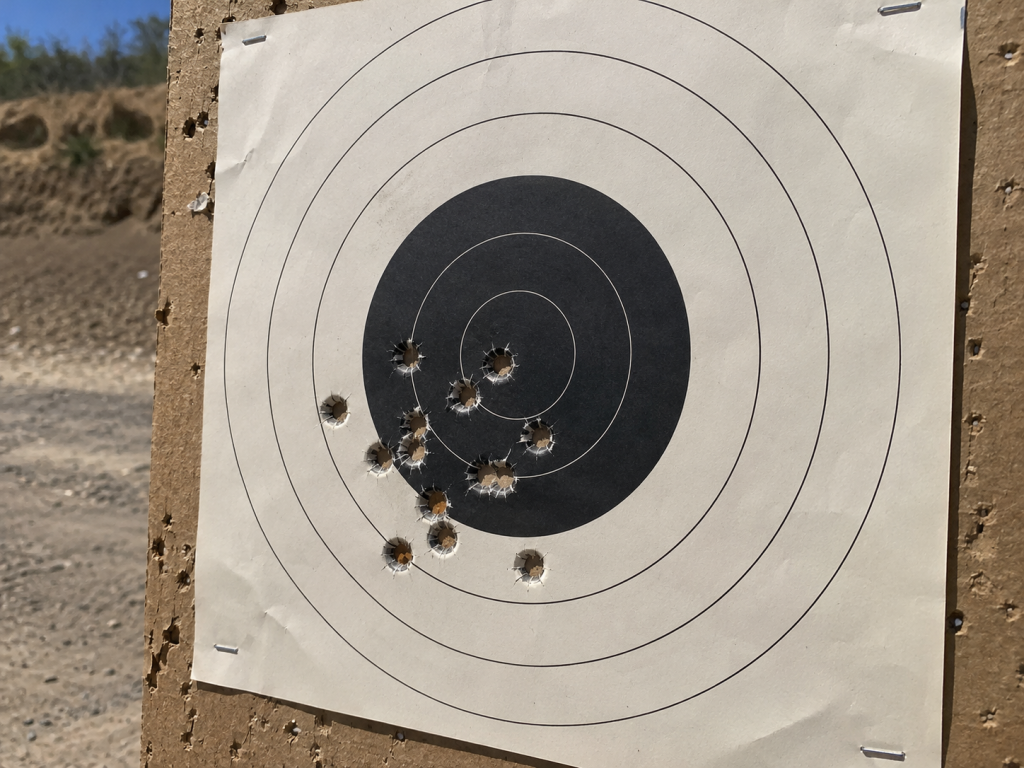
At 25 yards, three supported six-shot groups averaged 4.4 inches. The best group measured 3.8 inches. The .45 Colt load struck approximately three inches higher and slightly right of the .45 ACP point of impact.

Target photo: Three cylinders of 250-grain .45 Colt fired single-action at 25 yards.

That shift is important because the Model 22 uses fixed sights. The revolver cannot be instantly adjusted when changing cartridges, bullet weights or velocities. An owner should test the actual ammunition intended for field use instead of assuming every .45-caliber load will land in the same place.

Model 22 Trigger and Handling

The single-action trigger broke cleanly after a small amount of movement. It was not a fragile target trigger, nor should it be on a general-purpose fixed-sight revolver, but it allowed precise shooting without disturbing the sights.

The double-action stroke was heavier and substantially longer. It remained consistent throughout the cylinder, with no obvious stacking near the end of the pull.

Smooth walnut stocks certainly look correct. Under recoil, however, their lack of texture allowed the revolver to shift slightly in the hand. That was barely noticeable with .45 ACP and more apparent with .45 Colt.

The four-inch barrel balanced well. It kept enough weight forward to settle the sights without making the revolver feel like it wanted to dive out of the holster. The serrated ramp front sight was also easier to see than the rounded half-moon blade used on the longer 1917-style model.

Reliability and Reported Model 22 Problems

The revolver completed all 120 rounds without a misfire, sticky case or failure to rotate.

We found no obvious timing problem, excessive endshake or inconsistent lockup. The ejector rod remained tight, the grips did not move and all five moon clips continued to fit properly.

That does not establish long-term reliability for an entire production line. These revolvers are new, and a single range session cannot reveal what thousands of rounds or years of carry might uncover.

Prospective buyers should inspect:

  • Timing in every chamber
  • Cylinder lockup
  • Barrel-to-cylinder gap
  • Ejector-rod operation
  • Moon-clip fit
  • Clearance between loaded clips and the recoil shield
  • Point of impact with the intended ammunition
  • Finish condition around the cylinder and sideplate

A bent moon clip can imitate a revolver problem by dragging against the frame. Check the clip before blaming the gun.

Is the New Smith & Wesson Model 22 Worth $1,299?

The Model 22 Classic is expensive for a fixed-sight revolver. It also offers something few current handguns provide: a traditionally finished, lock-free N-frame that fires both .45 ACP and .45 Colt.

The .45 ACP capability makes regular practice easier and provides remarkably fast revolver reloads. The .45 Colt chambering eliminates the need for clips and gives the Model 22 the character expected from a large American revolver.

Buy the longer Model 22 of 1917 Classic if historical appearance matters most. Buy the four-inch Model 22 Classic if the gun will spend more time at the range, in a field holster or beside a box of ammunition than it will inside a display case.

This is not a polymer carry pistol, a competition revolver or an optics-ready tactical contraption. It is a blued, walnut-stocked sixgun chambered for two of America’s great .45-caliber cartridges.

Smith & Wesson did not attempt to make the Model 22 modern. It made the revolver useful again.

GarandThumb.com was established on May 4, 2012, to document my experiences trying to become a better marksman.

Posted in XTC