
Hornady’s new SBR Suppressed ammunition and three-inch Critical Defense Shotgun No. 1 buckshot appear to address opposite ends of the defensive-firearm spectrum. One is optimized for compact suppressed rifles; the other delivers a large payload from a 12-gauge shotgun.
Naturally, we brought both to the same range.
The rifle portion included Hornady’s new 73-grain 5.56 NATO and 178-grain .300 Blackout SBR Suppressed loads. The shotgun portion paired the new three-inch Heavy Magnum Critical Defense No. 1 buckshot with a Beretta A400 Solo.
By the end of the afternoon, the suppressors were hot, the shotgun targets looked diseased and our chronograph had developed the thousand-yard stare of an appliance that had spent six hours being shot over.
What Is Hornady SBR Suppressed Ammunition?
Hornady announced four SBR Suppressed supersonic loads for 2027:
- 5.56 NATO with a 73-grain ELD Match bullet
- 6mm ARC with a 108-grain ELD Match bullet
- .300 Blackout with a 178-grain ELD Match bullet
- .308 Winchester with a 178-grain ELD Match bullet
According to Hornady’s 2027 product announcement, the ammunition uses propellants selected to produce appropriate supersonic velocity and pressure while reducing fouling inside the firearm, gas system and suppressor.
That is a more specific mission than merely placing an existing cartridge inside a box marked “tactical.”
Short barrels provide less time for powder to burn before the bullet exits. A poorly matched load can produce excessive flash, unburned powder, violent gas-system behavior and disappointing velocity. Adding a suppressor changes back pressure and directs additional fouling into the action.
The Hornady SBR Suppressed line is supposed to reduce those compromises while retaining supersonic performance.
Hornady 5.56 SBR Suppressed Range Test
We fired the 73-grain 5.56 NATO load through a 10.3-inch AR-15 equipped with a conventional baffle suppressor, an H3 buffer and a 1:7-twist barrel.
The test consisted of:
- 100 rounds for function and handling
- Four five-shot accuracy groups at 100 yards
- Ten chronograph shots
- One deliberately fast 30-round string
- Ten rounds fired after removing the suppressor
Average velocity measured 2,347 feet per second. The extreme spread across the chronograph string was 46 feet per second.
The best five-shot group measured 1.42 inches at 100 yards. The four-group average was 1.71 inches.
That is excellent practical accuracy from a compact AR-15, particularly with an optic better suited to fast shooting than precision bench work.
All 100 suppressed rounds fed, fired, extracted and ejected without a stoppage. Ejection remained consistent at approximately four o’clock, and the rifle avoided the violent case-launching behavior often associated with heavily over-gassed short barrels.
The ammunition was not silent. No supersonic 5.56 load will be silent because the bullet creates its own ballistic crack. The suppressor substantially reduced muzzle blast, however, and the new load produced remarkably little visible flash beneath the covered firing line.
Removing the suppressor changed the rifle’s ejection pattern but did not cause a malfunction.
After the final string, the bolt carrier was dirty without looking as though somebody had poured fireplace ash through the ejection port. That is not a scientific fouling measurement, but it supported Hornady’s clean-burning claim better than a perfectly clean rifle and an untouched ammunition box would have.
Hornady 300 Blackout SBR Suppressed Test
The 178-grain .300 Blackout load went through a SIG MCX-LTAW with its 6.75-inch barrel and SQX suppressor.
My earlier SIG MCX-LTAW suppressed range report examined the platform with conventional subsonic, supersonic and defensive ammunition. The new Hornady load occupies an unusual middle ground: it uses a heavy 178-grain ELD Match bullet but remains supersonic.
Average velocity measured 1,486 feet per second. The load therefore produced a clear ballistic crack, although its muzzle report was less aggressive than lighter, faster .300 Blackout ammunition.
Five-shot groups measured:
- 1.18 inches at 50 yards
- 1.31 inches at 50 yards
- 2.46 inches at 100 yards
- 2.71 inches at 100 yards
The MCX fired all 80 rounds without a stoppage.
Recoil was mild but distinctly sharper than 220-grain subsonic ammunition. The additional velocity made steel targets react with more authority, while the heavy bullet retained the exaggerated hang-time sensation that makes .300 Blackout feel different from 5.56 at distance.
The 178-grain ELD Match is a match bullet rather than a purpose-built expanding defensive projectile. Buyers should not assume that accurate ammunition automatically provides ideal terminal performance for hunting or home defense.
Its obvious role is accurate supersonic shooting from a short suppressed .300 Blackout firearm.
SBR Suppressed Versus Subsonic Ammunition
“SBR Suppressed” and “subsonic” do not mean the same thing.
A suppressor reduces muzzle blast. Subsonic ammunition also avoids the ballistic crack created when a projectile exceeds the speed of sound.
Hornady’s four new SBR Suppressed loads are explicitly supersonic. They prioritize useful velocity, reliable function and reduced fouling rather than minimum sound.
Choose subsonic .300 Blackout when sound reduction is the dominant concern and the firearm reliably cycles the load. Consider supersonic SBR ammunition when trajectory, energy and reliable short-barrel operation matter more.
The 5.56 load has no realistic subsonic counterpart that preserves ordinary AR-15 reliability and useful rifle performance. A subsonic 5.56 cartridge would surrender most of what makes 5.56 worthwhile.
Hornady Critical Defense Shotgun No. 1 Buckshot
The second half of the range session involved Hornady’s new 12-gauge, three-inch Heavy Magnum Critical Defense Shotgun load containing nickel-plated No. 1 buckshot.
No. 1 buckshot uses smaller pellets than 00 buckshot. That allows a shell to carry more projectiles while each pellet remains considerably larger than birdshot.
The theoretical advantage is a dense pattern containing more wound-capable pellets. The potential disadvantages include heavy recoil, ammunition sensitivity and insufficient penetration if pellet construction or velocity is poorly balanced.
We fired the new load from the 28-inch Beretta A400 Solo previously examined in my A400 Solo review.
The gas-operated A400 and Kick-Off Plus stock made sense for a three-inch magnum shell. This was not ammunition selected for introducing a new shooter to shotguns.
Critical Defense Shotgun Pattern Test
Patterns were fired through Cylinder and Modified OptimaChoke HP tubes at 7, 15 and 25 yards.
At seven yards, the Cylinder choke kept every pellet inside a ragged four-inch cluster. The wad struck the target slightly below the central mass and tore a separate oblong hole.
At 15 yards, the Cylinder pattern expanded to approximately 9.5 inches. The Modified choke reduced that to 7.2 inches and placed most pellets near the point of aim.
At 25 yards:
- Cylinder produced a 17.8-inch pattern
- Modified produced a 13.6-inch pattern
- Neither load placed a pellet outside the silhouette
- Modified produced the most even central distribution
The nickel-plated pellets remained visibly rounder than the deformed lead recovered from the berm after firing conventional promotional buckshot. That does not prove identical behavior inside tissue, but round pellets generally fly more consistently than badly flattened ones.
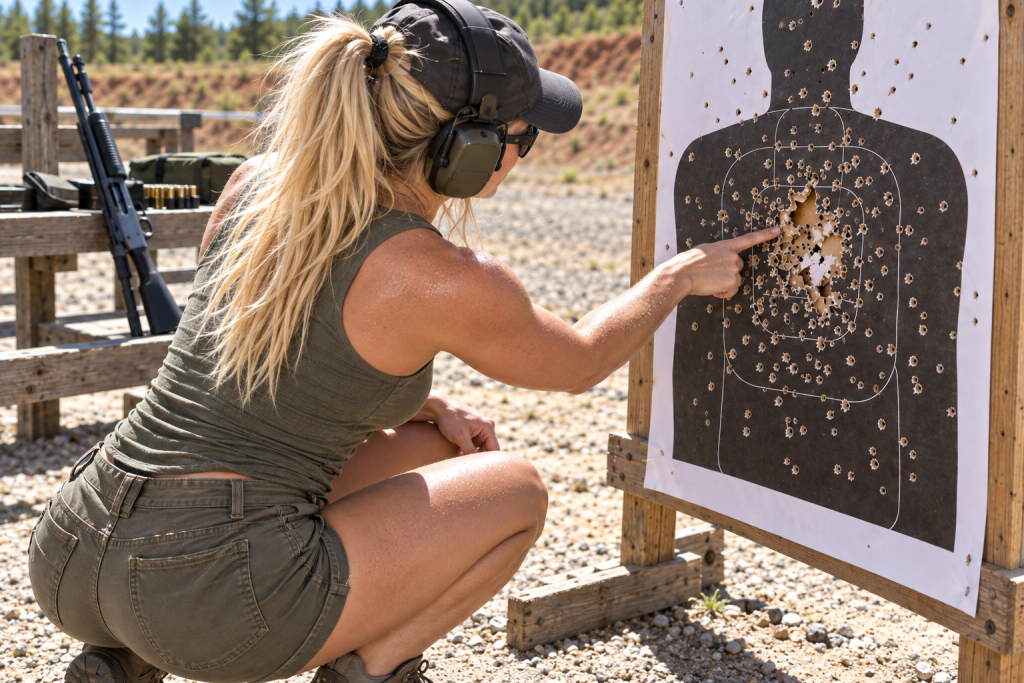
The target from 15 yards looked as though somebody had attempted to erase its chest with an industrial hole punch.
Our range influencer leaned toward the camera, pointed at the only clean patch near the left shoulder and announced, “This is where the bad guy got lucky.”
“It is a piece of cardboard.”
“It knows what it did.”
Recoil and Reliability
The A400 Solo fired 25 Heavy Magnum shells without a cycling failure.
Recoil was substantial. Beretta’s gas action and recoil-reduction stock prevented the load from becoming painful, but nobody confused it with light target ammunition.
The third shell in a quick string caused the muzzle to climb enough that disciplined technique became more important than enthusiasm. A heavy three-inch defensive shell provides no benefit when recoil prevents fast, accountable follow-up shots.
Shooters using lighter pumps or fixed-breech shotguns should expect harsher recoil than we experienced with the 7.7-pound gas-operated Beretta.
A person selecting this load for home defense should pattern it through the actual shotgun and choke being used. Shotgun patterns are not universal, and a printed distance on somebody else’s target cannot substitute for testing your firearm.
Final Verdict
Hornady’s SBR Suppressed line addresses a real problem. Short suppressed rifles benefit from ammunition designed around their limited barrel length, altered pressure behavior and tendency to accumulate fouling.
The 73-grain 5.56 load produced the best overall balance of accuracy, reliable function and practical short-barrel performance. The 178-grain .300 Blackout load was accurate and unusually pleasant, although buyers must remember that supersonic SBR ammunition is not intended to provide subsonic quiet.
Hornady Critical Defense Shotgun No. 1 buckshot delivered dense, even patterns and complete reliability through the Beretta A400 Solo. It also produced enough recoil to make the shooter respect every pull of the trigger.
For a compact suppressed AR-15, the new 73-grain 5.56 load deserves attention. For a suppressed .300 Blackout SBR, the 178-grain load offers an intriguing heavy-supersonic option.
For home defense, the three-inch No. 1 buckshot load provides impressive pattern density—but only for shooters and shotguns capable of controlling it.
The rifle ammunition behaved like a careful engineering project.
The shotgun ammunition behaved like a fistful of angry ball bearings that had recently received professional management.
Both worked.
GarandThumb.com was established on May 4, 2012, to document my experiences trying to become a better marksman.