
During the Pennsylvania Mid-Range Championship at Reade Range, part of the Riflemen’s Weekend competition, the shooter was working through the first string of a 3×600 match.
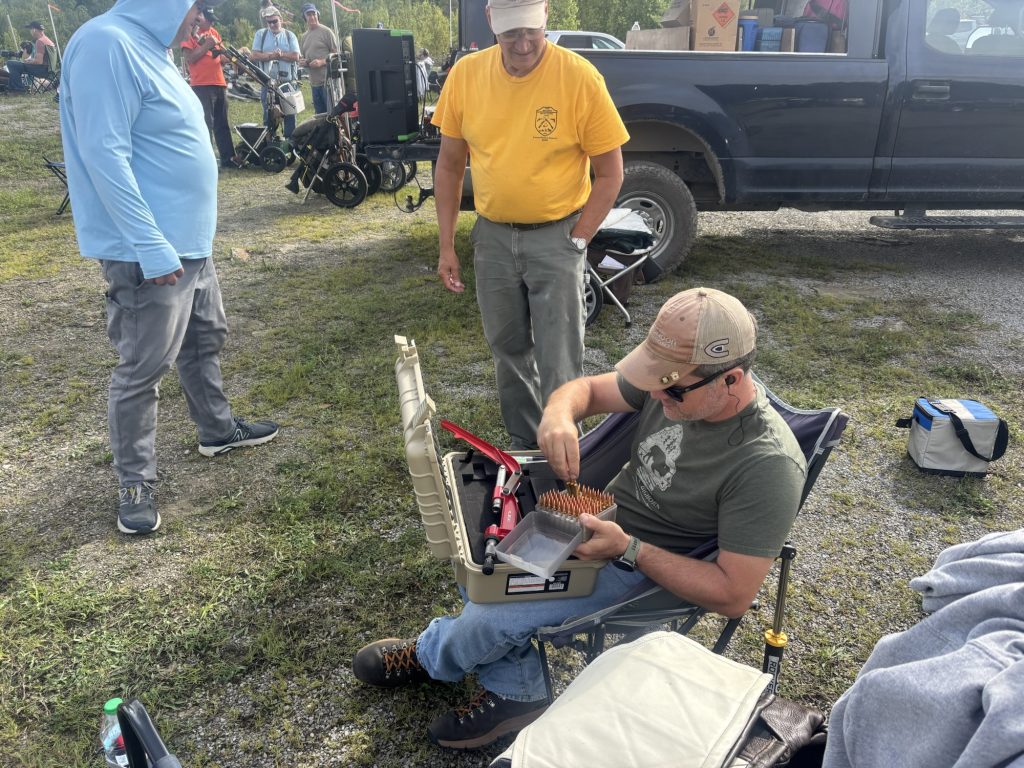
Three rounds turned out to be too long to chamber properly. Rather than force the issue and turn a minor ammunition problem into a major rifle problem, the rounds had to be beaten back out of the rifle.
That is when the scorer—and what looked like an entire reloading department—went into action.
The shooter dealt with the rifle while the scorer worked on the ammunition and helped get everything sorted out. High-power rifle competition is usually associated with precision, discipline, and carefully prepared equipment. It is also occasionally associated with tools scattered everywhere while somebody asks, “Who has a press?”
At 600 yards, every shot matters. A 3×600 match requires 60 record shots from the prone position, along with wind calls, sight adjustments, position management, rifle function, and ammunition that actually agrees with the chamber. There is not much room for a cartridge that decides it would rather remain outside the rifle.
A round that is slightly too long may not sound like a serious problem, but it can bring a match rifle to a complete stop. The shooter has to recognize the issue, keep the rifle safe, remove the ammunition, and decide whether the rounds can be corrected or need to be retired from competition. Losing time during a string can hurt almost as much as losing points on the target.
Fortunately, the firing line apparently had access to enough reloading equipment to handle the emergency. That is one of the benefits of shooting with experienced competitors: somebody usually has the exact tool needed, even if it is buried beneath three ammunition boxes, a spotting scope, and enough miscellaneous gear to open a small machine shop.
The score will record the points and center shots, but it will not record the interruption, the ammunition problem, or the scorer’s efforts to get everything back on track.
A 3×600 match may be built around precision, but it still includes the occasional reminder that even carefully prepared ammunition can develop an attitude—usually at the worst possible time, during the final string, with the clock running.