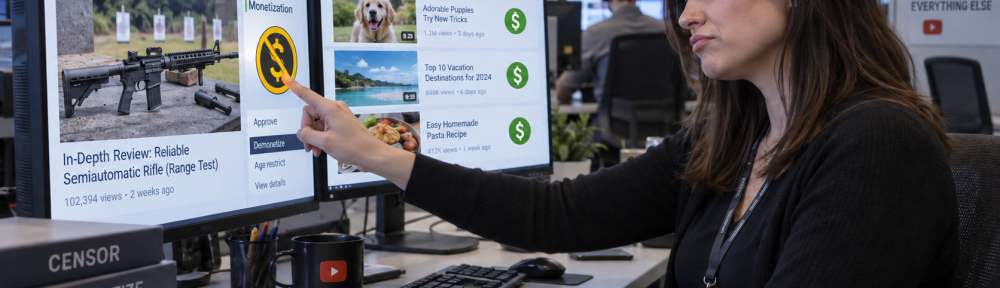
The YouTube gun rules for 2026 are ideological discrimination against lawful gun owners, firearms manufacturers and the creators who publish gun reviews.
YouTube has not formally banned every gun channel. Instead, it built something more dishonest: a maze of firearms policies that allows gun videos to remain online while demonetizing them, restricting their audience, prohibiting useful links and threatening entire channels with strikes.
A lawful gun review filmed at a legitimate shooting range may technically remain eligible for advertising. The same video can lose its advertising revenue because it mentions the manufacturer, identifies a retailer, includes a discount code, shows a thermal sight or features a magazine holding more than thirty rounds.
YouTube permits enough firearms content to deny that it has banned gun channels. It then makes that content harder to fund, harder to discover and more dangerous to publish.
That is not neutrality. It is anti-gun bigotry enforced by an algorithm.
What Are the YouTube Gun Rules in 2026?
As of September 21, 2026, YouTube applies several overlapping policies to gun videos:
- Community Guidelines decide whether firearms content may remain online.
- Advertiser-friendly guidelines determine whether the video can earn advertising revenue.
- Branded-content rules govern sponsored gun reviews and paid firearm promotions.
- Age restrictions limit who can watch certain gun videos.
- Linking rules determine whether creators can direct viewers to firearm retailers or products.
- Livestream rules prohibit real-time handling and transportation of firearms.
These policies do not produce one simple answer.
A video may remain online while being demonetized. It may receive an age restriction without a strike. It may comply with the YouTube firearms policy but fail the YouTube Partner Program firearms-monetization rules.
That confusion is useful to YouTube. The company can financially punish gun channels while insisting it still “allows” firearms content.
Are Gun Channels Banned on YouTube in 2026?
No official policy says all gun channels are banned from YouTube.
That does not mean gun channels are treated fairly.
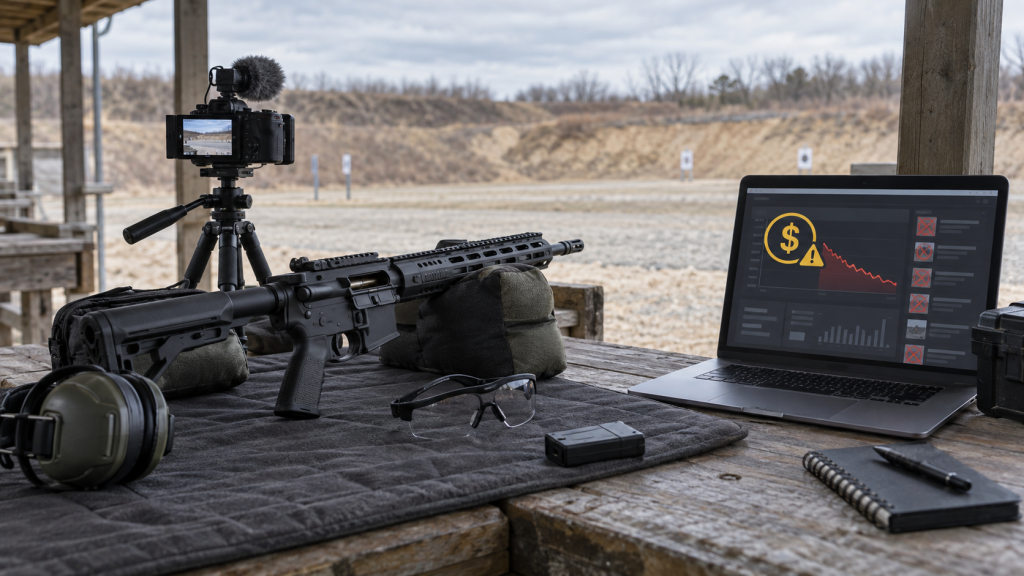
YouTube’s current advertiser-friendly firearms guidelines say the following content can earn advertising revenue:
- Gun reviews and firearm demonstrations
- Unmodified semiautomatic firearms used at established shooting ranges
- Bolt-action, lever-action, pump-action and other manually operated firearms
- Firearm repair and maintenance
- Routine firearm disassembly and reassembly
- Rifle-scope and red-dot-optic content
- Suppressor and silencer content
- Gun-law and gun-control discussions
- Responsible airsoft and BB-gun videos
YouTube therefore admits that responsible gun reviews and shooting videos can be legitimate advertiser-supported content.
Then it buries that admission beneath enough restrictions to make every upload a gamble.
The result is not a straightforward YouTube gun ban. It is a campaign of economic and algorithmic pressure against firearm channels.
YouTube Firearms Monetization Rules Are Deliberately Contradictory
The YouTube Partner Program firearms policy says gun reviews can receive advertising revenue.
It also says a video can receive no advertising revenue when it promotes:
- Gun manufacturers
- Firearm retailers
- Gun-store discount codes
- Ammunition
- Suppressors
- Stocks
- Grips
- Sights
- Scopes
- Conversion kits
- Magazines
- Other components that affect firearm operation
That creates an obvious problem.
A useful Smith & Wesson, Glock, SIG Sauer, Ruger, Colt or Springfield Armory review must identify the manufacturer. A useful rifle-scope review must identify the optic. A suppressor review must identify the suppressor.
A real equipment review should tell the reader what the product costs, what it fits, what ammunition it accepts and where replacement magazines or mounting components can be found.
YouTube says gun reviews are eligible for monetization while threatening to remove monetization when those reviews contain the information that makes them useful.
That is not a carefully written policy. It is corporate gibberish produced by people who are ideologically hostile to the subject.
YouTube Gun-Channel Demonetization Is Ideological Discrimination
YouTube does not apply this suffocating standard equally to every lawful product.
Car channels identify automobile manufacturers, dealerships, replacement parts and performance accessories. Computer channels promote manufacturers, retailers, processors and graphics cards. Sports channels discuss equipment companies and ticket sellers.
Gun channels are expected to discuss products without helping viewers locate those products.
The difference is ideological.
The anti-gun bigot views lawful gun ownership as suspicious by default. He may tolerate a firearm as a historical object, movie prop or police tool, but he becomes uncomfortable when an ordinary citizen treats the same firearm as useful personal property.
That is why the policies focus so heavily on commerce and practical information.
The goal is not merely to prevent criminal instructions. YouTube already has rules against illegal activity. The broader policy isolates lawful gun culture by making it more difficult to finance, advertise and connect buyers with legal products.
A website does not need to announce, “We hate gun owners,” when its policies produce the same practical result.
What Gun Videos Can Earn Advertising Revenue?
According to YouTube, an unmodified firearm may appear in an advertiser-friendly video when used in a controlled environment such as a dedicated shooting range.
Examples of potentially monetized gun content include:
- Rifle reviews
- Handgun reviews
- Shotgun reviews
- Firearm accuracy tests
- Shooting-range demonstrations
- Optics reviews
- Red-dot-sight reviews
- Suppressor reviews
- Firearm cleaning videos
- Routine maintenance demonstrations
- Gun-history documentaries
- Discussions about gun laws
- Competitive-shooting videos
Even those categories are not guaranteed normal monetization.
YouTube applies its advertising policy to the video, title, description, thumbnail and tags. A firearm review may therefore lose revenue because of a link or phrase placed outside the actual video.
YouTube also admits that its automated systems make mistakes and allows creators to request human review. That is not reassuring. It is an admission that creators may have to appeal decisions produced by a system that cannot reliably interpret the company’s own rules.
Which Gun Videos Receive No Advertising Revenue?
YouTube identifies several categories of firearms content as ineligible for advertising revenue.
These include content showing or promoting:
- Firearm construction
- Internal firearm modification
- Automatic firearms
- Firearms modified to fire more than once per trigger pull
- Bump stocks
- Hair triggers
- Explosive ammunition
- Incendiary ammunition
- Thermal or infrared firearm sights
- Magazines holding more than thirty rounds
- Unsupervised minors using firearms
- Firearm manufacturers or sellers
- Websites facilitating firearm sales
- Gun-store discount codes
Some of those subjects involve genuinely different legal or safety considerations.
Others reveal the political prejudices built into the YouTube firearms-monetization policy.
A thermal rifle scope is normal hunting equipment. A thirty-one-round magazine is not morally different from a thirty-round magazine. Mentioning a lawful manufacturer does not make a gun review unsafe.
YouTube lumps ordinary legal equipment together with unlawful modifications because the policy was written to appease people who dislike guns, not to explain firearms accurately.
“High-Capacity Magazine” Is Political Language
YouTube calls magazines holding more than thirty rounds “high capacity.”
That terminology is not a neutral mechanical description. It comes directly from gun-control politics.
Firearms are designed around specific magazine capacities. The standard magazine for a particular firearm may hold ten, fifteen, seventeen, twenty, thirty or more rounds. The proper capacity depends on the firearm and its intended use.
Anti-gun bigots use the phrase “high capacity” to make normal equipment sound abnormal.
YouTube adopted the same loaded language and attached financial punishment to it. A video featuring a magazine holding more than thirty rounds may receive no advertising revenue even when the magazine and firearm are completely lawful.
Nothing becomes less safe when a video includes a thirty-one-round magazine. YouTube merely selected an arbitrary number and converted political prejudice into advertising policy.
Are Sponsored Gun Reviews Allowed on YouTube?
Sponsored gun reviews are not automatically prohibited, but they present a serious monetization risk.
YouTube’s branded-content instructions require creators to disclose sponsorships, endorsements, free products and other commercial relationships. Selecting the paid-promotion option adds a disclosure label to the video.
Disclosure is reasonable. Viewers should know whether the manufacturer supplied the firearm, ammunition or equipment.
The problem is that disclosed sponsored content must also satisfy YouTube’s other advertising and Community Guidelines.
A creator can properly disclose that a manufacturer supplied a rifle and still lose advertising revenue because YouTube considers manufacturer promotion unsuitable for ads.
In other words:
- YouTube requires the creator to disclose the relationship.
- The disclosure identifies the video as a promotion.
- YouTube’s firearms rules can punish the promotion.
- YouTube may still collect traffic, data and subscription revenue from the video.
That is a rigged arrangement.
YouTube receives the content and audience. The gun reviewer absorbs the cost and risk.
Can Gun Channels Link to Firearm Retailers?
YouTube’s official firearms Community Guideline prohibits direct links to websites, marketplaces or peer-to-peer forums selling:
- Firearms
- Automatic-fire conversion devices
- Accessories that simulate automatic fire
- Magazines or ammunition belts holding more than thirty rounds
The restriction applies to links in titles, descriptions and other video metadata.
YouTube says creators may link to websites that discuss or review firearms, provided those websites do not directly sell or give away the regulated products.
That distinction makes independent firearms websites more important.
A gun video can demonstrate recoil, sound and operation. A written gun review can preserve specifications, magazine compatibility, ammunition results, accuracy data, photographs, maintenance information and links to related articles.
The Garand Thumb Blog YouTube page collects the site’s video material, but GarandThumb.com remains the permanent searchable archive.
A Garand Thumb video should support the written article. It should never be the only surviving copy of useful firearms information.
Are Suppressor Videos Allowed on YouTube?
Suppressor videos are not automatically banned.
YouTube’s advertiser-friendly guidelines specifically identify content featuring silencers as potentially eligible for advertising revenue.
However, YouTube prohibits instructions for manufacturing homemade suppressors. It may also prohibit sales links or monetization connected with suppressor promotion.
The policy therefore distinguishes between:
- Reviewing a commercially manufactured suppressor
- Demonstrating lawful suppressor use
- Discussing sound reduction and firearm compatibility
- Showing suppressor maintenance
- Providing instructions to manufacture a homemade suppressor
- Linking viewers directly to regulated-product sales
The first several categories may remain online and qualify for monetization. Homemade suppressor instructions are prohibited.
Whether YouTube enforces those distinctions consistently is another matter.
Are Gun Videos Age-Restricted on YouTube?
YouTube age-restricts real-world footage showing the use of:
- Homemade firearms
- 3D-printed firearms
- Fully automatic firearms
- Automatic-fire conversion devices
- Accessories that simulate automatic fire
- Magazines YouTube classifies as high capacity
- Homemade suppressors
Age restriction reduces the available audience and can affect recommendations, embedded playback and monetization.
A video does not have to be deleted to disappear from ordinary discovery.
Age restriction gives YouTube another method of suppressing gun content without accepting responsibility for banning it.
The company can claim that the video remains available while making it considerably more difficult to find.
YouTube Prohibits Gun Livestreams
YouTube says livestreams may not show someone holding, handling or transporting a firearm.
The firearm does not have to be fired.
That means a livestream from a gun show, competitive shooting match, hunting camp, gunsmith’s shop or shooting range could violate the YouTube firearms policy simply because someone lawfully handles a gun on camera.
A recorded video of the same activity may be permitted.
The difference is not public safety. The difference is YouTube’s unwillingness to evaluate live context.
Rather than create a sensible standard, it prohibits the entire category.
Gun Reviews Are Treated Worse Than Violent Entertainment
YouTube’s treatment of firearms becomes even more ridiculous when compared with entertainment content.
Movies, music videos and video games regularly feature firearms used to commit robberies, murders and acts of war. YouTube excuses much of that content as artistic, fictional or contextual.
The lawful gun owner firing at a paper target receives greater scrutiny than fictional characters shooting people.
That exposes the ideology underneath the policy.
A firearm in the hands of a government agent, movie actor or video-game character is culturally acceptable. The same firearm in the hands of an ordinary American exercising a constitutional right becomes controversial.
The anti-gun bigot does not merely dislike criminal misuse. He dislikes civilian ownership itself.
YouTube Gun Rules Hurt Small Firearms Channels Most
Large gun channels may survive demonetization through outside sponsorships, subscriptions, merchandise and established audiences.
Small firearms channels depend more heavily on:
- YouTube advertising revenue
- Search recommendations
- Suggested-video traffic
- Equipment sponsorships
- Retailer links
- Discount codes
- Affiliate revenue
YouTube’s firearms restrictions attack nearly every one of those income sources.
That makes it harder for new firearm reviewers, competitive shooters, gunsmiths, historians and collectors to build an audience.
The result is fewer independent voices and more dependence on a handful of enormous channels.
A policy supposedly intended to improve trust instead makes the firearms-review market less diverse and less independent.
Why Written Gun Reviews Matter More Than YouTube
YouTube is not a dependable home for firearms information.
It owns the platform, recommendation system, advertising system and enforcement process. It can change the rules, reinterpret existing language, restrict old videos or terminate a channel.
The creator owns none of that infrastructure.
A privately controlled firearms website can preserve:
- Complete gun reviews
- Round counts
- Accuracy targets
- Chronograph results
- Ammunition comparisons
- Firearm specifications
- Optic compatibility
- Magazine compatibility
- Maintenance instructions
- Competition reports
- Historical research
- Corrections and long-term updates
A searchable article can remain valuable for years. A YouTube gun video can become financially worthless because an automated system dislikes a link, magazine or manufacturer name.
GarandThumb.com exists because firearms information should not depend on the political tolerance of a giant technology company.
This Is Anti-Gun Bigotry, Not Neutral Moderation
YouTube is a private company, so this is not automatically a First Amendment violation by the government.
It is still ideological discrimination.
The platform treats lawful gun ownership as a disfavored activity. It places special restrictions on firearm manufacturers, retailers, reviewers and owners because corporate leadership considers their culture politically undesirable.
Anti-gun bigotry operates through intolerance.
It assumes lawful gun owners are dangerous, ignorant or morally defective. It treats firearm commerce as inherently suspicious. It describes standard equipment with loaded political terminology. It accepts gun ownership only after surrounding it with restrictions that do not apply to comparable lawful products.
The polite corporate language does not change the substance.
YouTube wants the traffic generated by gun videos without openly accepting gun owners as equal participants on the platform.
It wants firearm creators to supply free content while remaining permanently uncertain about monetization, links and channel survival.
That is exploitation built on ideological hostility.
Final Verdict
The YouTube gun rules for 2026 do not openly ban every firearms channel.
They do something more calculated.
YouTube permits selected gun reviews, shooting demonstrations, maintenance videos, optics reviews and suppressor discussions. It then uses separate advertising, linking, sponsorship, livestream and age-restriction policies to reduce their reach and revenue.
Gun channels can be demonetized for promoting manufacturers, stores, ammunition, scopes, sights, suppressors, magazines and other equipment that naturally appears in a useful firearm review.
The company’s message is obvious: gun owners may provide content, views and advertising inventory, but they should not expect equal treatment.
Firearms creators should not introduce YouTube as a friendly platform, a reliable archive or a dependable business partner. It is none of those things.
It is a hostile landlord that tolerates gun channels only while retaining the power to starve, restrict or remove them.
Anti-gun bigotry does not become respectable because an algorithm enforces it.
GarandThumb.com was established on May 4, 2012, to document my experiences trying to become a better marksman.