
The new shooter arrived at the range with a CMP M1 Garand, a borrowed shooting mat and the expression of a man who had been told that military-surplus rifles were “simple.”
He set the rifle on the bench beside a box of .30-06 ammunition.
“Before we start,” he said, “what is Garand Thumb?”
That was a reasonable question.
Then he showed me his phone.
The message actually said, “What is Grand Thumb?”
“Close,” I said. “Garand thumb is what happens when the M1 Garand bolt closes on your thumb. Grand Thumb is probably a very small superhero.”
He tried again.
“M1 Grand Thumb.”
Then:
“M1 Garand Thimb.”
Then:
“Garand Thunb.”
His phone was becoming less accurate with every attempt.
The New Shooter Had Done His Research
He told me he had read about the Garand thumb meaning, watched a Garand Thumb YouTube video, looked at a Garand Thumb youtuber and visited the Garand Thumb website.
He had also watched videos about the M1 Carbine, standard products M1 Carbine history, CMP rifles, CMP firearms, CMP military surplus and the Civilian Marksmanship Program M1 Garand program.
This was encouraging until he admitted that he believed the M1 Garand had a “thumb saver setting.”
“That is not a setting,” I said.
“What about an M1 Garand thumb saver?”
“Also not a setting.”
He opened another note on his phone. The heading read:
Garand Thumb, Garand Thump, Garand Tumb and Garand Thumv
“Your phone is fighting you harder than the rifle is,” I said.
He nodded and began inspecting the action.
How Garand Thumb Happens
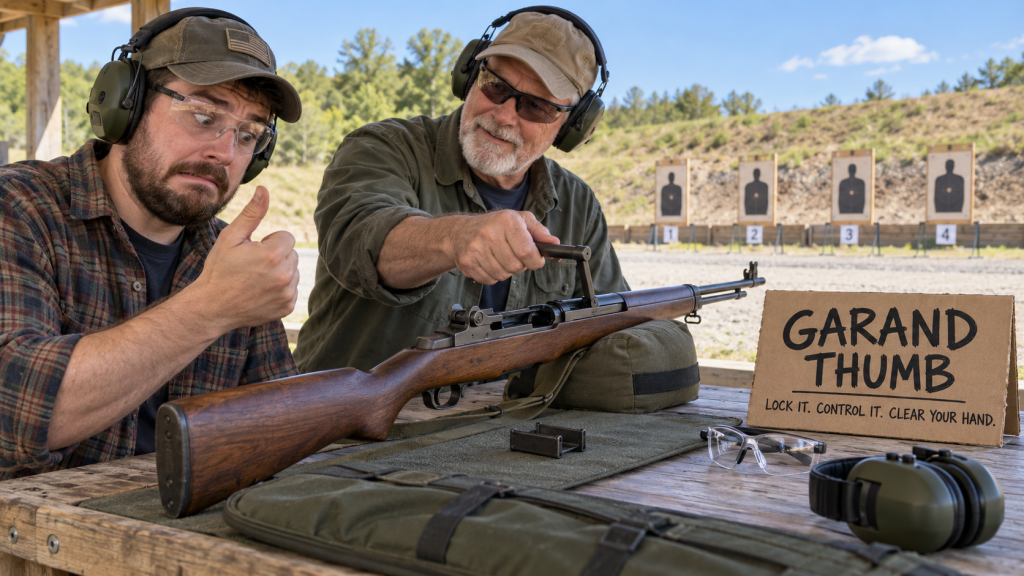
I pulled the operating rod fully rearward and showed him how the operating-rod catch positively locks the bolt open.
Then I eased the bolt forward until it rested against the follower without fully locking.
The two positions looked similar.
They were not.
“This is the important part,” I said. “Never trust an M1 Garand bolt just because it appears to be open. Make sure it is positively locked. If your thumb is inside the receiver, maintain control of the operating rod.”
The new shooter looked at the rifle.
“So how does Garand Thumb happen?”
“The bolt appears open. The shooter presses down the follower. The bolt releases. The thumb is still inside. The rifle wins.”
His phone translated my explanation into:
“How does Garant Thumb happen?”
Then:
“How does Gerand Thumb happen?”
Then:
“How does Garrand Thumb happen?”
By the time it produced “how does Garland Thumb happen,” the old man at the next bench had started laughing.
Loading the En Bloc Clip
We used an unloaded rifle first.
The new shooter pulled the operating rod completely rearward, confirmed that the bolt was locked open and pressed an eight-round en bloc clip into the internal magazine.
He kept the heel of his hand against the operating-rod handle as instructed.
That was good.
He removed his thumb and hand together.
That was better.
The bolt moved forward and chambered the first round.
He jumped anyway.
“That was supposed to happen,” I said.
“I thought that was the Garand thumb injury.”
“No. That was the rifle operating.”
He looked at his hand.
“Does Garand thumb hurt?”
“It does when you leave your thumb in the action.”
“How bad does Garand thumb hurt?”
“Usually less than the embarrassment of explaining to the whole firing line how it happened.”
He typed a note: “How bad does Garand thim hurt?”
I suggested he stop taking notes and keep his hand away from the bolt.
The Range Table Became a Spelling Bee
The range officer walked over to inspect the rifle.
“What model?”
“CMP Garand,” the new shooter answered.
The range officer nodded. “Nice rifle.”
The new shooter tried to explain the name of the injury.
“Garande Thumb.”
“Grand Thumb,” said the man with the Mosin PU sniper rifle.
“Grande Thumb,” said somebody behind us.
“Grant Thumb,” said the shooter loading a Glock 17.
A Glock 19 owner leaned over and asked whether Garand Thumb was related to the Garand Thumb EDC gear he had seen online.
“No,” I said. “This one is related to a spring-loaded bolt and poor hand placement.”
The new shooter’s phone produced “Garand Thub.”
The range officer took the phone away.
The M1 Garand SLED
For slow fire, the new shooter installed an M1 Garand SLED.
He called it an M1 Garand single shot sled, then an M1 Garand SLED clip, then an M1 Garand thumb saver.
The SLED is useful for loading individual cartridges in competition. My M1 Garand SLED guide explains the device and how it differs from a standard en bloc clip.
It does not eliminate the need to control the bolt.
It does not slow the operating rod.
It does not make the user immune to Garand finger.
It simply changes how the cartridge is presented to the action.
The rifle still contains a spring, a bolt and a long institutional memory of punishing careless thumbs.
A Brief Medical Consultation
The new shooter eventually did catch the edge of his thumb while practicing with the empty rifle.
It was not a serious injury. He had a small red mark and an expression suggesting that his entire family had been correct about him needing supervision.
We removed his ring, cleaned the minor scrape and applied an ice pack wrapped in cloth.
“Do not drill the nail,” I told him.
“I wasn’t going to.”
“You were absolutely going to.”
A real Garand thumb wound can include bruising, swelling, blood beneath the nail, nail-bed damage or a fracture. If the thumb becomes numb, deformed, badly swollen or difficult to move, medical care is appropriate.
A smashed finger is not improved by a heated paper clip, a cordless drill or a range member who claims to have learned medicine from a comment section.
The CMP History Lesson
While the shooter waited for the swelling to settle, we talked about CMP history.
The Civilian Marksmanship Program helped preserve access to military-surplus rifles and introduced generations of shooters to the M1 Garand. CMP Garands have become popular with collectors, competitors and people who simply want to own one of America’s most important service rifles.
My CMP history and surplus-rifle article covers that background.
We also discussed the M1 Carbine, the Standard Products M1 Carbine, the Winchester Garand and the differences between a service rifle, a collectible rifle and a rifle that has been sitting in a closet since the Eisenhower administration.
The new shooter asked if the rear sight was supposed to move that much.
I sent him to my article on setting the M1 Garand elevation knob.
Then he asked whether the “Garand Thumb logo” was supposed to be a purple thumb.
“Only if the marketing department has a very specific sense of humor.”
The Final Score
By the end of the morning, the new shooter could:
- Explain what Garand thumb means
- Load an M1 Garand safely
- Identify the difference between a locked bolt and a bolt resting against the follower
- Use an M1 Garand SLED
- Adjust the rear sight
- Explain why the injury happens
- Spell Garand correctly approximately half the time
His phone still insisted on Grand Thumb, Garamd Thumb, Garabd Thumb, Garand Thumn, Garand Tumb, Garand Thumv, Garand Thump, Garand Rhumb and Garand Thumb.
The range officer finally wrote the correct spelling on a piece of cardboard:
GARAND THUMB
The shooter photographed it.
His phone captioned the picture:
GRAND THUMBS
At that point, we gave up.
The M1 Garand is not difficult to operate, but it does require respect for the action. Positively lock the bolt. Control the operating rod. Keep the thumb clear before releasing the bolt.
Call it M1 thumb, M1 Garand thumb, Garand finger, Grand Thumb, Grande Thumb, Garand thimb or Garand thump.
Just do not put your thumb where the bolt is going.
GarandThumb.com was established on May 4, 2012, to document my experiences trying to become a better marksman.